

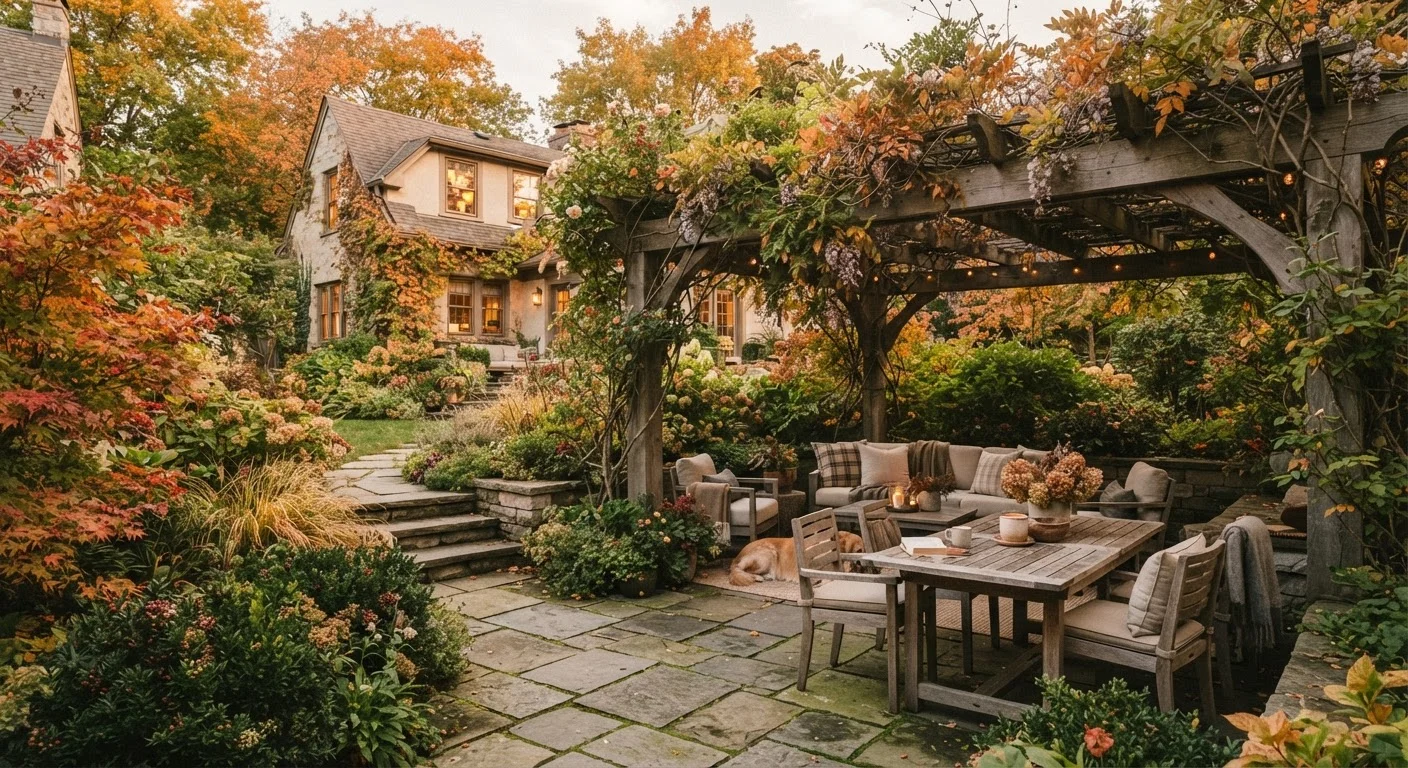
Key Takeaways
- Hardscape elements like patios, paths, and pergolas provide visual and functional structure in every season.
- A layered planting scheme combining evergreens, perennials, and ornamental grasses ensures year-round interest.
- Shelter features — pergolas, awnings, windbreaks — extend the usable season significantly.
- Outdoor lighting transforms a space in shorter winter days and cooler evenings.
- Low-maintenance material choices reduce the seasonal upkeep burden considerably.
- Designing in zones — dining, planting, circulation — helps the space function regardless of weather.
Why Year-Round Design Thinking Matters
Most outdoor spaces are designed with a single season in mind — typically summer. The result is a yard that looks spectacular in July and abandoned by October. A year-round approach treats the outdoor space as an extension of the home: somewhere that functions, invites use, and holds visual appeal even when the mercury drops or rain sets in.
This doesn't require a large budget or a professional landscaper. It requires a deliberate sequence: structure first, planting second, and finishing details last. Whether you're starting from bare soil or reworking an existing yard, the principles are the same. For those beginning from nothing, our practical first-year garden roadmap covers the foundational planning steps in detail.
Start With Structure: Hardscape as the Seasonal Backbone
Hardscaping — the non-living elements of a landscape, including patios, paths, walls, and raised beds — provides the skeleton your planting scheme drapes itself over. Crucially, it looks intentional year-round, even when beds are bare. Our guide to balancing hardscape and softscape explains how these two layers interact in practice.
When choosing hardscape materials, consider both durability and drainage. Permeable pavers or gravel allow rainwater to filter through rather than pool — a real advantage in wet seasons. Concrete and natural stone are generally frost-resistant, but it's worth confirming suitability for your USDA hardiness zone before installation. Raised planting beds made from rot-resistant lumber or stone not only improve drainage but also warm up faster in spring, extending your growing window.
When laying out zones, use a garden hose to outline areas on the ground before committing to any digging or paving. Sitting in the space at different times of day first reveals how light and wind move through it.
Scale and sun angles rarely behave as expected on paper; physical prototyping prevents costly layout mistakes and helps identify the best placement for seating and shade structures.
Choose at least one plant in each layer — ground cover, mid-border, and canopy — that offers winter interest through bark colour, berry, or persistent seed head rather than relying on summer flowers alone.
Layered planting that includes winter-interest plants creates visual depth that keeps a garden looking intentional even during dormancy, which is when structural planting choices become most visible.
Define zones within the space — a dining area, a path, a planting border — so the layout has logic even when beds are resting. A well-laid path draws the eye and creates the impression of a cared-for garden in the depths of winter.
Planting for All Four Seasons
The goal of a four-season planting scheme is overlapping interest: something coming into its own as something else fades. This requires a deliberate mix of plant types rather than a single-season flush of colour.
- Evergreens — boxwood, holly, ornamental grasses with persistent seed heads — provide structure and green throughout winter.
- Spring bulbs — planted in autumn — deliver early colour before most perennials emerge.
- Summer perennials — coneflowers, black-eyed Susans, catmint — offer long bloom periods with minimal intervention.
- Autumn interest — asters, ornamental kale, maples, and shrubs with berries — bridge the gap before dormancy.
Understanding the difference between annuals and perennials is central to this planning. Our article on annuals vs. perennials walks through cost, effort, and long-term design implications. For shaded corners that challenge most planting schemes, see our shade garden ideas and layouts.
If water use is a concern in your region, choosing drought-adapted species can reduce seasonal maintenance significantly. The principles of drought-tolerant gardening offer a practical framework for plant selection and soil management.
Shelter, Shade, and Weather Resilience
A space that's too exposed becomes uncomfortable and underused. Structural shelter — pergolas, shade sails, awnings, or a well-positioned hedge — dramatically extends the usable season by moderating wind, sun, and light rain.
Pergolas offer one of the most versatile shelter options: they provide partial shade in summer (especially when planted with climbing vines), and their open framework still admits low winter sun. If you're considering a covered structure that attaches to the house, the structural and planning considerations share some overlap with home extensions — our piece on flat vs. pitched roof extensions covers relevant structural trade-offs worth reading before committing to a design.
Windbreaks — whether a dense evergreen hedge, a slatted fence, or a planted berm — can raise the perceived temperature of a sheltered area by several degrees. Position seating areas on the lee side of prevailing winds for the most noticeable effect.
Note on permits: Any permanent roofed structure typically requires a building permit. Requirements vary significantly by municipality, so verify with your local planning or building department before construction begins.
Lighting and Ambiance Beyond Summer
Outdoor lighting is often treated as an afterthought, but it's one of the most cost-effective ways to extend a space's appeal into autumn and winter evenings. Low-voltage LED path lighting, uplighting for trees or architectural features, and string lights over a dining area all serve practical and atmospheric purposes.
Solar-powered fixtures have improved considerably in reliability but still depend on adequate daylight hours — a limitation in northern climates during winter. Hardwired low-voltage systems generally offer more consistent performance year-round. For any electrical work outdoors, local codes typically require a licensed electrician; this is not a task to approach as DIY without appropriate qualifications.
Candles and fire features — fire pits, chimineas — add warmth and atmosphere in cooler months. Place them on non-combustible surfaces, follow manufacturer clearance guidelines, and check local ordinances, which may restrict open-flame features in some areas.
Maintenance Planning That Keeps It Looking Good
A four-season space only works if maintenance is manageable. The planning stage is the right moment to make choices that reduce future workload: selecting disease-resistant plant varieties, installing edging to contain lawn creep, and using mulch to suppress weeds and retain moisture through summer dry spells.
At the close of the growing season, a structured shutdown routine protects your investment. Our end-of-season garden shutdown checklist covers plant protection, soil preparation, and tool storage in a practical, step-by-step format. Healthy soil underpins everything — if you haven't tested or amended yours recently, the guide to soil health explains what to look for and how to improve it without relying solely on fertilisers.
Finally, compost is one of the most reliable ways to improve soil structure and fertility over time. Our guide to home composting makes the process approachable even for beginners. Small, consistent maintenance habits across all four seasons will always outperform a single annual overhaul.