

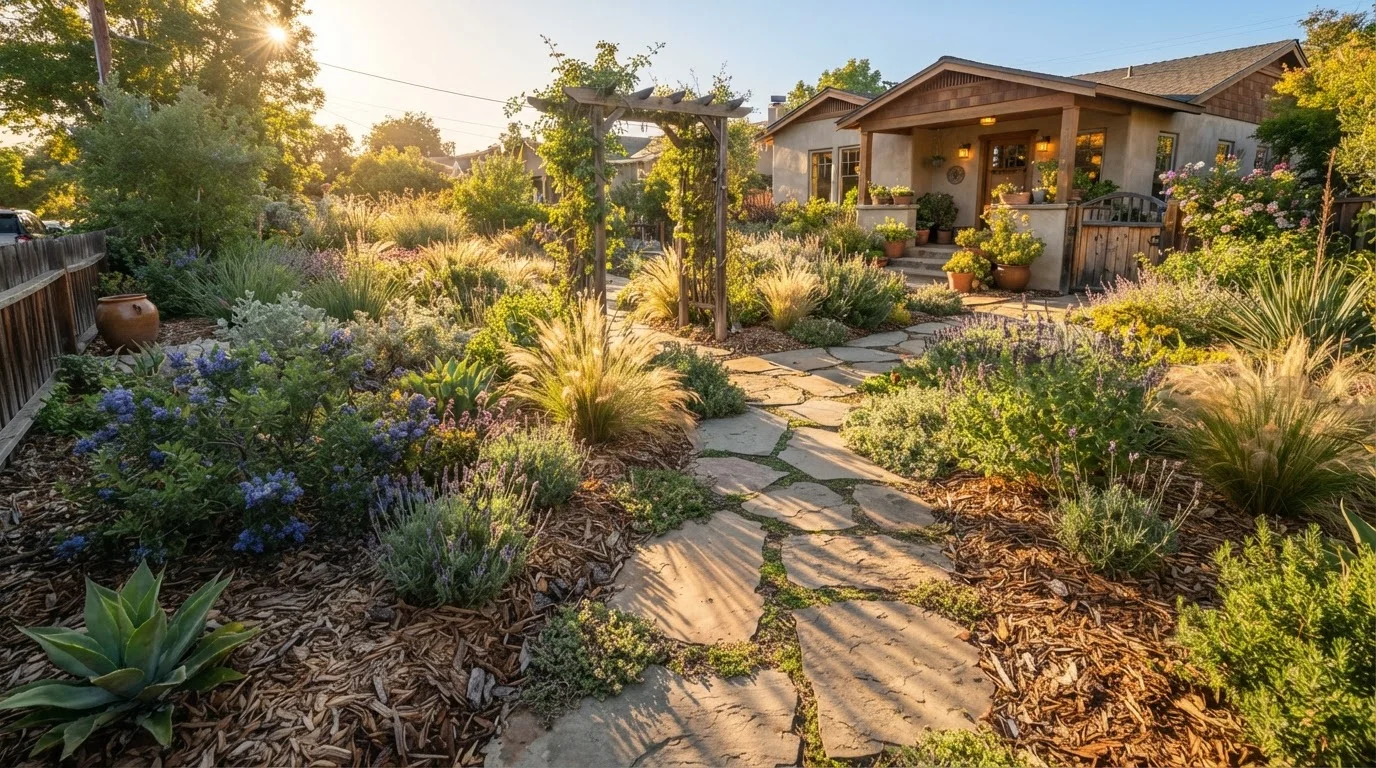
Key Takeaways
- Choosing plants native or adapted to your region dramatically reduces irrigation needs over time.
- Mulching is one of the most cost-effective ways to retain soil moisture and suppress weeds.
- Deep, infrequent watering trains roots to grow deeper and tolerate dry spells better.
- Improving soil structure with organic matter helps it hold water more efficiently between rain events.
- Grouping plants by water needs prevents overwatering thirsty species and underwatering drought-tolerant ones.
Why Lower-Water Gardening Starts with Plant Selection
The foundation of any drought-tolerant garden is choosing plants that are naturally adapted to survive — and even thrive — with limited rainfall. Plants native to your region have evolved alongside local rainfall patterns, soil conditions, and temperature swings. They typically establish deeper root systems that access subsoil moisture conventional ornamentals cannot reach.
Beyond natives, many non-native plants are still well-suited to low-water environments if they originate from climates with similar seasonal dry periods. Lavender, rosemary, catmint, and ornamental grasses, for example, are widely used across North America for their drought resilience. Checking a plant's native climate range — rather than just its USDA hardiness zone — gives you a more complete picture of its water needs.
A practical starting point is the concept of hydrozoning: grouping plants with similar water requirements together. This prevents the common mistake of placing a thirsty annual next to a drought-hardy perennial, which forces you to water to the needier plant's schedule. Effective hydrozoning is also explored in our guide to balancing hardscape and softscape in landscape design, where plant placement intersects with structural decisions.
When planning your selections, also consider mature plant size. Overcrowded plants compete for available moisture; giving each adequate space reduces water stress across the planting bed.
Mulching and Soil Management: The Moisture Retention Duo
Even the most drought-tolerant plants struggle in compacted, nutrient-poor soil that sheds water rather than absorbing it. Building healthy soil structure is an investment that pays dividends in reduced irrigation — water infiltrates more readily and is held longer in the root zone. Our in-depth article on soil health as the foundation of every thriving garden covers testing and amendment strategies in detail.
Organic matter — compost, aged leaf mold, or well-rotted manure — improves both sandy soils (which drain too fast) and clay soils (which compact and repel water). Incorporating compost before planting, and top-dressing annually, builds a soil ecosystem that retains moisture more effectively over each season. Learn how to make your own amendment with our guide on composting kitchen and garden waste at home.
Mulch applied at a 2–4 inch depth over planting beds delivers several advantages simultaneously: it slows evaporation from the soil surface, moderates soil temperature, suppresses weed competition, and gradually breaks down to feed the soil. Wood chips, shredded bark, and straw are common choices. Avoid piling mulch directly against plant stems, which can cause rot.
Stone Mulch: Effective but Different
Stone and gravel mulches are sometimes used in xeriscape designs — landscapes specifically planned around minimal irrigation. They can reduce evaporation effectively in hot, dry climates, though they don't improve soil organic matter the way wood-based mulches do. Consider the tradeoffs carefully: gravel can increase soil surface temperature in intense heat and is difficult to remove if you change your planting scheme.
Stone and gravel mulches are sometimes used in xeriscape designs — landscapes specifically planned around minimal irrigation. They can reduce evaporation effectively in hot, dry climates, though they don't improve soil organic matter the way wood-based mulches do. Consider the tradeoffs for your specific soil type and climate region.
Smarter Watering Habits That Train Plants to Need Less
How and when you water matters as much as how much you apply. Shallow, frequent watering encourages roots to stay near the surface, where they are most vulnerable to drying out. Deep, infrequent watering — allowing the top inch or two of soil to dry between sessions — encourages roots to follow moisture deeper into the soil profile, where it is more stable and less subject to surface evaporation.
Watering in the early morning, rather than midday or evening, allows moisture to reach roots before peak heat while reducing the leaf wetness that promotes fungal disease. This and other evidence-based habits are examined in our companion article on common garden watering myths that harm plants.
Drip irrigation and soaker hoses deliver water directly to the root zone with far less evaporation loss than overhead sprinklers. Many gardeners find that switching to a simple drip system — even a gravity-fed one — meaningfully reduces water use without requiring complex installation. For a broader look at household water efficiency, see what makes the biggest difference in home water efficiency.
Select plants rated for conditions drier than your average rainfall
Plants chosen for slightly drier conditions than your climate actually experiences build in a buffer for drought years and reduce routine irrigation needs. This margin of tolerance is what separates plants that survive drought from those that merely tolerate it briefly.
Apply a 3-inch layer of organic mulch across all planting beds each spring
Mulch reduces soil moisture evaporation by up to 70% under peak summer heat, according to university extension research, while simultaneously suppressing weeds that compete for available water. Replenishing annually maintains this protective layer as the material breaks down.
Water deeply but infrequently to encourage deep root development
Roots follow water. When water is applied deeply and then withheld, roots extend downward into cooler, moister soil layers — making the plant more resilient to dry surface conditions. Shallow daily watering produces the opposite effect.
Amend soil with compost before planting and as an annual top-dressing
Organic matter acts like a sponge in soil, increasing its water-holding capacity without creating waterlogged conditions. Over multiple seasons, consistent compost additions measurably improve a soil's ability to sustain plants between rain events.
Install drip irrigation or soaker hoses in high-priority planting areas
Overhead sprinklers lose a significant portion of water to evaporation and wind drift before it reaches the root zone. Drip systems deliver water precisely where plants need it, typically using 30–50% less water for the same area.
Designing for Resilience: Layout and Long-Term Thinking
Drought-tolerant gardening isn't a single technique — it's a design philosophy that considers site conditions, plant relationships, and water flow across the whole outdoor space. Slope, sun exposure, and prevailing wind all affect how quickly soil dries. Beds positioned to capture and hold rainfall — through gentle swales or berms — can make a meaningful difference in how much supplemental irrigation is necessary.
Consider how hardscaping integrates with planting areas. Permeable surfaces like gravel paths and decomposed granite allow rainfall to infiltrate rather than run off, recharging soil moisture. Solid paving, by contrast, diverts water away. This tension is worth thinking through in any landscape plan; our guide to designing an outdoor space that works through every season addresses how structure and planting interact across climate conditions.
Finally, realistic expectations matter. Newly planted drought-tolerant species still require regular watering during their establishment period — typically one to two growing seasons — before their root systems are deep enough to sustain themselves on rainfall alone. Front-loading care during establishment is what makes low-water maintenance possible in subsequent years.