

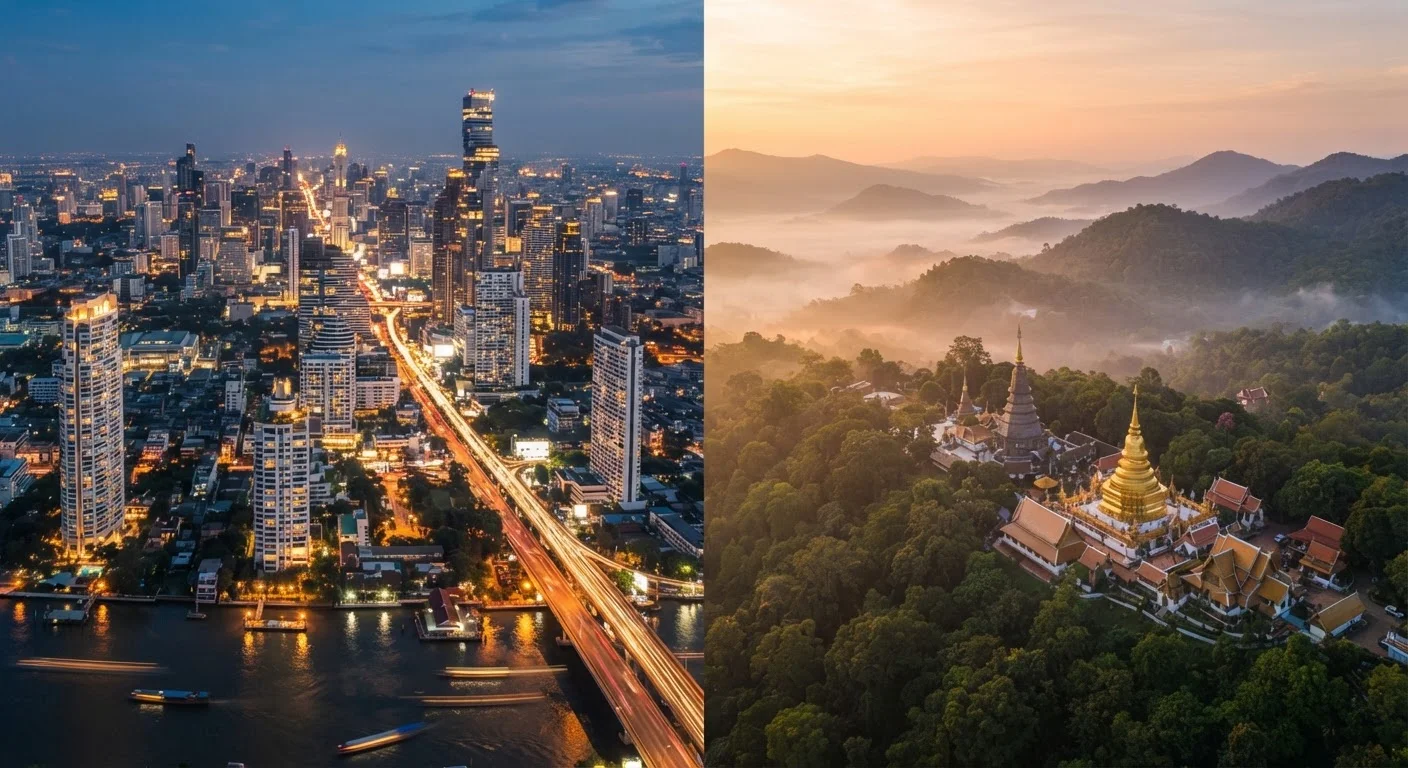
Key Takeaways
- Bangkok suits travelers who want urban density, diverse attractions, and strong international transport links.
- Chiang Mai offers a slower pace, cooler climate in the north, and easier access to trekking and rural Thailand.
- Both cities are affordable by international standards, though Bangkok's range of accommodation and dining skews wider.
- First-time visitors to Southeast Asia often find Chiang Mai's compact layout less overwhelming as an entry point.
- Many itineraries reasonably include both cities; a direct flight between them takes roughly one hour.
Option A
Bangkok
The relentless, world-class metropolis.
Best for: Travelers who want maximum variety — street food, nightlife, grand temples, shopping, and transport connections — packed into a dense, electric urban environment.
Option B
Chiang Mai
The measured, culturally rich northern retreat.
Best for: Travelers seeking a slower pace, deeper cultural immersion, outdoor access, and a walkable city that rewards longer stays.
If you want maximum activities and international connectivity
Bangkok
Bangkok's Suvarnabhumi and Don Mueang airports are major regional hubs, and the city's sheer scale means there's rarely a shortage of things to do, eat, or explore.
If you prefer a walkable city with a distinct local neighborhood feel
Chiang Mai
The Old City moat district is navigable on foot or by bicycle, and the pace of life makes it genuinely easy to settle in, explore markets, and connect with local culture.
If outdoor adventure and trekking are your primary goals
Chiang Mai
The surrounding mountains and national parks make Chiang Mai the natural base for hill tribe treks, waterfall visits, and elephant sanctuary experiences.
If this is a short trip of four days or fewer
Bangkok
Bangkok's concentration of iconic landmarks — the Grand Palace, Wat Pho, Chatuchak Market, and the Chao Phraya waterfront — means a short visit still yields a full experience.
If you're considering a longer stay or working remotely
Chiang Mai
Chiang Mai has developed a well-established infrastructure for longer-term visitors, with coworking spaces, a strong expat community, and lower average living costs than Bangkok.
Two Cities, Two Very Different Trips
Thailand's two most-visited cities sit about 435 miles apart and, in many ways, feel like different countries. Bangkok is one of Asia's great megacities — loud, layered, and relentlessly stimulating. Chiang Mai is measured and green, a cultural hub surrounded by mountains that rewards travelers who slow down. Neither is better in an absolute sense; the question is which matches how you actually want to spend your time.
If you're still deciding how much ground to cover on this trip, it's worth reading our comparison of slow versus fast-paced itineraries before committing to a pace. And if Thailand is your entry point to a broader Southeast Asia journey, our guide on choosing a starting point for Southeast Asia can help you frame the decision more broadly.
Atmosphere and Pace
Bangkok operates on its own logic. The city's BTS Skytrain and MRT metro systems make it navigable, but street-level Bangkok is dense, hot, and kinetic. Neighborhoods like Silom, Sukhumvit, and Rattanakosin each have distinct identities — you could spend a week and barely overlap your days. That variety is a genuine draw, but it also means decision fatigue is real.
Chiang Mai's Old City, enclosed by a square moat, gives the city an immediately legible structure. The Saturday and Sunday walking street markets are landmarks in themselves. Outside the old walls, neighborhoods like Nimman Road have a café and gallery district feel. The northern climate runs cooler than Bangkok — particularly from November through February — which makes walking outdoors genuinely pleasant rather than something to minimize.
| Criterion | Bangkok | Chiang Mai |
|---|---|---|
| City scale | Megacity, 10M+ residents | Mid-size city, ~130K in core |
| Navigability | Metro/BTS rail, ride-hailing | Walkable Old City, songthaew |
| Climate (Nov–Feb) | Hot and humid, ~85°F | Cooler, ~70°F in evenings |
| Outdoor access | Limited; good day-trip options | Strong — mountains, parks, treks |
| International flights | Major hub, wide connections | Regional hub, fewer routes |
| Cultural focus | Central Thai, royal heritage | Lanna heritage, temple culture |
| Typical trip length | 3–5 days adequate for highlights | Benefits from 5+ days or longer |
Culture, Food, and What You'll Actually Do
Bangkok's cultural weight is undeniable: the Grand Palace complex, Wat Pho's reclining Buddha, and the riverside temples along the Chao Phraya are among the most significant historical sites in Southeast Asia. The food scene is extraordinary in its range — from Michelin-recognized street stalls to some of the region's most respected fine dining restaurants.
Chiang Mai's cultural offerings center on its Lanna heritage, distinct from central Thai traditions. The city holds over 300 temples, with Doi Suthep temple on the hill above the city offering panoramic views and genuine religious significance. The food culture is different, too — northern specialties like khao soi (a coconut curry noodle soup) are easier to find in their most authentic form here than anywhere else in the country.
For outdoor activities, Chiang Mai is the clear choice. Ethical elephant sanctuaries, mountain biking trails, and organized treks into surrounding national parks are all accessible with minimal logistics. Bangkok offers excellent day trips — the ancient capital Ayutthaya is about 90 minutes by train — but it is not itself an outdoor destination.
Practical Considerations: Cost, Getting Around, and Timing
Both cities are affordable relative to most Western destinations, though costs vary more than broad comparisons suggest. Bangkok has a wider range at every price point: from very cheap guesthouses to luxury hotels, from street food under $2 to upscale dinners. Chiang Mai trends slightly lower overall, particularly for longer-stay accommodation and local food.
Getting between the two cities is straightforward. Budget airlines operate frequently between Bangkok's Don Mueang Airport and Chiang Mai, with flights typically under 90 minutes. Overnight sleeper trains are a slower but scenic alternative — roughly 12 hours — and a reasonable option if you're not rushed.
Timing matters, particularly for Chiang Mai. The city experiences significant smoke haze from agricultural burning, generally from February through April, which can affect air quality and outdoor enjoyment. Bangkok's heat is consistent year-round, with the coolest and driest period running from November to February — the same window that makes Chiang Mai most appealing.
Air Quality in Chiang Mai
Chiang Mai's burning season (roughly February through April) can produce significant particulate pollution, sometimes reaching levels that health authorities consider unhealthy for sensitive groups. If you're planning to spend time outdoors or trekking, this window is worth avoiding. Conditions vary year to year — check current air quality data through publicly available monitoring services before finalizing travel dates.