

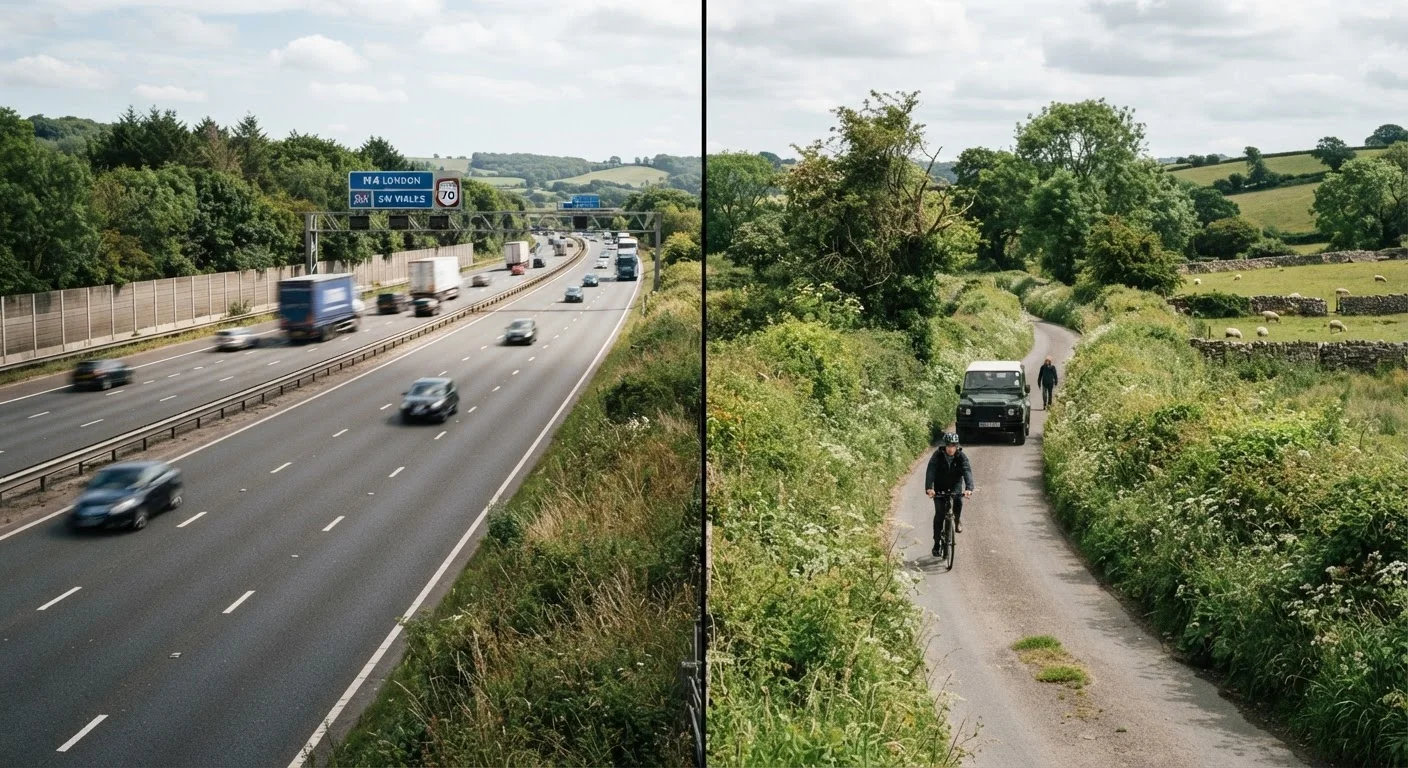
Key Takeaways
- Motorway driving demands sustained concentration and disciplined lane management at high speeds.
- Rural roads present hidden hazards — blind bends, livestock, and poor surfaces — requiring lower speeds and wider observation.
- Stopping distances increase sharply on wet or uneven rural surfaces compared to motorway tarmac.
- Fatigue is a greater risk on motorways due to monotony; complacency is a greater risk on quiet rural roads.
- Matching your following distance, scan range, and entry speed to the road type is fundamental to safe driving.
Option A
Motorway Driving
High-speed, high-volume, heavily regulated.
Best for: Covering long distances quickly on controlled-access roads with consistent traffic flow and clear lane discipline.
Option B
Rural Road Driving
Unpredictable, narrow, and constantly changing.
Best for: Navigating lower-speed country lanes and B-roads where hazards are hidden, surfaces vary, and traffic is sparse but erratic.
If you drive long distances regularly and want to reduce fatigue risk
Motorway Driving techniques
Structured lane discipline, consistent speed management, and planned rest stops make motorway travel more predictable — but drivers must actively counter monotony-induced fatigue.
If you frequently drive in rural areas or unfamiliar countryside
Rural Road Driving techniques
Slower approach speeds, wider observation arcs, and anticipating unseen hazards around bends are the skills that matter most on country lanes.
If you are a newer driver building road confidence
Motorway Driving techniques
Motorways are statistically among the safer road types per mile — learning their rules and conventions first can build systematic habits before tackling the unpredictability of rural roads.
The Core Difference: Predictability vs. Unpredictability
Motorways are engineered for consistency. Lane markings, barriers, overhead signs, and controlled access points create a structured environment where, theoretically, every vehicle is travelling in the same direction at broadly similar speeds. Rural roads are the opposite: unmarked junctions, blind summits, hidden field entrances, and varying surface conditions mean the hazard picture changes every few seconds.
That gap in predictability should directly shape how you drive. On a motorway, the key discipline is sustained attention over time — the monotony of a controlled environment is itself a hazard, because it encourages the brain to disengage. On rural roads, the key discipline is active hazard anticipation — treating every bend as potentially concealing an oncoming tractor, a cyclist, or a patch of mud shed from a field.
For a grounding in the principles that apply across both environments, see our guide to defensive driving.
Speed Management: What the Numbers Don't Tell You
The national speed limit applies to both motorways and many rural roads — but the number on the sign tells only part of the story. On a motorway, 70 mph on dry tarmac with clear sightlines and a maintained surface may feel manageable. On a rural single-track road, even 40 mph around an unsighted bend with a muddy surface can exceed your ability to stop in time if a hazard appears.
| Criterion | Motorway Driving | Rural Road Driving |
|---|---|---|
| Typical speed environment | Sustained high speed (up to 70 mph) | Variable; often well below posted limit |
| Primary hazard type | Tailgating, fatigue, lane discipline | Hidden bends, livestock, poor surfaces |
| Sightlines | Long and largely unobstructed | Short; frequently obscured by hedges or bends |
| Surface consistency | Generally well-maintained and uniform | Variable; mud, gravel, potholes common |
| Cognitive demand | Risk of under-stimulation and fatigue | Risk of overload from constant new hazards |
| Other road users | Motorised vehicles only, same direction | Cyclists, pedestrians, farm vehicles, animals |
| Stopping distance consideration | Long distances at speed; two-second rule minimum | Must stop within visible clear distance |
Appropriate speed on rural roads is almost always lower than the posted limit allows, because the limit reflects the maximum legal speed under ideal conditions — not the safe speed for the specific conditions in front of you. For a detailed breakdown of how limits apply across road types, our article on speed limits and legal grey areas is worth reading alongside this one.
Hazard Profiles: What to Watch For in Each Environment
Motorways: The dominant hazards are speed-related. Tailgating, lane-changing without adequate mirror checks, and failure to account for stopping distances at 70 mph are the primary collision contributors. At 70 mph, the Highway Code's recommended two-second gap extends to roughly 96 metres in dry conditions — and significantly more in wet weather. Fatigue is also a serious factor on long motorway runs; research consistently links drowsy driving to an impaired reaction time comparable to low-level alcohol impairment.
Tailgating on motorways is one of the most underestimated risks drivers face at speed.
Rural roads: Hazards arrive faster relative to reaction time because sightlines are short. Common rural-specific risks include: animals and farm vehicles emerging from unmarked junctions; walkers and cyclists with no pavement; surface debris like gravel, mud, and fallen branches; and road widths that require one vehicle to pull in to pass another. In adverse weather, rural roads are also slower to be gritted or cleared. See our article on driving in adverse weather for how conditions change what your vehicle can do.
57%
Of fatal crashes on rural roads (UK)
UK Department for Transport road casualty data consistently shows rural roads account for a disproportionate share of fatal collisions relative to traffic volume.
96 m
Stopping distance at 70 mph (dry)
The UK Highway Code's overall stopping distance at 70 mph in dry conditions, combining thinking and braking distance — equivalent to roughly 24 car lengths.
2 hrs
Recommended maximum drive before a break
Major road safety organisations advise taking a break of at least 15 minutes after every two hours of motorway driving to counter fatigue.
Scanning, Positioning, and Following Distance
On a motorway, your scan pattern should extend far ahead — at least 12 seconds of travel time, which at 70 mph is roughly a quarter of a mile. This gives you time to respond to brake lights, lane changes, or debris well before they become emergencies. Mirror checks every 5–8 seconds remain important, but your primary threat axis is longitudinal (ahead and behind in your lane).
On rural roads, the threat axis is lateral and close-range. You must scan hedgerows and gateways for movement, read the road surface for surface changes, and position your vehicle to maximise sightlines — typically keeping slightly left on left-hand bends to see further around them, while remaining aware of road edge hazards. Following distance should be generous: if you cannot stop in the distance you can see to be clear, you are travelling too fast.
Road markings and signs carry particular weight in rural environments where junctions can appear without warning. Our reference on road markings and signs every driver should know covers the key indicators you should be reading in both settings.
Mental Load and Fatigue: Opposite Problems, Same Risk
Motorway driving is cognitively under-stimulating for many drivers. The uniform environment reduces arousal, and without deliberate effort — talking through observations, varying scan patterns, taking regular breaks — concentration degrades. Transport safety guidance generally recommends stopping for at least 15 minutes every two hours on long motorway journeys.
Rural driving is cognitively over-stimulating by comparison. The constant stream of new hazards — junctions, bends, varying surfaces, other road users behaving unpredictably — demands continuous active processing. Paradoxically, this means rural roads are frequently more draining per mile, even at lower speeds. Drivers who are already tired from a long motorway section and then transition onto rural roads face a compounded risk: their cognitive reserves are depleted exactly when the environment demands more from them.
Distraction adds to both risks. Phone use at the wheel impairs hazard perception in either setting, but the consequences of a momentary lapse are often more immediate on rural roads where hazards resolve faster.
This article is for general educational purposes only and does not constitute legal or professional driving instruction. Always comply with the road traffic laws applicable in your jurisdiction.