

Key Takeaways
- At 60 mph, a car travels roughly 88 feet per second — reaction time alone can close the gap.
- The two-second rule is a minimum; double it in wet, icy, or low-visibility conditions.
- Tailgating is a leading factor in rear-end collisions, which account for a significant share of US crash injuries.
- Perceived time pressure is the most common psychological driver of following too closely.
- Increasing following distance costs almost no extra journey time but substantially reduces crash risk.
The Physics Behind Why Gaps Disappear So Fast
Most drivers underestimate how quickly a safe following distance can evaporate. At 60 mph, your vehicle covers approximately 88 feet every second. Average human reaction time — the gap between noticing a hazard and beginning to press the brake — runs between 1.5 and 2.5 seconds under normal conditions. That alone can account for 130–220 feet of travel before your brakes even engage. Add braking distance on top, and the total stopping distance at highway speed in dry conditions routinely exceeds the length of a football field.
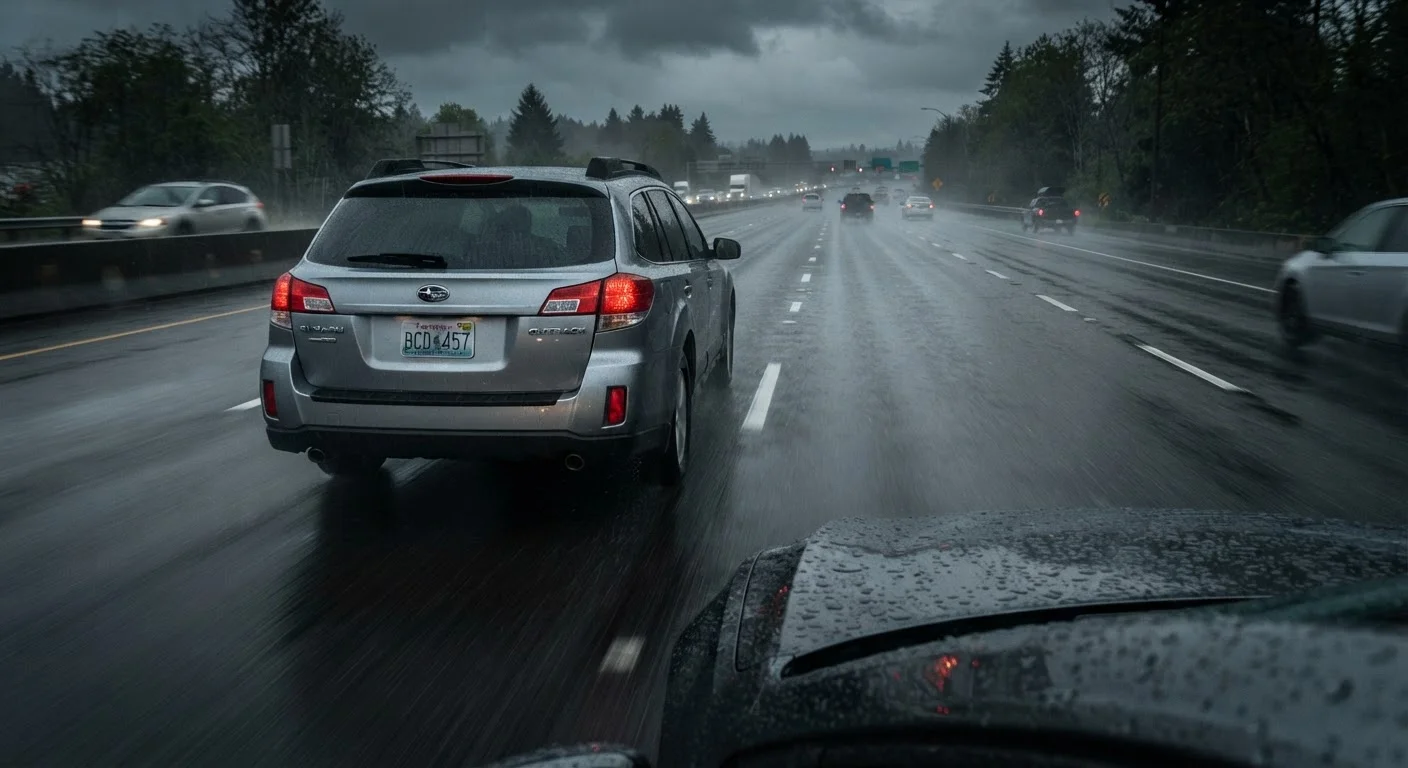
Wet roads compound the problem. Water reduces tire-road friction, meaning braking distances can increase by 50 percent or more compared to dry asphalt. Ice and snow push that figure far higher. When a driver is already following too closely, those extra feet simply do not exist.
Physics does not negotiate. If the vehicle ahead stops abruptly and you are less than your full stopping distance behind it, a collision is the mathematical outcome — regardless of driving skill.
Common Mistakes Drivers Make With Following Distance
Understanding what goes wrong is the first step toward correcting it. Below are the most widespread errors, each rooted in a mix of habit, misperception, and psychology.
Using car lengths instead of time to judge following distance.
Why it happens: Most drivers learned the 'three car lengths' rule informally, but car lengths do not scale with speed. At 70 mph, three car lengths is less than one second of following time.
Closing the gap to prevent other drivers from merging in front.
Why it happens: Drivers view their following gap as something that can be 'taken' from them, triggering a competitive response to close it before someone uses it.
Maintaining highway-speed gaps on roads where sudden stops are common, like urban arterials.
Why it happens: Drivers adapt to traffic flow rather than road type, unconsciously matching the short gaps common in urban stop-and-go driving even when speeds increase.
Failing to increase following distance when fatigued or distracted.
Why it happens: Impaired drivers often lack the self-awareness to recognise their own reduced reaction capacity. A driver who feels 'fine' may still have significantly slower reflexes.
Assuming a dry-conditions gap is adequate in rain or on wet roads.
Why it happens: The visual appearance of a gap does not change when roads are wet, so drivers do not intuitively adjust — even though braking distances can increase dramatically.
For a broader framework on anticipating these kinds of hazards before they develop, see our guide to defensive driving principles.
How Conditions Change the Equation
The standard two-second rule — picking a fixed point and ensuring the vehicle ahead passes it at least two seconds before you do — is a useful baseline, but it assumes dry roads and an alert driver. Several conditions demand a longer buffer.
~33%
Share of US crashes that are rear-end collisions
According to NHTSA crash data, rear-end collisions represent roughly one-third of all reported traffic crashes in the United States.
88 ft/sec
Distance covered at 60 mph per second
At 60 mph a vehicle travels approximately 88 feet every second, meaning a 1.5-second reaction delay alone consumes over 130 feet before braking begins.
+50%
Braking distance increase on wet roads
Traffic safety engineering references consistently cite wet asphalt as increasing braking distances by around 50 percent compared to dry conditions at the same speed.
- Rain and wet roads: Extend to a four-second gap minimum. Standing water can trigger hydroplaning, during which steering and braking effectiveness drop sharply.
- Night driving: Reduced visibility means hazards appear later in your field of view, cutting the time available to react. Night driving introduces risks that go beyond simply turning on your headlights — fatigue and glare both extend reaction times.
- Heavy vehicles ahead: Trucks and buses block your view of the road ahead, eliminating early warning of slowdowns. Add extra distance when following large vehicles.
- Fatigue: A tired driver's reaction time can approach that of a legally impaired driver. Driver fatigue degrades judgement and reflexes — both of which you depend on when following any vehicle.
Adjusting your gap for conditions is not timid driving — it is accurate driving.
What the Data and Research Show
Rear-end collisions are consistently among the most common crash types on US roads, and following-too-closely is identified as a primary contributing factor in a substantial share of them by traffic safety researchers and federal road safety agencies. The National Highway Traffic Safety Administration (NHTSA) has documented rear-end crashes as accounting for roughly one-third of all reported collisions, with many resulting in whiplash, traumatic brain injury, or fatality.
Research into driver behaviour consistently finds that drivers habitually underestimate the gap they are maintaining, partly because speed compresses perceived distance. At highway speed, a two-car-length gap looks adequate but equates to less than a second of reaction time — far below any safe threshold.
The good news: studies examining driver education interventions show that simply making drivers aware of the stopping-distance calculation leads to measurable increases in following distance. Awareness alone is not sufficient for all drivers, but it is a genuine starting point.