

Why Road Markings and Signs Still Trip Up Experienced Drivers
Most drivers passed their theory test years or even decades ago. Day-to-day familiarity with roads can breed overconfidence, and it's surprisingly easy to misread — or completely miss — markings and signs that carry real legal weight. Knowing what each one requires of you isn't optional: ignoring a regulatory sign can mean a fine, penalty points, or worse.
This reference covers the categories of road markings and signs you're most likely to encounter on UK roads, what each one means legally, and where confusion most commonly arises. For how these apply across different road types, see our guide on motorway versus rural road driving.
Road Markings: Lines, Lanes, and Painted Warnings
Road markings are governed by the Traffic Signs Regulations and General Directions (TSRGD). White lines are the most common; yellow lines restrict stopping and parking. Here's what the key markings mean:
- Single broken white centre line — advisory lane divide; you may cross it when safe.
- Double white lines (broken nearest you) — you may cross to overtake if it's safe and you can complete the manoeuvre before reaching a solid line on your side.
- Double white lines (solid nearest you) — you must not cross or straddle these lines except to enter a side road, pass a stationary vehicle, or pass a cyclist, horse, or road maintenance vehicle travelling at under 10 mph.
- Single yellow line — restricted parking or stopping; times vary by location and are shown on nearby kerb signs.
- Double yellow lines — no parking at any time; loading restrictions may also apply (indicated by yellow kerb dashes).
- Zigzag lines — found near pedestrian crossings and school entrances; no stopping, overtaking, or parking permitted.
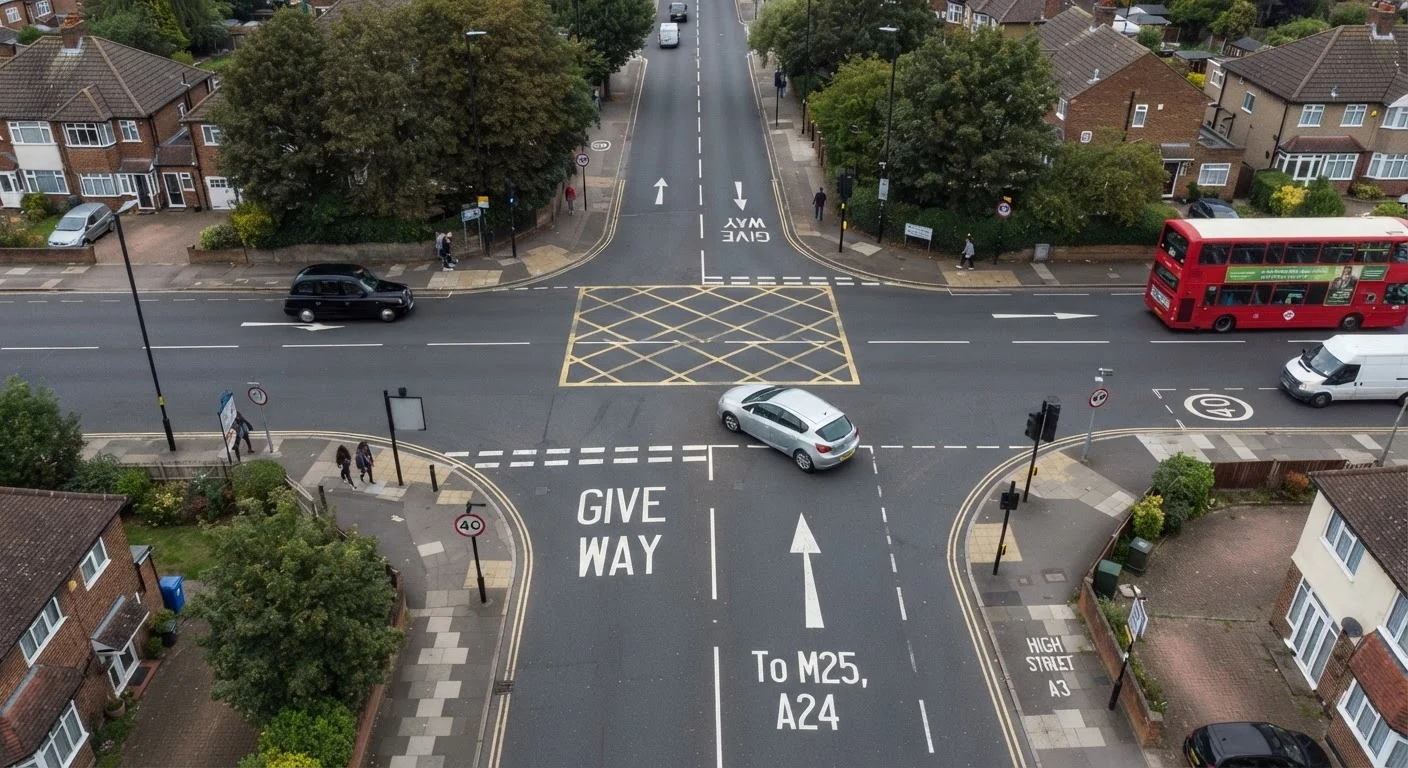
- Give way triangle (painted) — marks the road surface at junctions controlled by a give-way sign; you must yield to traffic on the major road.
- Lane arrows — indicate permitted directions from that lane; follow them unless an alternative is clearly signed ahead.
Speed limit changes are sometimes painted on the road surface as a reminder, but these are advisory reinforcements — the legally binding limit is set by the upright sign. For a full breakdown of how limits interact with road types, see speed limits explained.
Regulatory Signs: What You Must and Must Not Do
Regulatory signs impose legal obligations. They fall into two main visual categories:
- Red-bordered circular signs — prohibitions (what you must not do). Examples: speed limit circles, no entry, no U-turn, no overtaking.
- Blue circular signs — positive instructions (what you must do). Examples: turn left ahead, keep left, mini-roundabout direction.
A common point of confusion is the no entry sign versus the give way sign: no entry is a red circle with a white horizontal bar — driving past it is a criminal offence. Give way is an inverted red triangle — it requires you to yield but does not prohibit entry.
At roundabouts especially, lane discipline and sign compliance matter. Our article on roundabout rules covers the specific errors drivers make at these junctions.
Warning Signs and Information Signs
Warning signs are red-bordered triangles (pointing upward) alerting you to a hazard ahead — sharp bends, level crossings, road narrowing, or pedestrians. They don't impose a legal obligation but they do signal that you should adjust your speed and attention appropriately. Ignoring them and subsequently causing an incident can be a factor in determining fault or driver culpability.
Information signs are generally rectangular and blue (on motorways) or green (on primary routes). They tell you distances, directions, and available facilities — not restrictions. White rectangular signs typically appear in towns and on local roads.
A sign category that surprises many drivers: temporary signs on orange or yellow backgrounds used during roadworks. These carry the same legal force as permanent signs. A temporary speed limit displayed on a matrix sign or portable board is enforceable — treat it the same as a fixed sign.
This article provides general educational information about UK road signs and markings. Always refer to the current edition of the Highway Code and official DVSA guidance for authoritative and up-to-date requirements.