

Key Takeaways
- Stopping distances can increase by up to ten times on ice compared to dry tarmac.
- Aquaplaning can occur even at moderate speeds on standing water — ease off the throttle, don't brake hard.
- Fog lights are for dense fog only; using them in clear conditions dazzles other drivers.
- Sun glare causes more crashes than many drivers realise, particularly near sunrise and sunset.
- Tyre condition is the single biggest variable affecting how your car handles in all adverse conditions.
- Slowing down is the most universally effective adjustment across every type of bad weather.
Why Weather Conditions Change the Driving Equation
Most drivers learn the basics of vehicle control in decent conditions. But weather doesn't stay decent, and each type of adverse condition introduces its own set of physical forces that your car — and your reactions — have to contend with. Rain reduces friction between tyres and road. Fog compresses the visual field you have to respond to hazards. Ice drastically extends stopping distances. Sun glare temporarily eliminates your ability to see at all.
Understanding why these conditions are dangerous — not just that they are — lets you make smarter, faster adjustments when they occur. The guidance below covers each major weather hazard separately, with practical adjustments for each. The underlying principle across all of them is the same: give yourself more time and more space than you think you need.
For a complementary look at how road type shapes your driving decisions, see our guide to motorway vs. rural road driving.
Driving in Rain: Traction, Visibility, and Aquaplaning
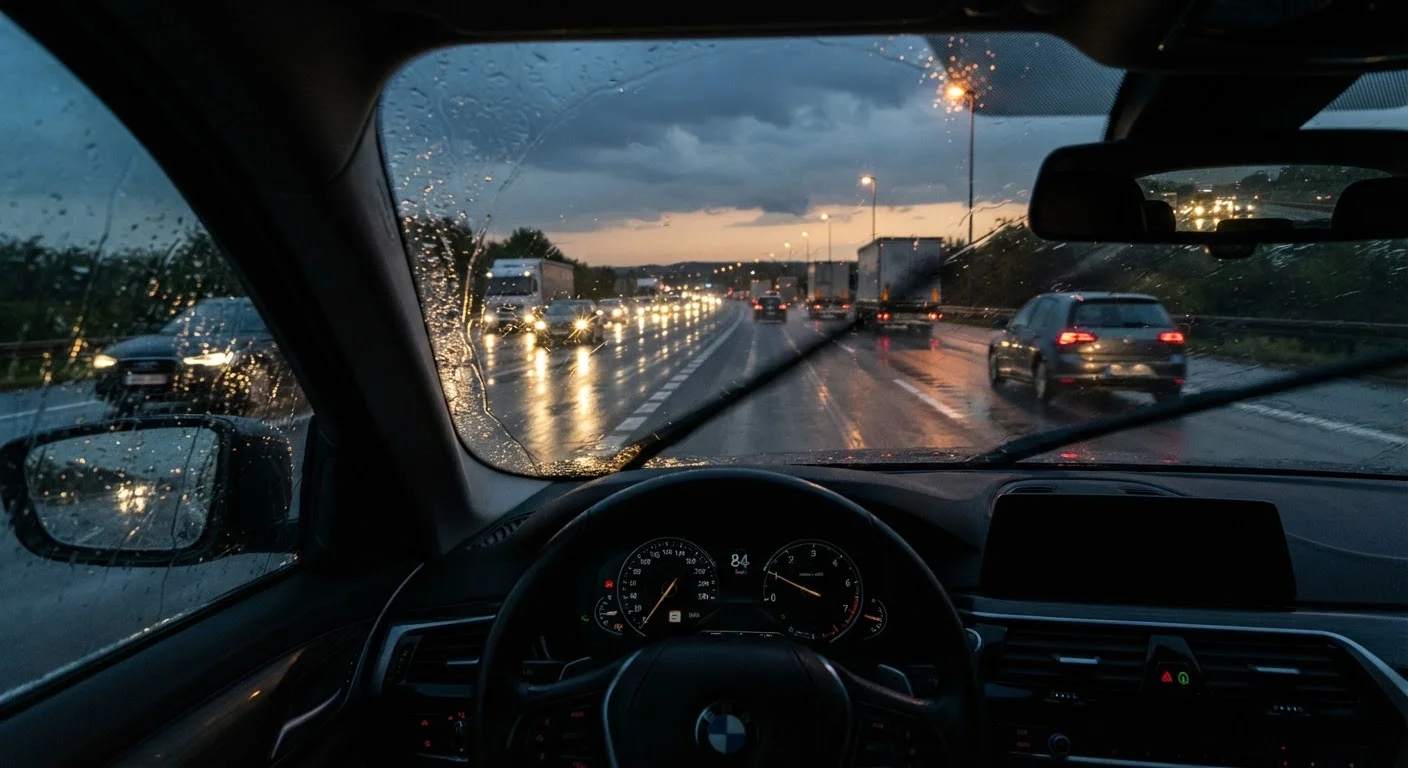
Rain affects your car in two major ways: it reduces tyre grip, and it degrades visibility through spray, water on the windshield, and reduced ambient light. On a wet road, braking distances roughly double compared to dry conditions — a figure that assumes your tyres are in good condition. Worn tread makes that figure considerably worse.
Aquaplaning occurs when a tyre rides up on a film of water faster than the tread can channel it away. The result is a sudden loss of steering and braking control. If you feel the steering go light, ease off the throttle smoothly, avoid hard braking, and hold the wheel straight until grip returns. Sudden inputs can cause a spin.
- Reduce speed progressively as rain intensifies — posted speed limits assume good conditions.
- Increase following distance to at least four seconds behind the vehicle ahead.
- Use dipped headlights when visibility is reduced, not just at night.
- Avoid lane changes through standing water where depth is unknown.
Your tyres are the critical link between all of these adjustments and the road surface. Our guide to tyre condition and handling explains what to check and what worn tread actually costs you in real stopping performance.
In heavy rain, slow down before you enter a puddle of unknown depth — driving through standing water at speed can cause aquaplaning and may also flood your brakes, reducing stopping power temporarily.
Water ingress into brake components can cause uneven braking response immediately after a water crossing, a risk that many drivers don't account for.
On icy roads, test your brakes and steering gently at low speed in a safe area as soon as conditions change — this gives you real data on how much grip you actually have rather than relying on assumptions.
Grip levels on ice vary significantly depending on temperature, road surface, and tyre type. A brief, controlled test in a quiet area calibrates your feel for the conditions before you encounter a real hazard.
If you must drive at dawn or dusk into direct sun glare, pre-plan your route to avoid east-facing roads at sunrise and west-facing roads at sunset where possible.
Route orientation is a practical, low-effort adjustment that many drivers overlook. Avoiding the sun's direct angle for just a few minutes can meaningfully reduce glare exposure.
Fog: The Visibility Hazard Drivers Consistently Underestimate
Fog is dangerous partly because of an optical illusion it creates: you feel like you're travelling slower than you are because reference points are harder to see. Drivers who trust their speedometer and build in appropriate space are far better positioned than those relying on feel alone.
The key rule is to drive so that you can stop within the distance you can see. If your headlights only illuminate 30 meters of road ahead, you need to be moving slowly enough to stop in 30 meters — which is much slower than most drivers travel in fog.
- Use fog lights only when visibility is seriously reduced (typically below 100 meters). Switch them off when conditions improve — they dazzle oncoming drivers in clearer conditions.
- Use dipped headlights, not full beam. Full beam reflects off fog and reduces your effective visibility.
- Increase following distance substantially. Rear-end collisions in fog are common because drivers tailgate as normal.
- Be especially alert at fog boundaries — patches of clear road can give a false sense of security before dense fog returns suddenly.
Ice and Snow: When Stopping Distances Multiply
On ice, stopping distances can be up to ten times greater than on dry tarmac. That is not a typo. At 30 mph on ice, a vehicle may need the equivalent of several football fields to stop. Speed and following distance adjustments that feel excessive in normal weather become entirely rational in icy conditions.
Black ice is particularly hazardous because it's nearly invisible. It forms most readily on bridges, overpasses, shaded road sections, and areas near water. If the road sounds quieter than usual under your tyres, or if the car ahead suddenly moves strangely, ice may be present.
- Accelerate, brake, and steer with gentle, gradual inputs — abrupt actions break traction on ice instantly.
- If your car begins to skid, look and steer where you want to go rather than fixating on the hazard.
- In vehicles without ABS, cadence braking (pump the brakes) prevents wheel lock. In ABS-equipped vehicles, apply firm continuous pressure and let the system do its job.
- Winter tyres — or all-season tyres rated for winter use — make a measurable difference in temperatures below 7°C (45°F).
Cold weather affects more than just the road surface. Our seasonal car maintenance guide covers what to check on your vehicle before winter conditions arrive.
Sun Glare: Temporary Blindness at the Worst Moments
Sun glare is among the most underrated driving hazards. Low-angle sun — particularly in the hour after sunrise and the hour before sunset — can completely overwhelm your vision for several seconds. This is especially problematic at junctions, where pedestrians, cyclists, and crossing traffic may be invisible during the glare.
Unlike other weather conditions, glare can appear without warning and disappear just as quickly, which means preparation matters more than reaction.
- Keep your windshield clean, inside and out. Smears and film dramatically worsen glare scatter.
- Use your sun visor — and consider a secondary clip-on extension for low-angle sun that the fixed visor doesn't cover.
- Polarised sunglasses reduce glare effectively, but check that your lenses don't interfere with reading digital dashboard displays.
- Slow down when approaching junctions in glare conditions. A pedestrian you cannot see can still step into the road.
- Increase following distance — the vehicle ahead may brake sharply when glare blinds the driver.
The challenges of low light and impaired vision also overlap with nighttime driving. Our night driving guide explains what happens physiologically and how to adapt.
Vehicle Preparation and Ongoing Maintenance
No amount of careful driving fully compensates for a vehicle that isn't ready for adverse conditions. Several maintenance items directly affect how your car performs when weather turns bad:
- Tyres
- Tread depth, pressure, and tyre type are the single biggest variables. Legal minimums are a floor, not a target — consider replacing tyres before they reach minimum depth if you drive frequently in wet or cold conditions.
- Wipers and washers
- Streaking or skipping wiper blades dramatically reduce visibility in rain. Replace them annually or when performance drops. Keep washer fluid topped up with a formula rated for low temperatures in winter.
- Brakes
- Worn brake pads and discs extend stopping distances. If you notice increased stopping distances, squealing, or vibration under braking, have the system inspected.
- Lights
- Check all exterior bulbs regularly, including fog lights. In low-visibility conditions, being seen is as important as being able to see.
- Defrosting systems
- Ensure your front and rear demisters work before winter. A fogged-up rear window is a legal and safety issue.
For a full vehicle readiness checklist, see our car maintenance hub.
This article provides general educational information about driving in adverse weather conditions. Always follow local traffic laws, posted speed limits, and official road safety guidance. If you are uncertain about your vehicle's roadworthiness, consult a qualified mechanic before driving in challenging conditions.