

Key Takeaways
- UK law bans handheld phone use while driving; penalties include six points and a £200 fine.
- Hands-free calling is legal but still measurably impairs reaction time and hazard perception.
- Cognitive distraction from a phone conversation can persist for several seconds after the call ends.
- Research consistently links phone use at the wheel to significantly elevated crash risk.
- The safest approach is to silence your phone and store it out of reach before every journey.
Driver Distraction
Driver distraction occurs when a driver's attention is diverted from the primary task of operating a vehicle safely. Using a mobile phone while driving is one of the most studied and well-documented forms of distraction. It impairs reaction times, narrows attention, and reduces the driver's awareness of hazards — regardless of whether the phone is held or used hands-free.
Researchers distinguish between visual distraction (eyes off road), manual distraction (hands off wheel), and cognitive distraction (mind off driving). Phone use — even hands-free — consistently triggers the third type, which is the hardest to detect and the most persistently dangerous.
What the Law Actually Says
UK legislation on mobile phone use behind the wheel has tightened considerably in recent years. Since March 2022, the rules were strengthened to close a widely exploited loophole: it is now illegal to use a handheld mobile phone while driving for any purpose — not just calling or texting, but also scrolling, taking photos, or playing music. The previous law only clearly prohibited interactive communication functions, which courts found difficult to enforce against drivers caught swiping through playlists.
The standard fixed penalty is six points and a £200 fine. For newly qualified drivers, six points within two years of passing means an automatic licence revocation and the requirement to retake both theory and practical tests. Courts can impose higher fines, longer bans, or a criminal conviction for dangerous driving where the phone use contributed to a collision.
There are narrow exceptions: contacting emergency services when it is unsafe to stop, and using a device while safely parked with the engine off. Sitting in a drive-through queue with your engine running does not qualify.
Hands-free use — via a dashboard cradle, Bluetooth, or vehicle integration — remains lawful, but the police retain the power to charge a driver with careless or dangerous driving if hands-free use causes poor vehicle control. The law permits it; the research is less forgiving. For a parallel look at how legal thresholds can diverge from actual risk, see our article on common misconceptions about drink-drive limits.
The Cognitive Science Behind the Risk
The reason phone use is dangerous is not simply that drivers take their eyes off the road, though that happens too. The deeper problem is cognitive load — the mental effort a conversation demands competes directly with the attentional resources needed to drive safely.
Driving is a complex, continuous task requiring the simultaneous processing of road layout, speed, other vehicles, pedestrians, signals, and unexpected hazards. A phone conversation introduces a second demanding mental task. Because human attention is finite, something has to give — and what gives is typically the detection of peripheral or unexpected hazards.
“Hands-free is not risk-free. The conversation itself is the distraction — and that distraction doesn't disappear just because a driver's hands are on the wheel.”
— Road Safety Foundation, UK-based road safety charity and research body
This effect, sometimes called inattentional blindness, means a driver can be looking directly at a cyclist or a junction and still fail to register it consciously. Studies using driving simulators have shown that conversing drivers miss a meaningful proportion of roadside hazards that undistracted drivers would detect.
Critically, this applies to hands-free calls almost as much as handheld calls. The conversation itself — not just holding the device — is the primary source of impairment. Talking to a passenger produces less impairment because passengers naturally pause during complex driving moments and share the driver's situational awareness. A caller on the other end of a phone does neither.
Reaction time impairment from a phone call can also persist briefly after the call ends — a lag sometimes described as a cognitive aftermath. This matters particularly at speed, where a fraction of a second corresponds to significant stopping distance. For context on how reaction time interacts with following distance, our piece on why tailgating is more dangerous than most drivers realise covers the physics in detail.
What the Data Shows About Crash Risk
Establishing a precise causal link between phone use and crashes is methodologically difficult — drivers rarely self-report distraction after a collision, and phone records must be subpoenaed to confirm use. Nevertheless, the body of evidence is substantial and consistent.
6 points
Penalty points for handheld phone use
Under UK law, a single offence of using a handheld device while driving carries six penalty points — enough to revoke a newly qualified driver's licence automatically.
~4×
Estimated crash risk increase from handheld phone use
Multiple peer-reviewed studies have estimated that handheld phone use at the wheel raises crash risk by approximately four times compared with undistracted driving, though exact figures vary by study design.
27 metres
Typical stopping distance at 70 mph
At 70 mph, a car travels roughly 27 metres in one second — illustrating how even a brief cognitive lag from phone distraction can place a driver well past a safe stopping point.
Research published in peer-reviewed transport safety journals has found that handheld phone use at the wheel is associated with crash risk estimated to be several times higher than undistracted driving. Hands-free use, while lower-risk than handheld, still produces statistically significant impairment relative to an undistracted baseline.
Official UK collision data compiled by the Department for Transport records hundreds of reported injury collisions each year where mobile phone use is a contributory factor — and researchers widely acknowledge that figure is an undercount, since distraction is difficult to confirm at the scene without phone records.
Distraction-related impairment shares several characteristics with fatigue-related impairment: both degrade hazard perception, slow reaction times, and reduce lane discipline. Our article on driver fatigue and its warning signs explores those parallels in more depth. Conditions that compound cognitive load — darkness, unfamiliar roads, heavy traffic — amplify the risk further, as covered in our guide to night driving hazards.
Practical Steps for Safer Journeys
Understanding the risk is the first step; reducing it requires concrete habit changes. The most effective approach is also the simplest: treat your phone like a passenger who needs to stay quiet for the duration of the journey.
- Before you set off: Enable 'Do Not Disturb While Driving' mode (available on most smartphones), set any navigation, and place the phone in your bag, glove box, or centre console — out of sight and reach.
- If you need to make or receive a call: Find a safe, legal place to park, switch off the engine, and then use your phone. Even a two-minute call is worth pulling over for.
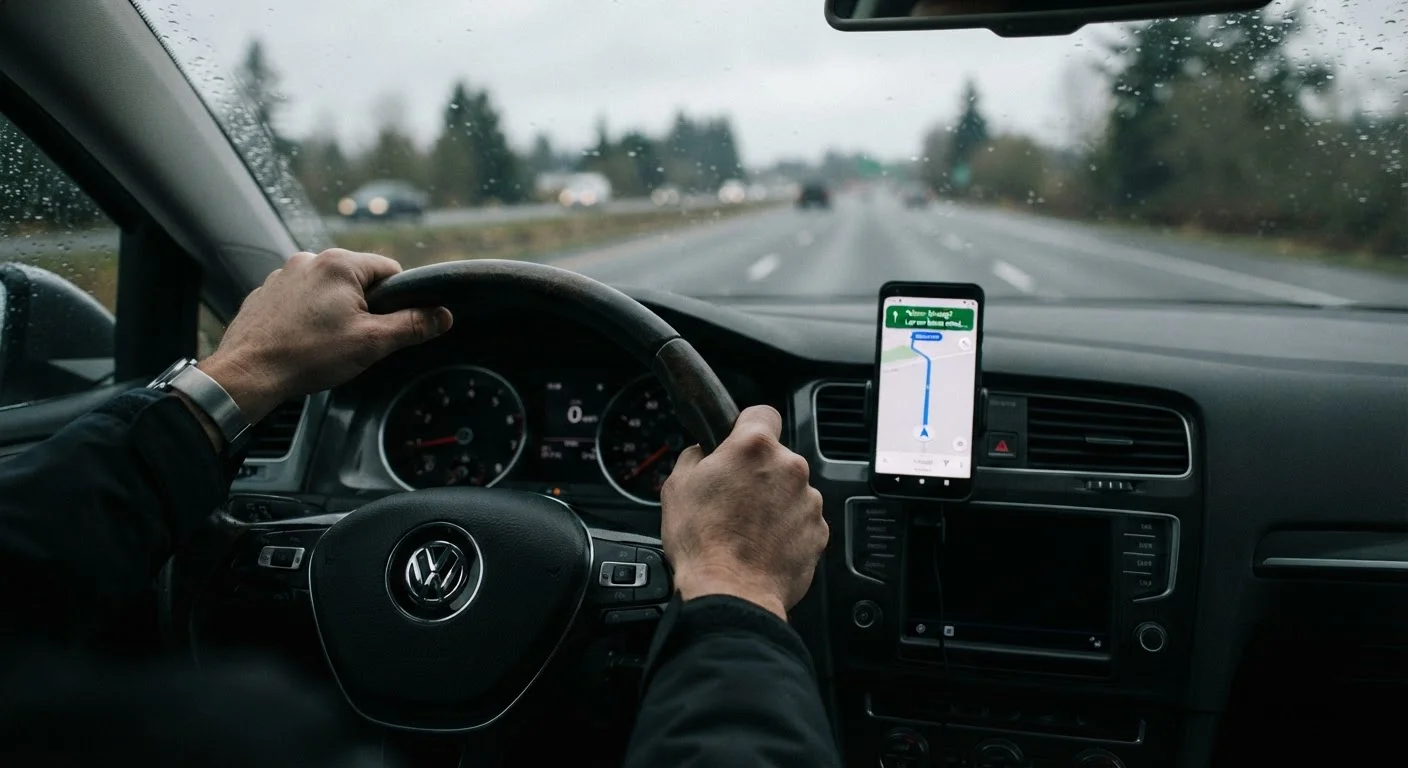
- For navigation: A properly mounted device in a cradle, set before departure, is the least disruptive option. Avoid re-routing or searching while moving.
- Passengers can help: If someone is in the car, they can manage the phone, answer messages, or speak to callers on your behalf.
No incoming message, notification, or call is worth the consequence of a collision. The habit of silencing and stowing the phone before every journey is one of the highest-impact safety decisions a driver can make — and costs nothing.
The Simplest Habit That Makes a Difference
Before starting the engine, put your phone on 'Do Not Disturb' and place it somewhere you cannot reach it while seated. This single pre-journey action removes both the temptation and the legal risk entirely. It takes less than ten seconds and requires no technology beyond what your phone already has.