
Speed Limits Explained: National Limits, Variable Limits, and Legal Grey Areas

Key Takeaways
- National speed limits in the UK are 30 mph in built-up areas, 60 mph on single carriageways, and 70 mph on dual carriageways and motorways.
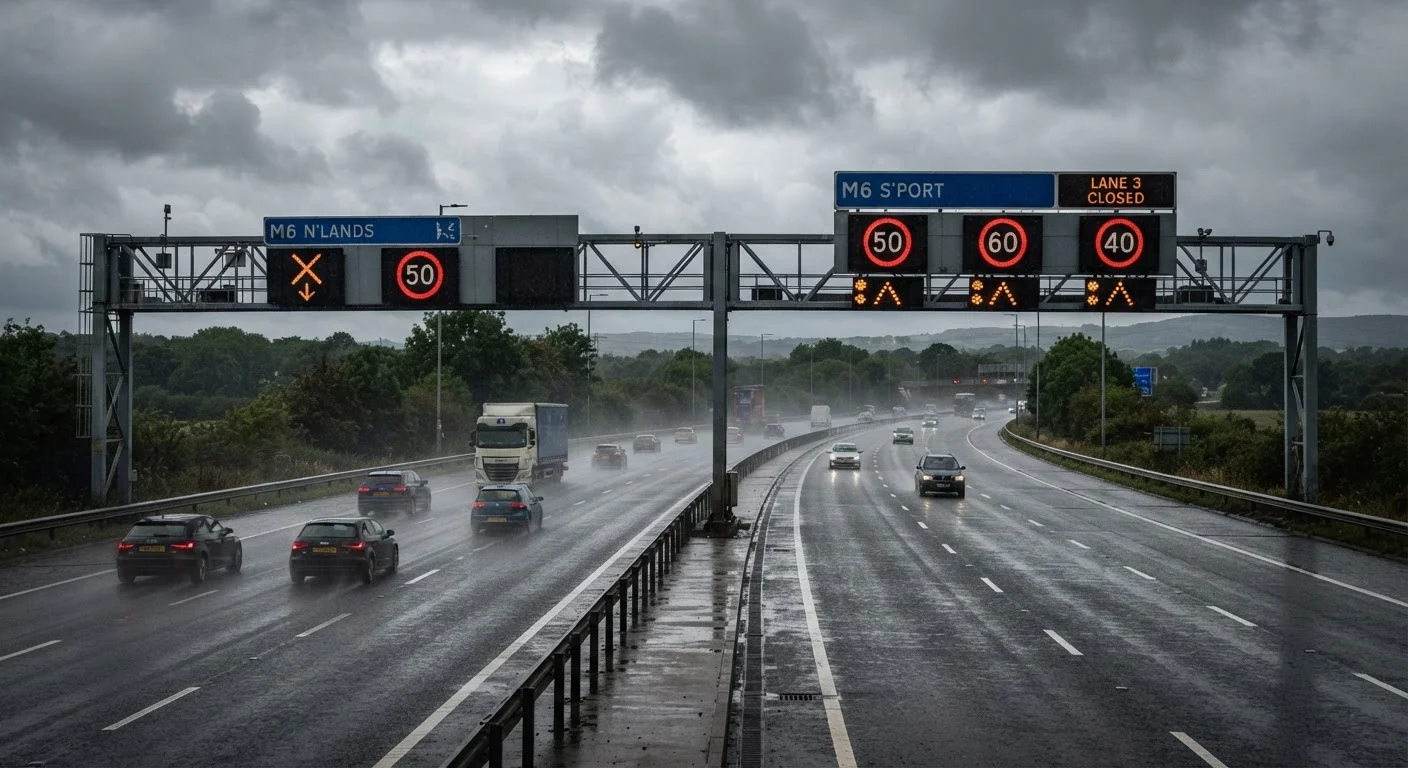
- Variable speed limits displayed on smart motorway gantries are legally enforceable the moment they appear.
- A 20 mph zone is distinct from a 20 mph limit — zones include physical traffic-calming measures, while limits rely on signing alone.
- Driving below the speed limit can still be an offence if your speed is dangerous given the conditions.
- Average speed cameras measure your speed across a distance, not at a single point — consistent compliance throughout is essential.
Speed Limit
A speed limit is the maximum legal speed at which a vehicle may travel on a given road under normal conditions. In the UK, limits are set by Parliament, local authorities, or highway agencies and are communicated through road signs, road markings, and — on smart motorways — overhead electronic signals. Driving above the posted limit is a criminal offence, regardless of road conditions.
Speed limits define a legal ceiling, not a recommended safe speed. The Highway Code makes clear that drivers must also drive at a speed appropriate to conditions, which may be well below the posted limit.
The Three National Speed Limits You Need to Know
Most drivers know the basics, but confusion arises in the gaps. The UK operates three national speed limits for cars and motorcycles: 30 mph in areas with street lighting (unless otherwise signed), 60 mph on single-carriageway roads, and 70 mph on dual carriageways and motorways. These are maximums, not targets.
The critical distinction drivers miss is between a signed limit and an implied one. Street lighting alone — lamp posts no more than 200 yards apart — implies a 30 mph limit even when no signs are present. On a rural road without lighting, the national speed limit applies and is shown by the white circular sign with a diagonal black stripe. If you don't see that sign, look for the last posted limit and assume it still applies.
Different vehicle types carry different limits under the same national framework. A car towing a caravan is limited to 60 mph on motorways; a large goods vehicle faces 60 mph on dual carriageways and 50 mph on single carriageways. Driving the car limit in a vehicle subject to a lower one is an offence. Understand how road type changes your obligations for a fuller picture of how environment shapes legal requirements.
Variable Speed Limits: Smart Motorways and Roadworks
Variable speed limits are where many drivers hit legal grey areas. On smart motorways, overhead matrix signals can display mandatory speed limits — typically in red-bordered circles — that are legally binding the moment they illuminate. A blank or dashed overhead signal does not mean the limit has lifted; it means the national limit applies unless the previous gantry still shows a mandatory figure.
A common misunderstanding: drivers assume a variable limit is advisory rather than mandatory. In fact, if the signal shows a number in a red circle, treating it as advisory is a fixable-penalty offence. Amber warning signals showing a speed are advisory; red-circle signals are mandatory. The difference is visible and consistent — learn it once and it applies across the network.
Roadworks speed limits carry the same legal weight. A 50 mph limit through an active roadworks zone is enforceable even outside working hours, because the signing remains in place and the hazards — uneven surfaces, narrowed lanes, workers potentially present — do not disappear when contractors leave for the day.
20 mph
Limit now covering most of Wales by default
Wales introduced a default 20 mph limit on restricted roads in September 2023, one of the most significant changes to national speed limit policy in the UK in decades.
~33%
Of fatal crashes involve exceeding or inappropriate speed
UK Department for Transport data consistently identifies speed as a contributory factor in roughly one third of road fatalities, making it the single most cited factor.
2–3x
Greater stopping distance on wet roads vs dry
The Highway Code advises that stopping distances at least double in wet conditions and can be ten times longer on ice, underlining why the posted limit is not always the safe speed.
20 mph Zones, Average Speed Cameras, and Common Misreadings
The rollout of 20 mph limits across residential and town-centre roads has created genuine confusion. A 20 mph zone begins with a zone entry sign and ends with a zone exit sign; repeater signs within the zone confirm the limit. A 20 mph speed limit road uses standard circular signs without implying a zone. Both are enforceable — the distinction matters only for understanding why physical calming features may or may not be present.
Average speed cameras are widely misunderstood. Because they calculate mean speed across a measured distance rather than at a single point, brief compliance near the camera while speeding between cameras offers no protection. The calculation is indifferent to your speed at any one moment. If a roadworks section spans three miles with a 50 mph average camera system, your time of travel must be consistent with 50 mph or below across the entire stretch.
Road markings and signs every driver should recognise covers the specific signs that signal limit changes — worth revisiting if you are uncertain about identifying zone boundaries or national limit indicators.
When Staying Within the Limit Is Still Not Enough
Speed limits define a legal ceiling, not a guarantee of safety. The Highway Code is explicit: you must drive at a speed appropriate to conditions. In fog, heavy rain, ice, or on roads with poor visibility, the appropriate speed may be significantly below the posted limit. A driver doing 60 mph on a national-limit single carriageway in dense fog can still be prosecuted for dangerous or careless driving, even though they have not technically exceeded the limit.
Equally, exceeding the speed limit by even 1 mph is technically an offence, although enforcement thresholds in practice — as set by the National Police Chiefs' Council — typically allow for a tolerance margin. Drivers should not treat that tolerance as a guaranteed buffer, because it is an operational guideline, not a legal right, and camera calibration tolerances vary.
The core principle is consistent: the speed limit is a ceiling set under idealised conditions. Your responsibility as a driver is to assess whether that ceiling is appropriate for the road, vehicle, weather, and traffic in front of you at every moment. Compare safe-speed thinking on motorways versus rural roads to see how this plays out across different environments.