

Key Takeaways
- Container labels identify exactly what is inside each vessel; category labels define shelf zones by food type.
- Container labelling requires consistent decanting habits to stay accurate and useful.
- Category labelling tolerates original packaging and irregular shopping cycles more gracefully.
- Many well-organized pantries use both systems together rather than choosing just one.
- Maintenance commitment and household size are the two most important factors when choosing a system.
Option A
Container Labels
The precise, content-specific approach.
Best for: Households that decant food into uniform containers and want every vessel clearly identified at a glance.
Option B
Category Labels
The flexible, zone-based approach.
Best for: Households with mixed packaging, frequent shoppers, or multiple people restocking shelves independently.
If you decant most pantry items into uniform containers
Container Labels
When everything is transferred out of original packaging, a container label is the only reliable identifier — category zones alone won't tell you whether a jar holds semolina or bread flour.
If multiple household members restock shelves independently
Category Labels
Zone-based labels communicate where things belong without requiring anyone to match a specific container, reducing misplaced items after grocery runs.
If your pantry holds a wide variety of original packaging formats
Category Labels
Category labels work alongside boxes, bags, and cans without requiring you to transfer contents first, making the system far easier to sustain.
If you want the most precise, visually cohesive pantry possible
Container Labels
Matching containers with clear individual labels create a uniform look and eliminate any guesswork about contents, expiry reference, or quantity.
If you want a low-maintenance system that can adapt to changing pantry contents
Category Labels
Category zones stay accurate even as specific products rotate in and out, requiring far fewer label updates over time.
What Each System Actually Does
These two labelling approaches solve different problems, and conflating them leads to pantries that are half-organized at best.
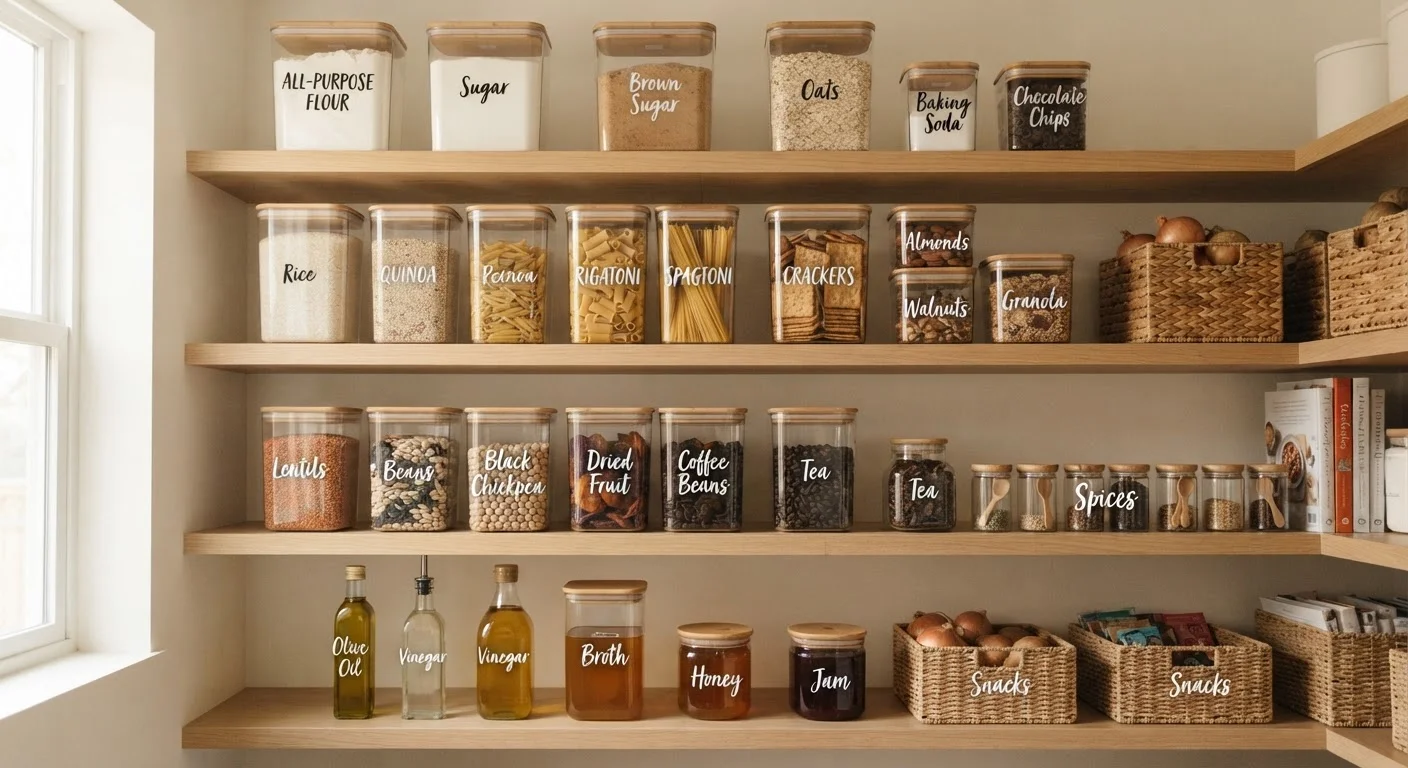
Container labels are applied directly to individual storage vessels — typically uniform jars, canisters, or bins — and identify the specific contents inside. A label might read "Whole Wheat Flour," "Brown Basmati Rice," or "Pitted Medjool Dates." The label travels with the container and loses its function the moment different contents go inside without a corresponding update.
Category labels are fixed to shelves, baskets, or wall space and mark a designated zone rather than an individual vessel. A shelf edge might be labelled "Grains," a basket tagged "Snacks," or a bin marked "Baking Supplies." The label stays accurate regardless of which specific products occupy that zone on any given week.
The practical consequence: container labelling is a content-identification system, while category labelling is a location-assignment system. Both improve pantry usability, but they do so by different mechanisms — and they demand different habits from the people using the pantry.
Head-to-Head: How the Two Systems Compare
Before deciding which approach fits your household, it helps to see both systems measured against the same practical criteria.
| Criterion | Container Labels | Category Labels |
|---|---|---|
| What gets labelled | Individual containers | Shelf zones or baskets |
| Setup time | High — requires decanting | Low — label zones only |
| Ongoing maintenance | High — update per content change | Low — zones rarely change |
| Works with original packaging | No — requires transfer | Yes — packaging stays |
| Content clarity | Very high — exact identification | Moderate — zone only |
| Best household fit | Consistent decanting households | Mixed or multi-person households |
| Visual uniformity | High when containers match | Variable — depends on packaging |
One pattern that emerges quickly: container labels demand higher initial investment (time, containers, and labelling materials) but pay off with exceptional clarity once established. Category labels are faster to implement and easier to maintain, particularly when reducing food waste is a goal — because zone-based organization makes it easier to audit what you already have before shopping.
Where Each System Falls Short
Neither approach is without drawbacks, and understanding those limitations upfront prevents frustration later.
Container Label Pitfalls
- Maintenance lag: If a container gets refilled with a different product and the label isn't updated immediately, the whole system becomes untrustworthy. This is especially common in shared households — see organizing shared spaces for strategies that help.
- Decanting commitment: The system only works if every pantry item actually gets transferred out of original packaging. Partial decanting creates two parallel systems, which is often more confusing than having no labels at all.
- Cost and time: Purchasing uniform containers and maintaining a supply of labels or a label maker is an ongoing investment.
Category Label Pitfalls
- Vague boundaries: If categories are too broad ("Miscellaneous") or overlap ("Dry Goods" vs. "Grains"), the system stops guiding decisions and becomes decorative.
- Crowding: When a zone fills beyond its designated space, items migrate, and the category label no longer reflects what's actually on that shelf.
- No content identification: If you decant items into opaque or identical containers and rely only on category labels, you'll still need to open everything to figure out what's inside.
For pantries with deep shelving, pairing either label type with the right storage tools matters considerably — the right bins and baskets make both systems significantly more effective.
Combining Both Systems — and Knowing When To
The most functional pantries often use both systems in tandem, applying each where it performs best. A practical hybrid approach works as follows:
- Use category labels on shelves, baskets, or zones to establish clear locations for food types — Grains, Canned Goods, Baking, Snacks, Oils & Condiments.
- Use container labels on any vessel where the contents aren't visually obvious — opaque canisters, identical mason jars, or multi-purpose bins.
- Leave original packaging in its category zone without individual container labels when the packaging itself is self-identifying (a cereal box, a can of tomatoes).
This hybrid removes the all-or-nothing commitment of either pure system and scales naturally as your pantry evolves. It also accommodates households where storage space and layout vary — something worth considering alongside your vertical or horizontal storage arrangement, which affects how labels are most legibly positioned.
If your pantry is open shelving rather than closed cabinets, category labels serve double duty — they communicate organization visually to anyone in the kitchen, not just the person doing the restocking. The open vs. closed shelving trade-offs are worth reviewing if you're reconsidering your pantry layout alongside your labelling system.
A Note on Label Materials
Chalkboard labels, printed adhesive labels, and erasable plastic tags all have different durability profiles. Adhesive labels applied to glass or smooth plastic containers tend to hold well in dry pantry conditions but may peel in high-humidity environments near stovetops or sinks. Chalkboard labels are easy to update but can smudge if the surface isn't sealed. Whichever material you choose, test one or two labels before committing to the whole pantry — removal difficulty varies significantly between label types and container surfaces.