

Key Takeaways
- Visibility is the single biggest factor in reducing food waste at home.
- Applying a first-in, first-out system to your fridge and pantry prevents items from expiring unnoticed.
- A dedicated 'use first' zone reduces spoilage without requiring constant mental tracking.
- Consistent organisation lowers impulse buying by making inventory clear before each shopping trip.
- Small storage adjustments — not buying more containers — drive the biggest improvements.
What you will need
Why Kitchen Layout Directly Affects Spending
Food waste is rarely caused by carelessness. More often, it's caused by a kitchen layout that makes it easy to forget what's already there. When items are stacked behind others, pushed to the back of shelves, or stored in opaque packaging, they effectively disappear — until they're discovered expired and discarded.
Research from food systems organisations consistently shows that households waste a meaningful share of the food they purchase, with a significant portion due to spoilage rather than deliberate discard. The financial impact compounds weekly: a household that consistently wastes a fraction of its grocery spend loses a noticeable sum over a year without realising it.
The good news is that kitchen organisation addresses this without requiring a complete renovation. The changes that move the needle most are behavioural and spatial — how items are positioned, rotated, and made visible. For a broader look at how storage systems affect whole-home functionality, see our piece on storage habits that make small homes more functional.
Organisation Doesn't Require Buying More
A common misconception is that getting organised means purchasing matching containers, baskets, and labels. In practice, rearranging what you already own produces most of the benefit. Introducing new storage products before establishing a system often adds clutter rather than reducing it. Start with habits and layout; buy only what a specific, identified gap demands.
This approach also sidesteps a trap worth naming: the belief that more storage products will solve a disorganisation problem. Common organisation myths — including the idea that buying more containers automatically creates order — can lead to spending more money while solving nothing structural.
Clear storage containers
Allow you to see contents and quantities at a glance, reducing duplicate purchases.
Masking tape and marker
Used to add open dates or 'use by' reminders to packages and containers quickly.
Small bin or basket
Designated container for the 'use first' zone in the fridge or pantry.
Notepad or phone notes app
Running grocery list updated in real time as items run low.
How to Reorganise Your Kitchen Step by Step
The following steps move from clearing and auditing to building durable daily habits. They're designed to be done in sequence, though you can spread them across a weekend if a single session isn't practical.
What you will need
Audit and discard before reorganising anything
Pull everything out of one zone at a time — fridge, then freezer, then pantry. Check dates, assess condition, and discard anything spoiled or well past use. Group items by category as you set them aside. This step gives you an accurate picture of what you actually own, which prevents buying duplicates on your next shop. If you find significant quantities of food you didn't know you had, note those categories — they're your highest-waste areas.
Apply first-in, first-out to every shelf
First-in, first-out (FIFO) means newer items go behind or beneath older ones every time you unpack groceries. This is the same stock-rotation method used in commercial kitchens and grocery stores. In practice: when you bring home a new carton of broth, push the existing one to the front and place the new one behind it. In the fridge, older leftovers and open packages move to eye-level; newer ones go to the back. The habit takes about 90 seconds per grocery unpack and dramatically reduces silent expiry.
Create a dedicated 'use first' zone in the fridge
Designate one shelf or bin — typically at eye level — as the use-first zone. Anything approaching its use-by date, any open package, or any leftovers goes here automatically. Everyone in the household should know that food in this zone gets eaten before anything else is opened. This removes the mental overhead of remembering what needs to be used and makes the decision obvious at meal prep time.
Store like with like and keep categories consistent
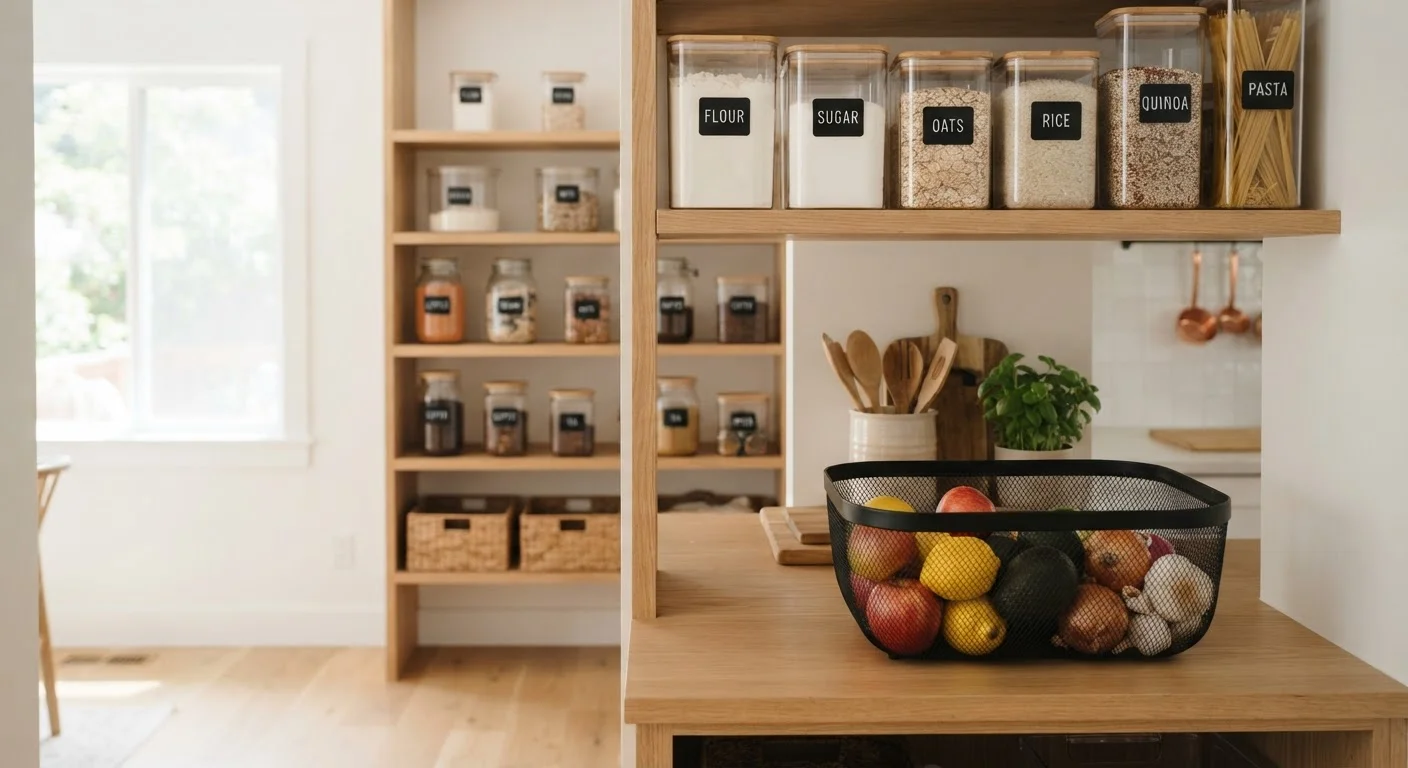
Group items by type: all grains together, all canned proteins together, all baking staples together. Consistency means you always know where to look, which prevents buying a second jar of something you already own. In the pantry, opaque packaging makes it harder to see quantities — transfer frequently used dry goods to clear containers if you find yourself consistently misjudging how much you have. See our guide to pantry labelling systems for help deciding between container-level and category-level labels.
Align your shopping list with your visible inventory
Before each grocery run, physically check your use-first zone, scan your pantry categories, and build your list from gaps — not habits. Habit-based shopping (buying the same items each week regardless of what's already on hand) is one of the leading causes of household food waste. A quick visual check takes two minutes and directly informs a more accurate list. Pairing this with a meal plan for the coming week tightens the loop further: you buy what you'll actually cook, not a general surplus. Our pre-shopping checklist offers a structured framework for this step.
Review and adjust the system monthly
Spend ten minutes once a month checking whether the system is holding. Look for items that have drifted to the back, categories that have merged or sprawled, and any new food types that don't have a designated home. Small drift is normal; catching it monthly prevents it from compounding into the disorganised baseline you started from. If certain food categories are consistently wasted, consider whether your household actually uses them or whether they're aspirational purchases worth dropping from your regular list.
Audit Before You Shop Every Time
Spend two minutes checking your fridge, freezer, and pantry before writing a shopping list. Cross-referencing what you already have against what you plan to cook is the simplest way to avoid duplicating purchases. This habit compounds over time — households that do it consistently report noticeably lower weekly grocery spend.
Once your kitchen organisation is stable, the next logical step is reducing what can't be eaten at all. Our guide to composting kitchen waste at home covers how to handle unavoidable food scraps in a way that's useful rather than simply discarded. And if you're organising a shared kitchen where household members have different habits, strategies for shared spaces offers practical approaches for getting everyone on the same system.