

| Drawer dividers best for | Flat, similarly sized, frequently accessed items |
| Bins best for | Loose items on open shelves and in cabinets |
| Baskets best for | Soft goods, irregular shapes, and living area storage |
| Most common misuse | Using one storage type uniformly across all spaces |
| Divider limitation | Poor fit for items that vary widely in depth or height |
| Basket caution | Natural fiber baskets can degrade in damp environments |
Why Storage Tool Choice Matters
Not every organizing problem needs the same solution. A bin that works brilliantly in a pantry can create frustration in a bathroom vanity. Drawer dividers that tame a utensil drawer may be completely wrong for a linen closet. Understanding what each storage format is actually designed to do — and where it struggles — saves both money and the aggravation of reorganizing a space twice.
This reference covers the three most common storage tools homeowners reach for: drawer dividers, bins, and baskets. For each, we describe the core use case, common misapplications, and where it performs best. For broader organizing strategy, see our room-by-room decluttering walkthrough before investing in any storage hardware.
| Drawer dividers best for | Flat, similarly sized, frequently accessed items |
| Bins best for | Loose items on open shelves and in cabinets |
| Baskets best for | Soft goods, irregular shapes, and living area storage |
| Most common misuse | Using one storage type uniformly across all spaces |
| Divider limitation | Poor fit for items that vary widely in depth or height |
| Basket caution | Natural fiber baskets can degrade in damp environments |
Drawer Dividers: Precision for Flat Spaces
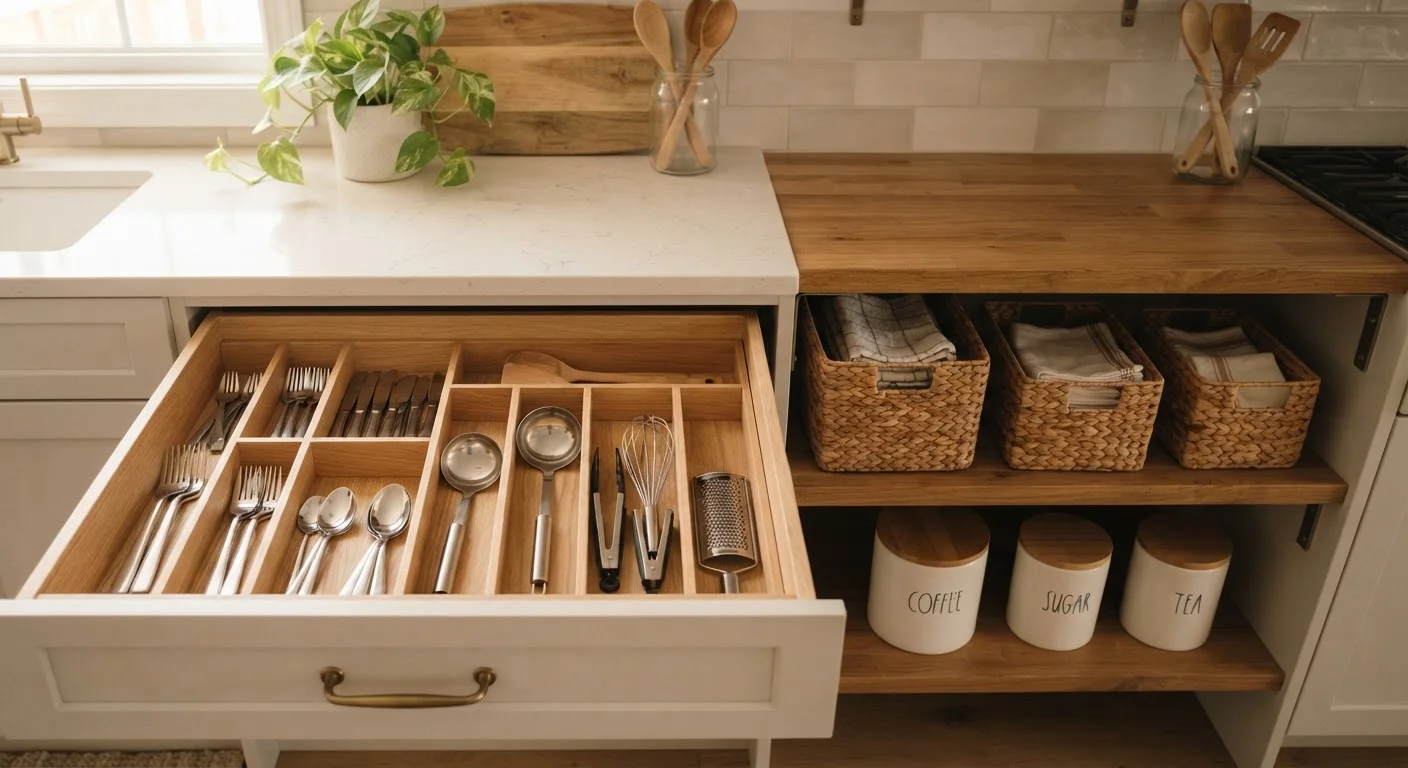
Drawer dividers are rigid or semi-rigid inserts that subdivide the horizontal plane of a drawer into defined sections. They excel when items are similarly sized, frequently accessed, and need to stay visually separated — think flatware, craft supplies, office tools, or folded garments.
Where they work best
- Kitchen utensil drawers: Keeps spatulas, whisks, and measuring spoons from shifting into a tangled pile.
- Desk drawers: Separates pens, clips, and sticky notes without requiring labeled containers.
- Clothing drawers: Adjustable dividers help maintain folded stacks in dresser drawers, particularly for smaller items like socks and underwear.
Common misuses
Dividers fail when items vary too much in depth or height — deep bottles, rolled towels, or bulky tools will simply tip over or not fit cleanly in a divided cell. They also require a drawer deep enough to accommodate the divider's own height. Using rigid, fixed-size dividers in a drawer with irregular contents tends to create awkward dead zones rather than functional sections.
Bins: Structure for Open Shelves and Cabinets
Bins — typically rigid containers with open tops and straight sides — bring structure to spaces that lack built-in compartments. They group loose items into a retrievable unit that can be pulled out as a whole rather than searched piece by piece. Think of them as portable drawers for shelves.
Where they work best
- Pantry shelves: Corrals snack packets, condiment packets, or backup supplies into a single pullable unit.
- Under-sink cabinets: Keeps cleaning products separated from first-aid or personal care items.
- Refrigerator shelves: Groups yogurt cups, deli items, or beverages so the back of the shelf stays accessible.
Common misuses
Bins lose their utility when overfilled — once items are stacked higher than the bin's walls, visibility and retrieval deteriorate. They're also a poor match for very heavy items on deep shelves, since a full bin can be difficult to pull out safely. For labeling approaches that pair well with bin systems, compare container and category labeling methods before committing to a system.
Baskets: Flexible Storage for Soft or Irregular Items
Baskets — whether woven, wire, or fabric-lined — handle what rigid containers cannot: soft goods, odd shapes, and items that don't need precise sorting. Their flexibility makes them useful in living spaces where aesthetics and function need to coexist, such as entryways, bathrooms, and bedroom closets.
Where they work best
- Entryway shelves or benches: Corrals scarves, gloves, or sunglasses without requiring neat stacking.
- Bathroom open shelving: Houses rolled towels, extra toilet paper, or bath products in a visually cohesive way.
- Living room ottomans or cubbies: Keeps throw blankets, remote controls, or reading materials tidy but accessible.
Common misuses
Baskets become a clutter trap when used as catch-alls without any category discipline. Without at least a loose rule about what belongs in each basket, they tend to accumulate everything and nothing — making retrieval harder, not easier. Woven baskets also aren't ideal for damp or humid environments unless they're specifically treated or lined, as moisture can degrade natural fibers over time. For guidance on how storage tool choice fits into a larger spatial strategy, explore vertical vs. horizontal storage trade-offs in small spaces.
Matching the tool to the task — rather than buying a uniform set of one type — is what makes organizing systems stick. For households navigating multiple preferences, strategies for shared-space organizing can help translate good systems into shared habits.