

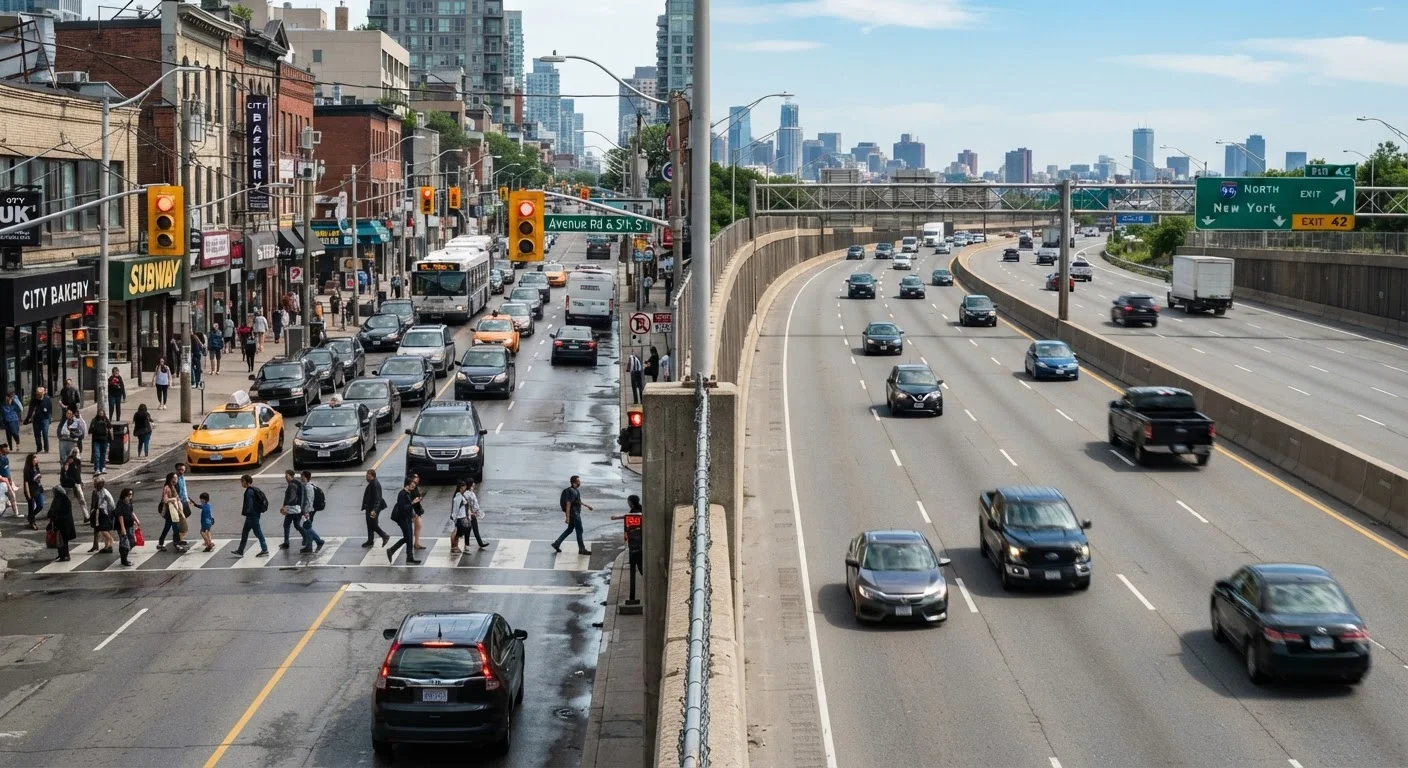
Key Takeaways
- Urban driving demands constant attention to unpredictable hazards like pedestrians, cyclists, and junctions.
- Motorway driving requires managing speed, distance, and lane discipline over sustained periods.
- Stopping distances increase dramatically with speed — understanding this is essential on motorways.
- New drivers often find motorways feel safer than cities, but complacency at high speed is a serious risk.
- Practising both environments deliberately, rather than by accident, accelerates genuine competence.
Start here
Why These Two Environments Need Separate Thinking
Next
Urban Driving: Managing Complexity at Lower Speed
Then
Motorway Driving: Managing Risk at Higher Speed
Compare
Key Technique Differences Side by Side
Apply it
Building Confidence in Both Environments
Why These Two Environments Need Separate Thinking
Most new drivers pass their test having practised primarily on local roads. That leaves two environments underexplored: dense urban streets and high-speed motorways. Each makes fundamentally different demands on your attention, decision-making, and vehicle control — which is why treating them as extensions of the same skill set is one of the most common early mistakes.
Urban driving is characterised by complexity: dozens of potential hazards compressed into a short stretch of road. Motorway driving replaces that complexity with sustained speed, where the consequences of a lapse in concentration escalate rapidly. Neither is inherently more forgiving than the other; they simply require a different mental model. For a broader look at what newly qualified drivers routinely underestimate, see what newly qualified drivers get wrong in their first year.
Velocity adaptation
A perceptual effect where sustained high-speed driving makes lower speeds feel slower than they are — commonly experienced when leaving a motorway onto a slip road with a lower speed limit.
Following distance
The gap maintained between your vehicle and the one ahead, measured in time rather than vehicle lengths. A minimum of two seconds is the standard guideline under dry conditions.
Lane discipline
Driving in the correct lane for your speed and direction, particularly on multi-lane roads. On UK motorways, the left lane is the default; other lanes are for overtaking only.
Hazard anticipation
Reading the road ahead to identify potential risks before they require an emergency response — a core skill in both urban and motorway driving.
Slip road
A short connecting road used to join or leave a motorway. Drivers use it to accelerate to motorway speed before merging, or to decelerate safely after exiting.
Urban Driving: Managing Complexity at Lower Speed
City and town driving involves constant, rapid hazard scanning. In a single mile you might encounter traffic signals, pedestrian crossings, cyclists filtering through traffic, buses pulling out, parked vehicles obscuring sightlines, and multiple junction types — including roundabouts, where right-of-way confusion is common even among experienced drivers. Our roundabout rules guide covers this in detail.
The key urban skill is anticipation: reading road conditions ahead rather than reacting only to what's immediately in front of you. Watch for pedestrians about to step off a kerb, not just those already crossing. Watch for the gap between parked vehicles where a cyclist may emerge. Lower speeds give you more time to respond — but urban environments can also produce sudden stops, so keep your following distance honest even at 20–30 mph.
Gear selection and smooth braking also matter more in town. Frequent acceleration and braking is normal; abrupt inputs cause instability and increase wear. Aim for progressive braking rather than late, sharp application.
Motorway Driving: Managing Risk at Higher Speed
Motorways are statistically among the safer road types per mile travelled in the UK — largely because traffic flows in one direction, pedestrians are excluded, and junctions are controlled. But the physics of high-speed driving are unforgiving. At 70 mph, your stopping distance in good conditions is approximately 96 metres (the length of roughly six average cars), compared to around 23 metres at 30 mph. Understanding this is fundamental — our article on stopping distances explains the underlying mechanics clearly.
The primary motorway discipline is space management. Maintain a minimum two-second gap to the vehicle ahead in dry conditions — four seconds in wet weather. Speed on a motorway can feel lower than it actually is after sustained driving, a phenomenon called velocity adaptation. Be alert to this when exiting: the slip road speed limit will feel slower than your body expects.
Lane discipline is equally important. Drive in the left lane unless overtaking, and return to it promptly after passing. Middle-lane hogging is not just a courtesy issue — it is an offence under UK traffic law. For a comparison of motorway and rural road techniques, see our guide on motorway driving vs. rural roads.
Key Technique Differences Side by Side
| Factor | Urban | Motorway |
|---|---|---|
| Hazard type | Pedestrians, cyclists, junctions, signals | Speed differentials, lane changes, tailgating |
| Following distance | 2+ seconds; more near junctions | 2 seconds minimum; 4 in wet conditions |
| Speed management | Frequent changes; keep speed low and controlled | Sustained; avoid sudden acceleration or braking |
| Lane use | Select lane early for turns and roundabouts | Stay left; centre/right for overtaking only |
| Mirror checks | Every 5–8 seconds; before every manoeuvre | Every 5–8 seconds; essential before lane changes |
| Fatigue risk | Low — constant engagement keeps you alert | Higher — monotony can cause attention to drift |
Building Confidence in Both Environments
Confidence comes from structured exposure, not just accumulated miles. For urban driving, focus deliberate practice sessions on junction types you find challenging, rather than avoiding them. Seek out busier routes with qualified supervision before driving them solo.
For motorways, consider a post-test motorway lesson with an approved driving instructor before your first solo journey. Joining and leaving at slip roads, managing speed on entry, and reading gantry signs are all skills that benefit from a guided first attempt. Applying defensive driving principles — anticipating hazards before they develop — is especially valuable on motorways, where the margin for error is smaller.
Finally, ensure your vehicle is roadworthy before tackling either environment. Tyres, lights, and fluid levels matter everywhere, but tyre condition and pressure become critical at motorway speeds. See our car maintenance guide for new drivers for practical upkeep habits to build from the start.