

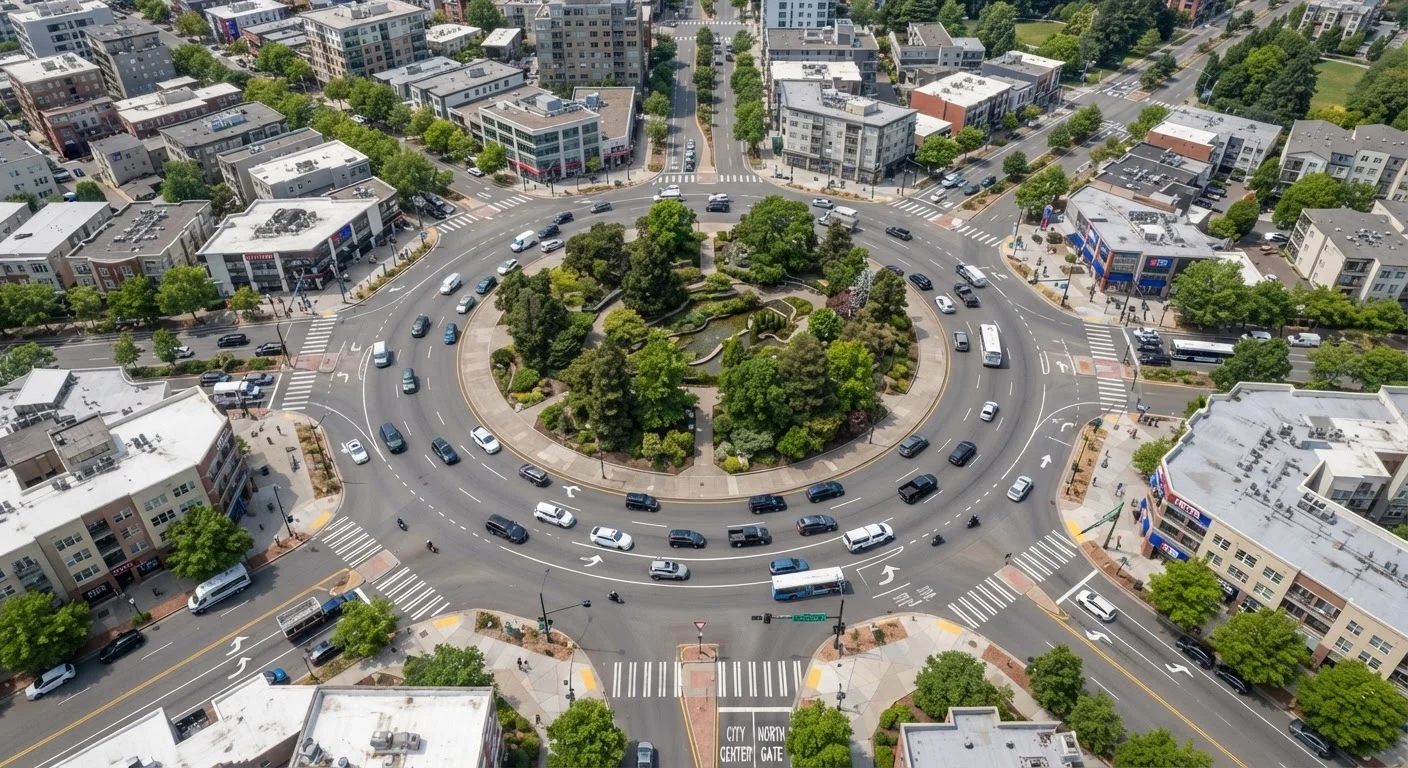
Key Takeaways
- Traffic already inside the roundabout has priority — yield before entering, not after.
- Lane choice on approach determines your exit; switching lanes inside the roundabout is dangerous.
- Signaling correctly on exit helps other drivers anticipate your movement and prevents collisions.
- Speed should be reduced on approach; entering too fast limits your ability to yield safely.
- Pedestrian crossings just outside roundabouts require the same attention as any other crossing.
Why Roundabouts Catch Drivers Off Guard
Roundabouts are expanding rapidly across the US, and research from the Insurance Institute for Highway Safety (IIHS) consistently finds they reduce fatal crashes at intersections significantly compared to traditional signalized junctions. Despite that safety record, many drivers find them disorienting — especially those trained primarily on stop signs and traffic lights.
The confusion usually isn't about the concept. Most drivers understand that traffic flows in a circle. The problems appear in the details: who goes first, which lane to use, when to signal, and how fast to go. These are precise, rule-governed behaviors — and getting them wrong creates dangerous situations for everyone in and around the roundabout.
If you're building broader driving confidence, the habits covered in what newly qualified drivers get wrong in their first year reinforce many of the same attention and awareness principles that apply here.
Yield to Circulating Traffic — Always
The fundamental rule of every roundabout in the US is that drivers entering must yield to vehicles already traveling inside the circle. Failure to yield at roundabout entries is among the most cited causes of roundabout crashes. No matter how slowly traffic inside is moving, do not enter until there is a safe gap. The yield sign at the entry point is a legal requirement, not a suggestion.
The Most Common Roundabout Mistakes — and How to Fix Them
The errors below account for the vast majority of roundabout conflicts and near-misses. Each one is correctable with a clear understanding of the rules and some deliberate practice.
Failing to yield to circulating traffic before entering the roundabout.
Why it happens: Many drivers treat roundabout entries like regular intersections, assuming they can merge at any speed if they see a small gap. Years of four-way stop and traffic-light conditioning makes the yield-on-entry rule feel counterintuitive.
Choosing the wrong lane on approach, then trying to correct inside the roundabout.
Why it happens: Drivers often decide which exit they need only after they've entered, leading to last-minute lane changes inside the circle — which is both illegal and dangerous.
Not signaling when exiting the roundabout.
Why it happens: Many drivers focus so heavily on navigating the circle that signaling gets forgotten. Some also mistakenly believe signals only matter on entry.
Entering the roundabout at too high a speed.
Why it happens: Drivers accustomed to high-speed intersections underestimate how quickly roundabout geometry tightens. Speed feels manageable until the curve demands a sharper turn than expected.
Ignoring pedestrians on the crosswalks just outside the roundabout.
Why it happens: Drivers exiting are focused on the traffic inside the circle rather than what lies immediately beyond the exit lane. The crosswalk is physically close to the exit but psychologically easy to miss.
For context on how road markings inside and approaching roundabouts interact with these rules, road markings and signs every driver should know is a useful companion reference.
Building Roundabout Confidence Over Time
Roundabout proficiency improves quickly with deliberate repetition. If a particular roundabout near you causes recurring uncertainty, approach it a few times during low-traffic periods — early morning or off-peak hours — to get a feel for the geometry and lane layout without pressure.
Multi-lane roundabouts introduce additional complexity: drivers must maintain lane discipline throughout the circle and be especially alert to vehicles alongside them. The same principles apply — yield on entry, commit to your lane, signal your exit — but the margin for error is tighter. Treating each roundabout pass as an active exercise rather than autopilot driving is the most reliable way to build clean habits.
Roundabouts are one of many environments where urban and suburban driving demands sharp situational awareness. Urban driving techniques covers the wider set of skills that make city and suburban roads easier to navigate confidently.
~40%
Reduction in injury crashes at roundabout conversions
According to the Insurance Institute for Highway Safety (IIHS), converting traditional intersections to roundabouts reduces injury crashes by roughly 40% on average.
~76%
Reduction in fatal crashes after roundabout conversion
IIHS data indicates fatal and incapacitating injury crashes drop by approximately 76% when signalized intersections are replaced with roundabouts.