

Key Takeaways
- Your eyes take up to 30 minutes to fully adapt to darkness after exposure to bright light.
- Headlights on low beam typically illuminate only 160–200 feet ahead — less stopping distance than highway speeds require.
- Fatigue peaks between midnight and 6 a.m., compounding every other night-driving risk.
- Glare from oncoming high beams can cause temporary blindness lasting several seconds.
- Pedestrians and cyclists are far harder to see at night, especially away from lit urban areas.
- Slowing down and increasing following distance are the two most effective adjustments you can make.
Night Driving Risk
Night driving refers to operating a vehicle after dark, when reduced natural light forces the visual system and the driver to work harder. The combination of limited visibility, slower pupil response, glare from oncoming headlights, and higher fatigue levels makes nighttime driving statistically more dangerous than daytime driving, even on familiar roads. Understanding what's changing physiologically — not just environmentally — helps drivers make better decisions.
The human eye's rod photoreceptors handle low-light vision but have lower acuity and no color sensitivity; the transition from cone-dominant (daylight) to rod-dominant (dark-adapted) vision takes up to 30 minutes and can be reset by a single bright light source.
What Your Eyes Are Actually Doing After Dark
Driving at night isn't simply daytime driving with the lights on. Your visual system shifts into a fundamentally different mode once ambient light drops. In daylight, your eyes rely on cone photoreceptors — concentrated in the center of your retina — for sharp, color-rich detail. At night, the visual load shifts toward rod photoreceptors, which are more sensitive to low light but offer lower resolution and no color discrimination.
This transition, called dark adaptation, takes 20 to 30 minutes to complete. During that window — say, when you first pull out of a brightly lit gas station or parking garage — your ability to detect low-contrast objects like pedestrians in dark clothing is meaningfully compromised. A single burst of bright light from oncoming high beams can partially reset this process, leaving you temporarily less adapted than before.
Depth perception also suffers at night. Without adequate contrast and visual anchors, judging the distance and speed of oncoming vehicles or objects in the road becomes harder. For drivers with uncorrected vision or early presbyopia (age-related difficulty with near focus), these challenges are amplified further.
Protect Your Dark Adaptation Before You Drive
Avoid staring at bright screens — phones, dashboards, or interior lights — for the 15 to 20 minutes before a night drive. When you do need to glance at a screen while driving, dim it as low as practical. Preserving dark adaptation is one of the simplest ways to extend your effective visual range in low-light conditions.
The Visibility Gap: How Far Your Headlights Actually Reach
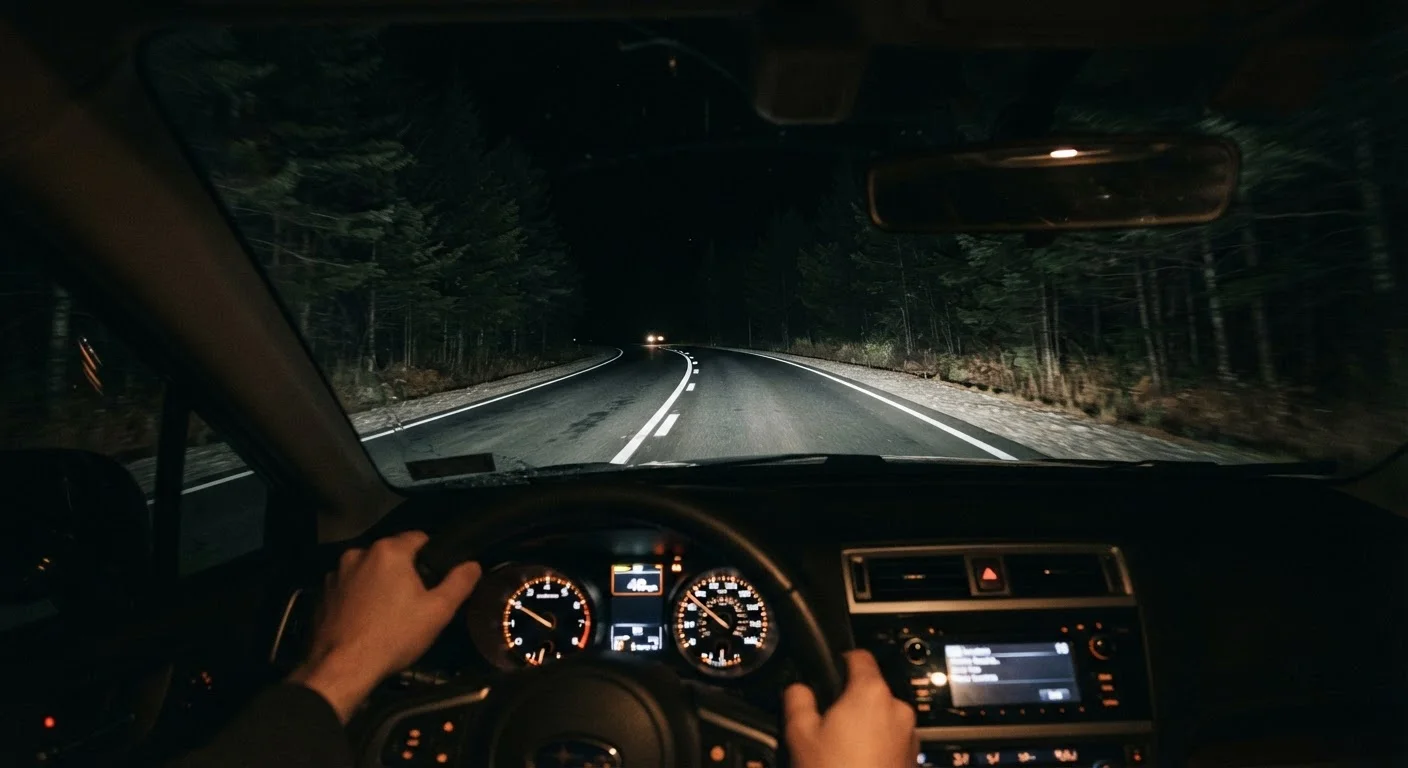
Standard low-beam headlights illuminate roughly 160 to 200 feet of road ahead. At 60 mph, your stopping distance — accounting for both reaction time and braking — can exceed 240 feet under ideal conditions. That gap between what you can see and what you need to stop safely is one of the most underappreciated risks in night driving, often called overdriving your headlights.
High beams extend visibility to around 350–500 feet, which is why using them on unlit roads when no other vehicles are nearby is a meaningful safety gain. The practical rule: switch to low beams within approximately 500 feet of an oncoming vehicle and when following within around 200 to 300 feet of the car ahead.
This visibility gap is why speed reduction at night matters even on roads you know well. A deer, debris, or a pedestrian entering the road may appear at the very edge of your headlight range, leaving little time to respond. This same logic applies in adverse weather — see our coverage of driving in rain, fog, and other challenging conditions for how visibility compounds across multiple factors.
~50%
Of traffic fatalities occur at night
Despite only about 25% of driving happening after dark, roughly half of all traffic fatalities in the U.S. occur at night, according to NHTSA data.
160–200 ft
Typical low-beam headlight range
Standard low-beam headlights illuminate approximately 160 to 200 feet of road — often less than the stopping distance needed at highway speeds.
3x higher
Nighttime pedestrian fatality risk
NHTSA data indicate that pedestrian fatality rates are roughly three times higher at night than during daylight hours, largely due to reduced detection distance.
Fatigue: The Invisible Multiplier
Fatigue doesn't just make you feel tired — it degrades the same cognitive functions that safe driving depends on: reaction time, hazard detection, decision speed, and lane tracking. What makes nighttime driving particularly dangerous is that your circadian rhythm — the internal body clock — suppresses alertness during the hours between roughly midnight and 6 a.m., regardless of how much sleep you had the night before.
During this window, the risk of microsleeps (brief, involuntary lapses in consciousness lasting 1–3 seconds) rises sharply. At 65 mph, a 2-second microsleep means traveling over 190 feet with no driver input. Because microsleeps often go unnoticed by the driver, there's rarely a warning before the consequences unfold.
The relationship between fatigue and impairment is well-documented. Research consistently shows that driving after 18 hours without sleep produces impairment comparable to a blood alcohol concentration at or near legal driving limits in many U.S. states. Our guide on recognising driver fatigue warning signs covers the specific physical cues to watch for and how to respond before a situation becomes dangerous.
Glare, Pedestrians, and Underrated Hazards
Glare from oncoming headlights — particularly modern LED or HID systems, which are brighter than older halogen units — can cause a temporary partial blindness that lingers for several seconds after the vehicle passes. On a road where you're covering ground quickly, those seconds represent significant distance traveled in reduced visual clarity.
Pedestrians and cyclists represent a disproportionate share of nighttime traffic fatalities. Studies from the National Highway Traffic Safety Administration (NHTSA) have consistently found that the majority of pedestrian fatalities occur in dark conditions. This isn't entirely about speed — it's largely about detection distance. A pedestrian in dark clothing on an unlit road may not be visible until they're within 50 to 100 feet of your vehicle, far inside the reaction buffer most drivers assume they have.
The same applies to rural and highway driving at night. Animals entering the road are harder to spot, and the absence of streetlighting removes the environmental context cues that help drivers anticipate curves, intersections, and merge points. Motorway and rural driving demand different approaches at any hour — but the contrast in risk sharpens considerably after dark.
Applying defensive driving principles — scanning further ahead, increasing following distance, and anticipating what may not yet be visible — is particularly valuable at night. These habits don't slow you down meaningfully; they give you the reaction time that darkness otherwise takes away.