

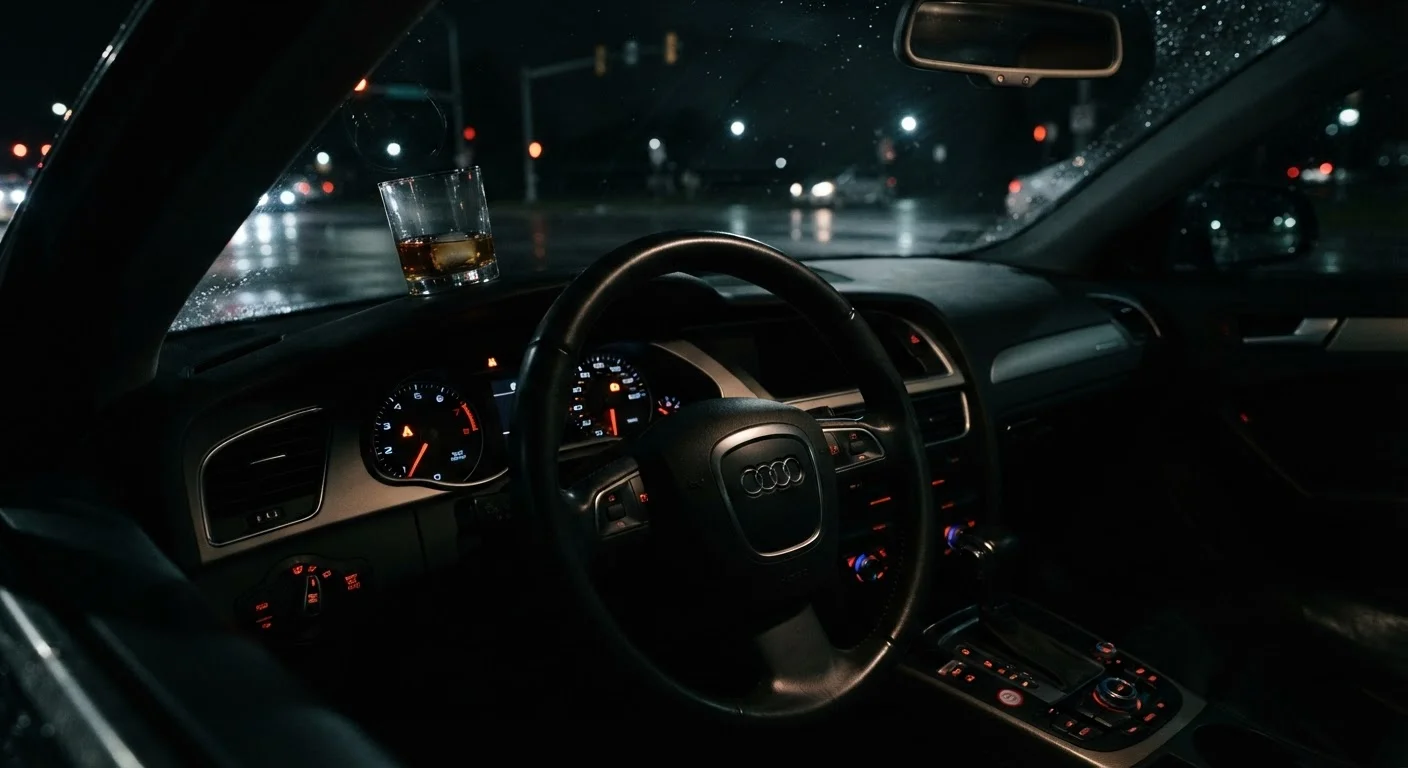
Key Takeaways
- The legal limit does not represent a safe threshold — impairment begins before you reach it.
- Food, coffee, water, and sleep cannot speed up alcohol metabolism in your body.
- Body weight, gender, and metabolism cause blood alcohol levels to vary widely between individuals.
- Morning-after driving is a genuine risk; alcohol consumed the night before may still be in your system.
- Feeling fine after drinking is not a reliable indicator of your actual driving ability.
Why the Legal Limit Is Misunderstood
Most drivers know there is a legal drink-drive limit. Far fewer understand what that number actually represents — or what it doesn't. The 0.08% BAC standard used in most US states is a legal threshold developed for enforcement purposes. It reflects a level at which impairment is considered severe enough to prosecute, not a level below which driving is medically considered safe.
This distinction matters in practice. Impairment to driving-relevant skills — divided attention, hazard detection, reaction speed — begins at far lower concentrations. Understanding the gap between "legal" and "safe" is the foundation of genuinely informed decision-making about alcohol and driving.
No Amount of Alcohol Guarantees Safe Driving
Research consistently shows that driving ability begins to degrade at blood alcohol concentrations below the legal limit in most US states. Reaction time, hazard perception, and divided attention are all measurably impaired before a driver feels drunk. The legal limit is a law enforcement threshold, not a safety certification.
For context on how other forms of impairment affect driving, see our article on mobile phone use at the wheel, which explores how cognitive distraction mirrors some of the effects of alcohol on driver performance.
The Myths That Put Drivers at Risk
Several persistent beliefs lead drivers to underestimate their impairment or overestimate their ability to counteract it. The myth-and-fact pairs below address the most common — and most consequential — of these misconceptions.
Myth
As long as I'm under the legal limit, I'm safe to drive.
Fact
The legal limit defines the boundary of criminal liability, not the boundary of impairment. Driving ability declines measurably at levels well below most state limits.
In the US, most states set the blood alcohol concentration (BAC) limit at 0.08% for adults. But research published in peer-reviewed journals, including studies cited by the National Highway Traffic Safety Administration (NHTSA), shows that reaction time and coordination begin to degrade at BAC levels as low as 0.02%. By 0.05%, tracking ability and emergency response are noticeably affected.
The legal limit exists because enforcement requires a measurable, enforceable standard — not because 0.08% is medically determined to be the point at which driving becomes dangerous. Treating the limit as a clearance level is a misreading of what the number means.
Myth
Coffee and a big meal will sober me up before I get in the car.
Fact
Neither food nor caffeine speeds up the rate at which your liver processes alcohol. Only time does.
Your liver eliminates alcohol at a fairly fixed rate — roughly 0.015% BAC per hour for most adults, though this varies by individual. Eating before or during drinking can slow the initial absorption of alcohol into the bloodstream, but once alcohol is absorbed, food has no meaningful effect on how quickly it leaves your system.
Caffeine can make you feel more alert, but it does not reduce your actual BAC or restore the cognitive functions that alcohol has impaired. A tired, drunk driver who drinks coffee becomes an alert, drunk driver — the impairment remains. For a related look at how fatigue interacts with driving ability, see our guide on driver fatigue.
Myth
I've had the same amount as my friend and they're fine, so I should be too.
Fact
Alcohol affects individuals differently based on body weight, gender, metabolic rate, food intake, and tolerance. There is no reliable way to compare your BAC to someone else's.
Blood alcohol concentration is influenced by a range of biological factors. Body water content, liver enzyme activity, and hormonal differences all affect how quickly alcohol is absorbed and metabolised. Two people of the same weight can have meaningfully different BAC readings after drinking the same amount.
Perceived tolerance also creates a false sense of security. A person who drinks regularly may feel less impaired at a given BAC, but their actual reaction time and hazard perception are still compromised. Feeling capable is not the same as being capable — a distinction that matters enormously when stopping distances are measured in fractions of a second.
Myth
I only had drinks last night, so I'm fine to drive this morning.
Fact
Alcohol consumed the previous evening can still be present in your bloodstream the following morning, particularly after heavy drinking.
If you consume a large amount of alcohol and go to sleep, your body continues processing it overnight — but may not finish before you wake up. Someone who finishes drinking at midnight after a significant session could still have a measurable and illegal BAC at 7 or 8 a.m.
Morning-after impairment is a documented and underappreciated road safety issue. Symptoms like dehydration and disrupted sleep compound the effects, meaning cognitive performance can be reduced even if BAC has returned to near zero. This risk is especially relevant for newer drivers, who may underestimate how long alcohol stays in the system.
Myth
I can tell when I've had too much — I know my own limits.
Fact
Alcohol impairs the very faculties used to judge impairment, making self-assessment after drinking inherently unreliable.
One of the more insidious effects of alcohol is that it reduces self-awareness alongside physical performance. Studies on cognitive impairment consistently show that people overestimate their competence as intoxication increases. Drivers who have been drinking tend to rate their own driving as better than it actually is.
This is compounded by the fact that alcohol suppresses the anxiety response that would ordinarily make risky behaviour feel uncomfortable. The result is a driver who feels confident precisely when they should feel cautious. Awareness of this dynamic is as important to road safety as understanding the law — much in the same way that night driving presents hazards that drivers routinely underestimate.
Impaired driving shares characteristics with other dangerous road behaviours that drivers tend to underestimate. Tailgating, distraction, and fatigue all reduce the margins available to a driver in an emergency — and alcohol compounds each of these risks.
What the Evidence Actually Supports
The clearest takeaway from the research is simple: there is no reliable self-test for fitness to drive after drinking. BAC calculations based on drinks consumed are approximations with wide margins of error. How you feel is an unreliable guide. The only approach that eliminates alcohol-related driving risk entirely is not driving after consuming alcohol.
For situations where a decision has to be made — a longer gathering, unfamiliar territory, or uncertainty about timing — the evidence-based approach is to plan transport in advance. Designating a non-drinking driver, using ride-share services, or arranging an overnight stay removes the decision from a moment when judgment is already compromised.
0.02%
BAC at which driving ability begins to decline
According to NHTSA data, tracking ability and response to emergency situations starts degrading at BAC levels as low as 0.02% — well below most legal limits.
~0.015%
BAC eliminated per hour by the liver
The liver processes alcohol at a broadly fixed rate for most adults; no food, drink, or activity meaningfully accelerates this process.
30%
Of traffic fatalities involving alcohol-impaired drivers
The NHTSA estimates that roughly 30% of all US traffic crash fatalities involve drivers with a BAC at or above 0.08%.
Drivers who want to understand the broader picture of how impairment affects physical performance behind the wheel may also find it useful to review the science behind stopping distances, which illustrates how even small increases in reaction time translate to significantly longer stopping distances at road speeds.