

Key Takeaways
- Digital tools offer real-time syncing, offline access, and easy itinerary sharing with travel companions.
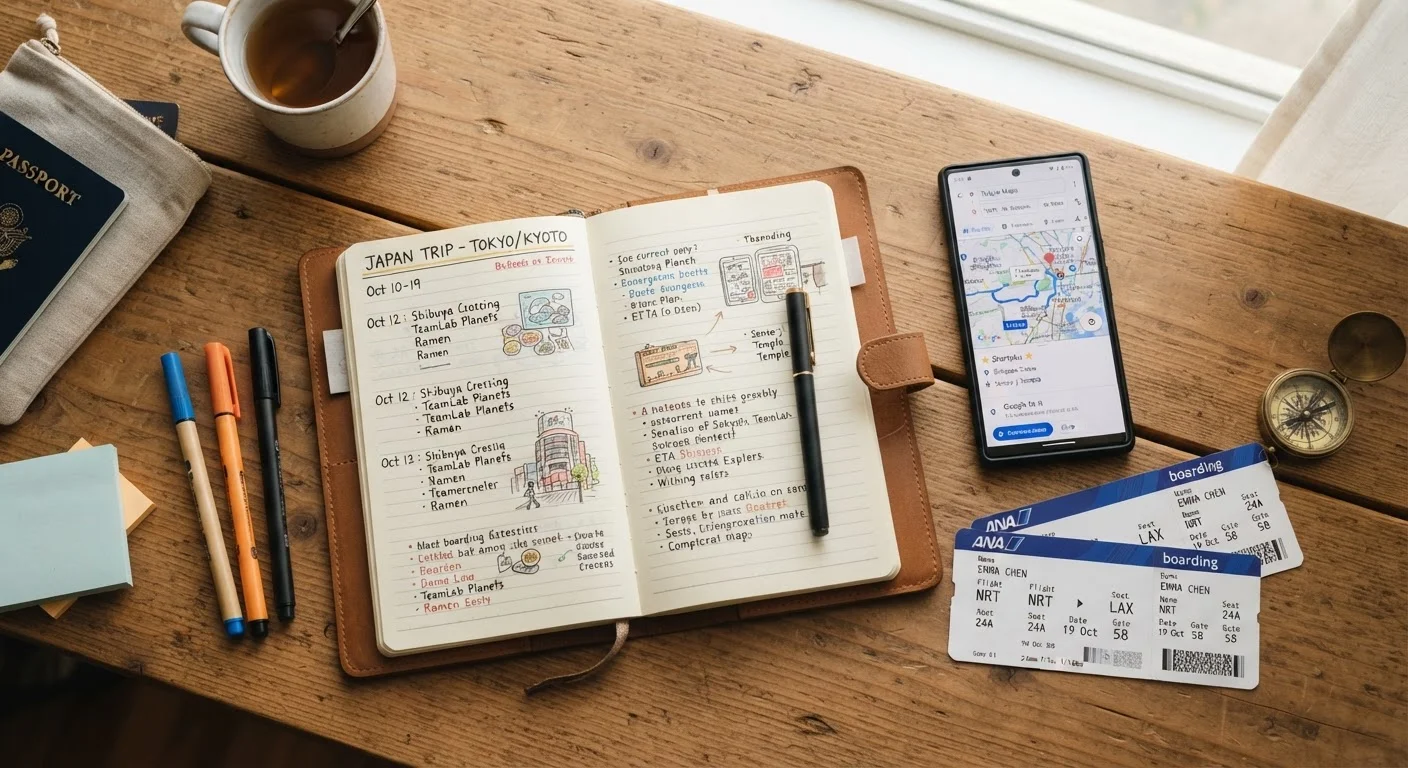
- Paper planning requires no battery, no connectivity, and appeals to visual thinkers who process information by writing.
- A hybrid approach — using digital tools for bookings and paper for daily schedules — works well for many travelers.
- Neither method is universally superior; the best system is the one you'll actually maintain throughout your trip.
- Consider destination infrastructure, trip length, and your own planning habits before committing to one approach.
Our Verdict
Digital tools hold a practical edge for managing complex, multi-destination trips where real-time updates, offline maps, and shared access matter. Paper planning remains genuinely valuable for short trips, low-connectivity destinations, or travelers who think and retain information better by writing. For most people, a hybrid setup — digital for confirmations and logistics, paper for the day-to-day flow — offers the most resilient combination.
| Best for | Recommended |
|---|---|
| Multi-destination or group trips requiring coordination | Digital tools |
| Remote destinations with limited connectivity | Paper planning |
| Short, simple weekend trips | Paper planning |
| Travelers who want flexibility without losing confirmations | Hybrid approach |
Why Your Planning Method Matters
The way you organise a trip shapes more than just your pre-departure stress levels — it affects how confidently you move through your destination, how quickly you recover when plans shift, and how much mental energy you spend on logistics versus actually enjoying the experience. Yet most travel advice skips over the mechanics of planning itself.
Whether you're working through a complete trip planning framework or building on years of travel experience, choosing a planning method that fits your habits is one of the more practical decisions you can make before departure. This comparison breaks down digital tools and paper planning honestly — including where each genuinely struggles.
The Case for Digital Tools
Digital planning tools — whether that means dedicated travel apps, cloud-based spreadsheets, or document-sharing platforms — offer tangible advantages for complex itineraries. Their core strength is consolidation: flight confirmations, accommodation addresses, restaurant reservations, and transit notes can all live in one searchable place.
Real-time updates are a meaningful benefit. If a flight time changes or a venue closes, digital documents can be edited from anywhere, and those changes immediately reach anyone the itinerary is shared with. For group travel or trips involving a co-planner back home, this matters. Offline map functionality, available through several navigation tools, is particularly useful in destinations where roaming data is unreliable or expensive.
The downsides are real, though. Devices run out of battery. Screens crack. Software updates sometimes reorganise interfaces mid-trip. There's also a cognitive load issue for some travelers: switching between apps, managing notifications, and troubleshooting sync errors can add friction at exactly the moments when you want simplicity. For a fuller look at how digital tracking compares to manual methods across other contexts, see this breakdown of manual versus app-based spending tracking.
| Digital Tools | Paper Planning | Hybrid Approach | |
|---|---|---|---|
| Battery / connectivity dependency | High — requires charge and often data | None — fully offline | Low — paper backup reduces risk |
| Ease of updating on the go | Instant edits, syncs automatically | Requires rewriting or crossing out | Digital portion updates; paper stays static |
| Sharing with travel companions | Easy — shared links or apps | Requires physical copy or photo | Digital portion shareable; paper stays personal |
| Resilience to device failure | Vulnerable without backup | Fully resilient | Strong — paper covers device failure |
| Best for trip complexity | Multi-destination, group travel | Short, simple itineraries | Any complexity with proper setup |
| Information retention (planning phase) | Convenient but passive | Writing aids memory retention | Combines both benefits |
The Case for Paper Planning
Paper planning has genuine, non-nostalgic advantages. A printed or handwritten itinerary doesn't need a charger, won't freeze, and is readable in direct sunlight. For destinations with limited Wi-Fi or unreliable power infrastructure, having key information on paper is a practical backup at minimum — and a complete system at best.
There's also a cognitive argument for writing by hand. Research in learning science suggests that writing information down by hand tends to improve retention compared to typing, which may explain why many experienced travelers still prefer a notebook for day-by-day schedules even when they use digital tools elsewhere. For visual thinkers, a hand-drawn map or color-coded daily layout can be easier to scan quickly than navigating nested app menus.
The limits are equally honest: paper can't update itself, sharing requires physical copies or photos, and a lost notebook represents a significant planning setback. Rain, spills, and wear are real risks depending on the environment. Paper works best when the itinerary is relatively stable and the trip is short enough that a complete rewrite wouldn't be catastrophic.
Hybrid Approaches: Taking What Works From Each
Many experienced travelers land on a hybrid setup without consciously deciding to do so — digital for anything that needs to be retrieved precisely (booking references, addresses, emergency contacts) and paper for the daily rhythm of a trip. This combination offers resilience: if your phone dies, your day's plan is still in your pocket; if your notebook gets soaked, your confirmation numbers are still in your email.
A practical hybrid framework might look like this:
- Digital: Store all booking confirmations, travel documents, and shared group logistics in a cloud folder or dedicated app with offline access enabled.
- Paper: Write a one-page daily schedule for each destination, including key addresses and a rough timeline, kept in a small notebook or folded in your bag.
- Printed backup: Print one copy of critical documents — accommodation addresses, emergency contacts, entry requirements — and keep it separate from your phone.
This approach pairs naturally with building a structured day-by-day itinerary that is realistic rather than overpacked. If you're also managing a tight travel budget, the end-to-end budget travel planning guide covers how to layer financial planning into whatever organisational system you use.
Choosing What Actually Fits You
The right planning method isn't the one with the most features — it's the one you'll use consistently from research through return. A few practical questions can help you decide:
- How long and complex is your trip? A weekend city break rarely needs more than a simple list. A three-country itinerary benefits from digital organisation.
- Who else is involved? Solo travelers have maximum flexibility; group trips benefit from shared digital access.
- What's the connectivity situation at your destination? Check this before assuming digital-first is the reliable option.
- How do you actually process information? If you've never voluntarily used a planning app before, a trip is unlikely to change that habit under pressure.
Planning packing with the same deliberateness as your itinerary system also pays off — see packing strategies that reduce stress on travel day for a practical approach. For travelers working within tight financial constraints, prioritising where to allocate a limited travel budget is a useful companion to whatever planning format you choose.