

Key Takeaways
- New Orleans has six distinct neighbourhoods with vastly different atmospheres, costs, and visitor experiences.
- The city is genuinely livable and locals-focused beyond the French Quarter tourist corridor.
- Food, music, and architecture are the city's real draws — not just nightlife and Mardi Gras.
- Heat, humidity, and flooding risk are real logistical considerations for trip planning.
- Costs vary significantly depending on where you eat, stay, and what season you visit.
What the Neighbourhoods Actually Feel Like
New Orleans is not a monolithic city — it's a loose collection of districts with distinct personalities, walkability profiles, and visitor suitability. Understanding this geography is the most practical thing a first-time visitor can do before booking.
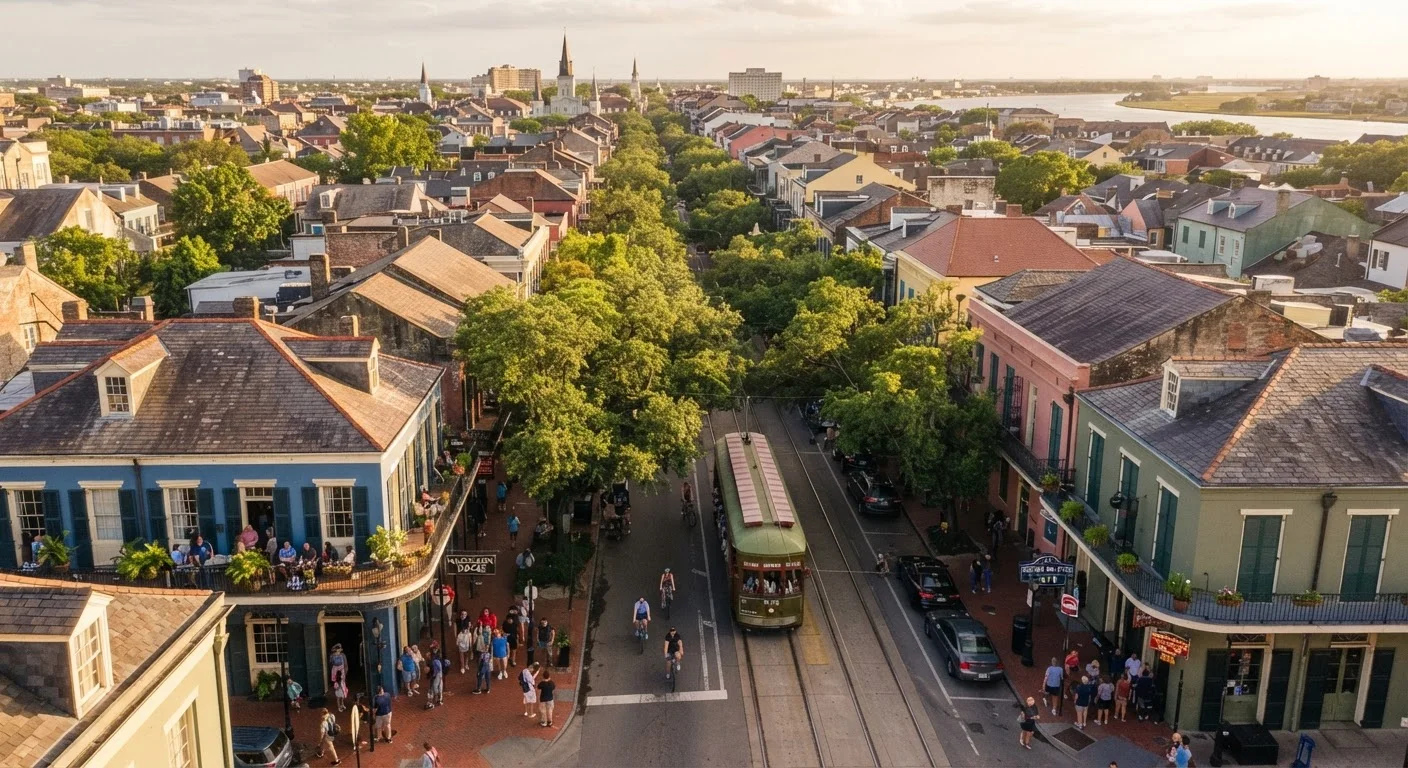
The French Quarter is historic, atmospheric in places, and genuinely worth exploring — but its southern end near Bourbon Street operates as a commercial entertainment zone with all the noise and pricing that entails. The Garden District offers grand antebellum architecture and a calmer atmosphere, best explored on foot. The Marigny and Bywater, just downriver from the Quarter, are where much of the city's working creative culture actually lives — smaller music venues, independent restaurants, and a younger local demographic. Tremé, one of the oldest African American neighbourhoods in the country, is culturally essential context for understanding New Orleans' music history.
If you're thinking about how neighbourhood concentration affects a destination's authenticity, see our look at over-touristed destinations for a broader framework.
Myth
New Orleans is basically one long party street — Bourbon Street is the city.
Fact
Bourbon Street is a single commercial block within a much larger, historically layered city. Most of New Orleans' character lives elsewhere.
Bourbon Street is loud, crowded, and almost entirely oriented toward a transient party economy. It tells you almost nothing about the city's actual culture. The French Quarter itself contains quieter, residential blocks and serious culinary institutions. Move outward to the Garden District, Marigny, Bywater, or Tremé, and you'll encounter a New Orleans defined by 19th-century architecture, a deeply rooted music scene, and neighbourhood life that continues largely undisturbed by tourism.
Myth
New Orleans is only worth visiting during Mardi Gras.
Fact
Mardi Gras is one of dozens of annual festivals, and the city offers compelling experiences year-round outside of its peak celebration season.
The weeks surrounding Mardi Gras bring the city's largest crowds, highest accommodation prices, and logistical complexity. Jazz Fest in late April and early May draws serious music fans. The city's food scene, architecture, and neighbourhood atmosphere don't operate on a festival calendar — they're persistent and accessible any month. October and November offer more manageable temperatures and thinner crowds without sacrificing character.
Myth
The food scene is all fried food, po'boys, and beignets aimed at tourists.
Fact
New Orleans has one of the most deeply rooted regional culinary traditions in the United States, spanning Creole, Cajun, and Vietnamese influences.
The city's food culture reflects centuries of French, Spanish, African, and Caribbean influence, which is why dishes like gumbo, red beans and rice, and crawfish étouffée taste meaningfully different here than anywhere else. Beyond Creole classics, New Orleans has a notable Vietnamese community — particularly in the eastern suburbs — whose restaurants are well-regarded nationally. Eating well does not require expensive tourist restaurants; neighbourhood spots and corner lunch counters often deliver the most authentic and affordable meals.
Myth
New Orleans is too expensive to visit on a moderate budget.
Fact
Costs vary widely. Accommodation and dining in tourist corridors are expensive, but genuine value exists throughout the city.
Staying in the French Quarter during peak season is genuinely costly. But neighbourhoods like Mid-City or the Marigny offer more affordable lodging options, and the city's food scene has plentiful lunch counter, food truck, and neighbourhood restaurant options that don't carry tourist markups. Many of the best live music venues charge minimal or no cover. The biggest budget risk is concentrating entirely in the quarter, where everything — meals, drinks, parking — is priced for high-volume tourism.
Myth
The city hasn't really recovered since Hurricane Katrina.
Fact
New Orleans has undergone substantial rebuilding, though recovery has been uneven across neighbourhoods and income levels.
Nearly two decades after Katrina, most visitor-facing areas of the city are fully operational and in many cases renovated. However, it's accurate to say recovery has not been uniform — lower-income and geographically vulnerable neighbourhoods faced longer rebuilding timelines and some areas still show visible change. Acknowledging this complexity is more honest than either overstating damage or presenting the city as uniformly recovered. The city's resilience and cultural continuity are real; so is the ongoing work.
Common Misconceptions That Shape (and Distort) Trip Expectations
Most visitors arrive with a version of New Orleans assembled from film, television, and social media — which tends to compress the city into its most visually dramatic elements. The myths below represent the gaps between that image and the actual experience of being in the city.
Safety Varies Significantly by Area
New Orleans has neighbourhoods with higher crime rates than the US average, and that reality shouldn't be glossed over. The French Quarter and main tourist corridors see heavy foot traffic and visible policing, but conditions shift quickly as you move off the main streets. Consult current travel advisories and local guidance before exploring unfamiliar areas, especially at night.
Understanding these realities doesn't diminish the trip — it makes planning more effective and the experience more genuine. Visitors who spend time outside the French Quarter consistently report a richer, more textured experience than those who don't. For a comparable exercise applied to another US city, our neighbourhood breakdown of New York City uses the same approach.
Summer Heat Is a Serious Factor
New Orleans summers bring heat indices regularly exceeding 105°F alongside near-constant humidity. Outdoor walking itineraries become genuinely difficult from late June through August. Visitors with heat sensitivity, young children, or packed schedules should strongly consider spring or fall travel instead. Always factor hydration and shade into any warm-weather plan.