

Key Takeaways
- Cash envelopes create a physical spending limit that is impossible to accidentally exceed within a category.
- Digital trackers aggregate bank and card data automatically, reducing manual logging effort significantly.
- The envelope method struggles in a cashless economy; most transactions today are card or app-based.
- Digital tools can be ignored or dismissed; they require consistent engagement to be effective.
- Neither method inherently produces better financial outcomes — consistency of use is the deciding factor.
- Hybrid approaches combining envelope logic with digital categories work well for many households.
Option A
Cash Envelope System
The tactile, zero-ambiguity method built around physical cash.
Best for: People who overspend in specific categories and want a hard, physical stop when money runs out.
Option B
Digital Spending Trackers
The flexible, data-rich approach built for modern cashless life.
Best for: People who want real-time visibility across all accounts without handling physical cash.
If you regularly overspend on groceries, dining, or entertainment
Cash Envelope System
Physical cash creates an undeniable hard stop. When the envelope is empty, spending in that category stops — no notifications to dismiss, no willpower required.
If most of your spending is digital or card-based
Digital Spending Trackers
Forcing cash withdrawals for a card-dominant lifestyle adds friction without a proportional benefit. A tracker maps naturally onto how you already spend.
If you want a big-picture view across savings, debt, and spending simultaneously
Digital Spending Trackers
Most tracking apps consolidate multiple accounts into a single dashboard, giving you context that physical envelopes cannot provide on their own.
If you're new to budgeting and want an immediate, tactile learning tool
Cash Envelope System
Physically separating money into categories builds category-awareness fast. It makes abstract budget numbers concrete without any app setup or learning curve.
If you want to combine structure with convenience
Digital Spending Trackers
Many apps let you replicate envelope logic digitally using named budget categories, offering the same conceptual discipline with far less logistical overhead.
How Each Method Actually Works
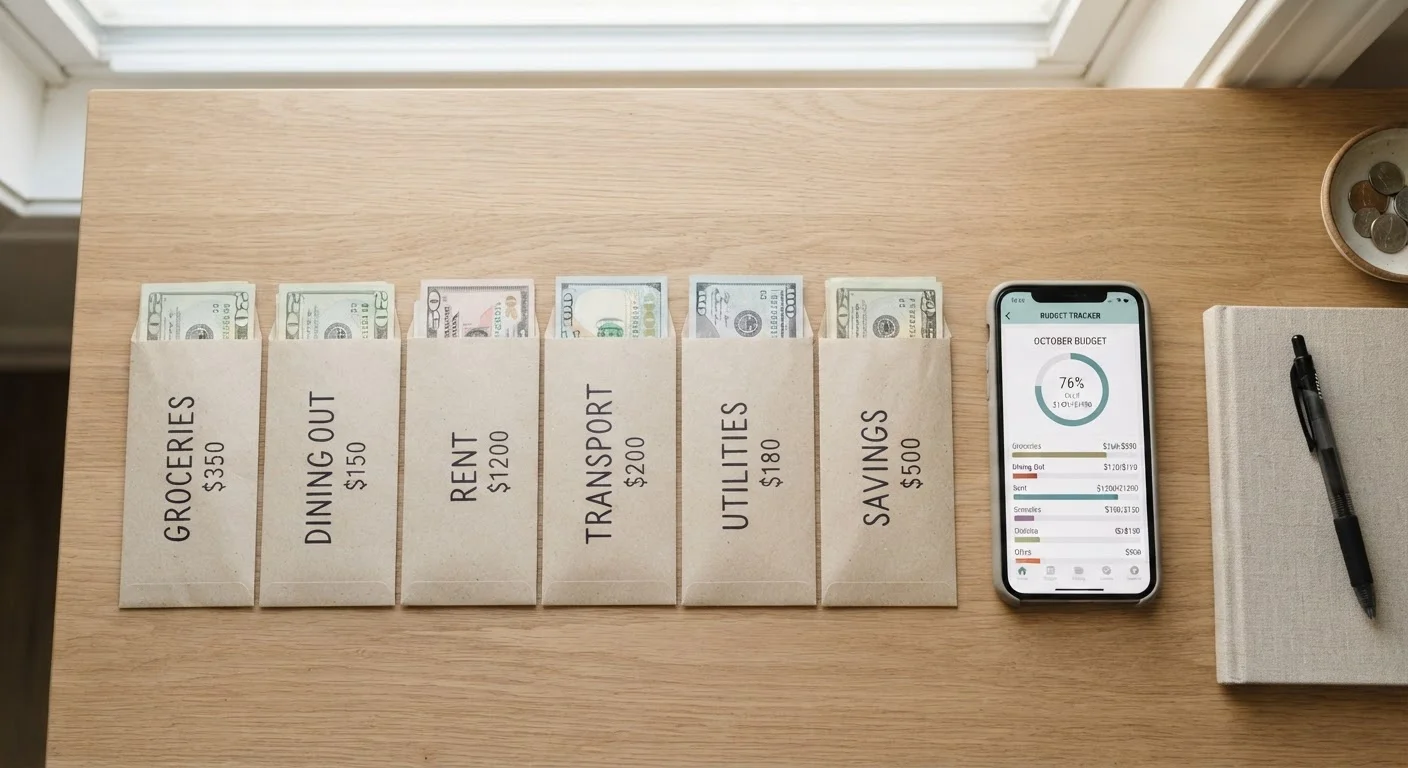
The cash envelope system is straightforward: at the start of each pay period, you withdraw cash and physically divide it into labeled envelopes — one per spending category. Groceries get $300, dining out gets $150, and so on. When an envelope is empty, that category is done for the period. No exceptions, no transfers.
Digital spending trackers work differently. Apps in this category — ranging from simple spreadsheet-style tools to platforms that connect directly to your bank accounts — record transactions automatically or let you log them manually. They sort spending into categories, show running totals, and alert you when you're approaching a limit. The comparison between manual and automated tracking is worth understanding before you pick a tool, since the experience varies considerably between the two approaches.
Both methods are rooted in the same behavioral principle: awareness of where money goes reduces unintentional overspending. The delivery mechanism is what differs.
Where Each Method Has the Advantage
The envelope system's defining strength is its finality. Physical cash triggers a different psychological response than swiping a card. Research in behavioral economics has consistently noted that spending cash feels more tangible than card-based transactions, which can make it easier to stay within limits. There is also no setup beyond envelopes and a pen — no syncing, no subscriptions, no data privacy considerations.
Digital trackers have a different kind of power: visibility at scale. A well-configured app shows your full financial picture — checking, savings, credit cards, even loans — in one place. Patterns that would take hours to spot manually (a slow creep in subscription costs, seasonal spikes in utility spending) surface quickly. For anyone managing a household budget across multiple accounts or income streams, that aggregation is genuinely difficult to replicate with envelopes.
| Criterion | Cash Envelope System | Digital Spending Trackers |
|---|---|---|
| Setup effort | Low — envelopes and cash | Moderate — account linking, app configuration |
| Works for cashless spending | Poorly — requires workarounds | Well — built for card and digital payments |
| Spending hard stop | Automatic — empty envelope stops you | Alert-based — relies on user response |
| Multi-account visibility | None — cash only | Strong — aggregates all linked accounts |
| Privacy / data exposure | None — fully offline | Varies — depends on app's data practices |
| Handling irregular expenses | Rigid — requires manual reallocation | Flexible — categories can be adjusted easily |
| Learning curve | Minimal — intuitive immediately | Moderate — features take time to learn |
The envelope system's weakness in a cashless economy is real. Many landlords, service providers, and online vendors don't accept cash, which means envelope users must mentally track a parallel system for non-cash expenses. Our article on envelope budgeting in a cashless world walks through practical adaptations if you want to preserve the method's discipline while navigating digital payments.
The Behavioral Reality of Both Approaches
Neither system is foolproof against the core problem: people stop using them. Envelope users sometimes raid other envelopes or stop restocking them mid-month. Digital tracker users receive push notifications, feel satisfied that spending is being logged, and gradually stop checking the summaries that would actually prompt a behavior change.
Consistency is the variable that determines outcomes, not the tool. That said, the two methods fail in different ways. The envelope system tends to break down during irregular expenses — a car repair, a medical bill — that don't fit neatly into pre-set categories. Digital trackers are more flexible here but introduce what could be called notification fatigue: when every alert looks the same, none feel urgent.
If you're uncertain which suits you, the case for and against strict budget categories is a useful starting point. Rigid categories work well for envelopes; flexible ones tend to suit digital tools better. Once you have a method in place, pairing it with a weekly money check-in routine significantly improves the chances you'll actually catch problems before they compound.
This article is for general informational purposes only and does not constitute personalized financial advice. Consult a qualified financial professional for guidance specific to your situation.