

Key Takeaways
- Thermal mass absorbs heat when temperatures rise and releases it slowly when temperatures drop.
- It works best in climates with significant day-to-night temperature swings.
- Dense materials like concrete, brick, and stone are common thermal mass elements.
- Thermal mass must be paired with good insulation to perform effectively.
- Proper placement — particularly near south-facing windows — determines whether thermal mass helps or hurts comfort.
- It is a passive strategy that reduces mechanical heating and cooling loads over time.
Thermal Mass
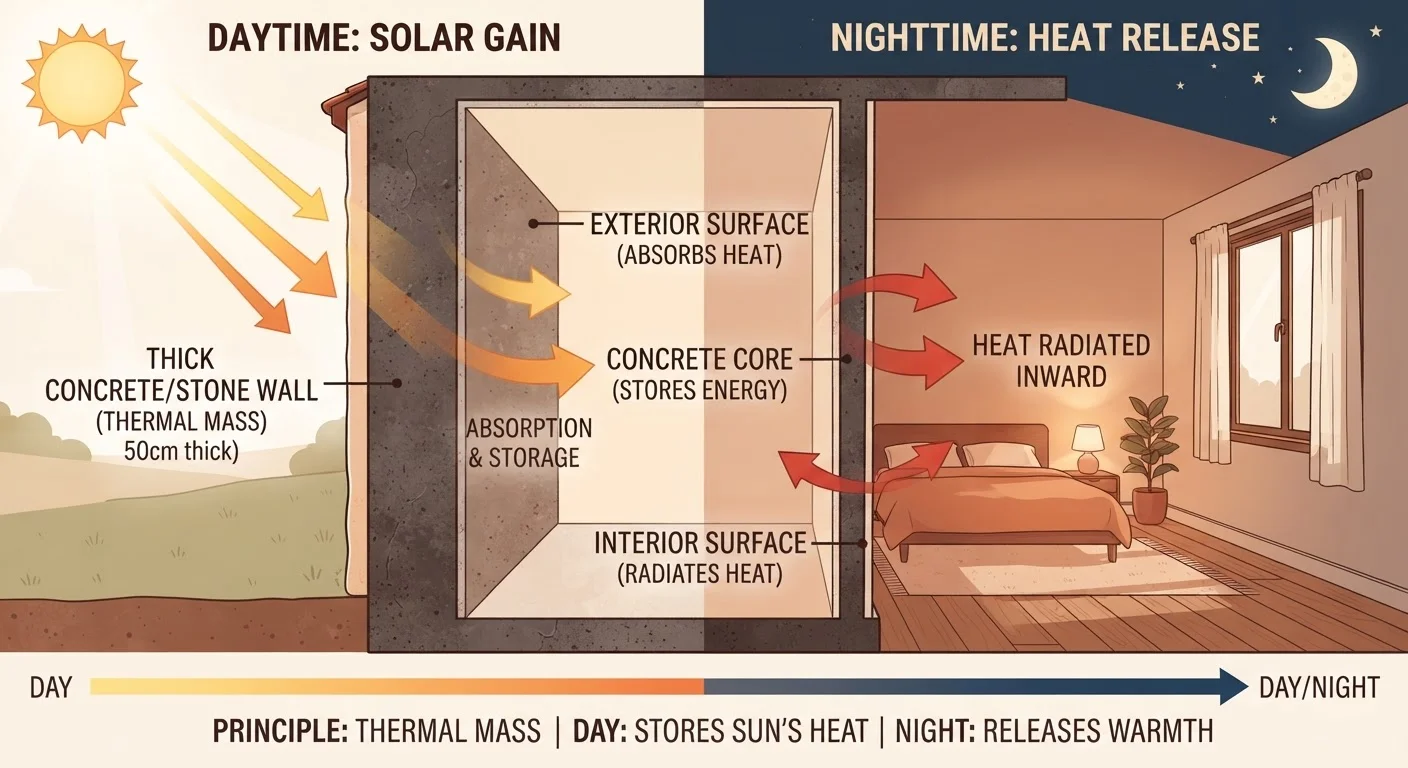
Thermal mass refers to a material's ability to absorb, store, and slowly release heat. Dense materials like concrete, brick, stone, and adobe absorb warmth when surrounding temperatures rise, then release that stored heat gradually as temperatures fall. This natural buffering effect helps keep indoor spaces more stable without relying on heating or cooling systems.
Thermal mass is measured by a material's volumetric heat capacity — the product of its density and specific heat. High values indicate greater heat storage per unit volume, making materials like concrete and rammed earth particularly effective.
The Basic Principle: Absorb Now, Release Later
Think of thermal mass as a slow-moving battery for heat. During the day, when outdoor temperatures — or direct sunlight — raise the temperature in a room, a dense wall or floor absorbs that energy rather than letting it immediately warm the air. As the day cools and indoor temperatures drop below the surface temperature of the material, the stored heat is released back into the space.
This time delay is the key feature. Instead of a sharp spike in afternoon heat followed by a cold night, the interior temperature stays relatively flat. That's useful comfort-wise, and it can reduce how hard your heating or cooling system has to work.
The same principle applies in winter when solar gain through south-facing windows warms a masonry floor during daylight hours. That floor then radiates heat back into the room through the evening — acting like passive radiant heating without any fuel cost.
Where Thermal Mass Works Best — and Where It Falls Short
Thermal mass is most effective in climates with large diurnal temperature swings — meaning significant differences between daytime highs and nighttime lows. Arid regions like the American Southwest are classic examples: days can be hot while nights drop sharply, and thermal mass directly exploits that pattern.
In hot, humid climates with warm nights, the stored heat has nowhere to go — the material never fully discharges, and indoor spaces can stay uncomfortably warm around the clock. In those conditions, thermal mass provides limited benefit unless paired with deliberate night ventilation strategies that flush warm air out before morning.
In cold climates, thermal mass can help — but placement and insulation matter enormously. A thick uninsulated concrete exterior wall will conduct heat outward in winter just as readily as it absorbs solar energy. The effective configuration places insulation on the outside of the thermal mass, allowing the mass to buffer interior temperatures without acting as a thermal bridge to the cold exterior. See our guide on insulating an older home for more on how insulation and mass interact in practice.
Night Flushing Maximises Thermal Mass Performance
In hot climates, open windows and vents during cooler nighttime hours to allow stored heat to escape from dense surfaces before morning. This 'resets' the thermal mass so it is ready to absorb the next day's heat. Without this step, mass materials can carry residual heat forward and make daytime temperatures worse.
Thermal Mass vs. Insulation: Two Different Jobs
A common point of confusion is treating thermal mass and insulation as interchangeable. They are not — they serve fundamentally different functions.
- Insulation resists heat flow. It slows the rate at which heat moves through a wall or ceiling, keeping conditioned air in and outdoor temperatures out.
- Thermal mass stores heat and shifts the timing of when that heat is released into the space.
A thick stone wall with no insulation can store a lot of heat — but it will also lose it readily to the outdoors. A well-insulated lightweight wall resists heat loss efficiently but offers little storage capacity. The best passive building designs typically combine both: dense materials on the interior to store and moderate temperature swings, and continuous insulation on the exterior to prevent that stored energy from escaping. For a closer look at related tradeoffs, insulation vs. draught-proofing explains how different heat-loss strategies compare.
~8 hrs
Typical heat release delay for a 12-inch concrete wall
A 12-inch (300mm) concrete wall can shift peak heat release by roughly 8 hours relative to peak solar exposure, according to building science reference data on thermal lag.
880 J/kg·K
Specific heat capacity of concrete
Concrete's specific heat capacity is approximately 880 joules per kilogram per kelvin — moderate on its own, but its high density gives it strong overall heat storage per unit volume.
30–50%
Potential reduction in peak cooling load
Research on passive solar and thermal mass design suggests well-configured mass elements can reduce peak mechanical cooling demand by 30–50% in suitable climates, though results vary significantly by design and location.
Practical Implications for Your Home
If you are renovating or building, thermal mass decisions are worth considering early — retrofitting dense materials into an existing home is difficult and expensive. That said, some targeted applications are feasible:
- Tiled or slate floors over a concrete subfloor in sun-exposed rooms can provide measurable temperature buffering.
- Exposed interior brick or stone walls, particularly on south- or west-facing interior surfaces, can absorb afternoon solar gain and re-radiate it in the evening.
- Concrete countertops or hearths contribute at a smaller scale in regularly occupied rooms.
Position matters as much as material. Thermal mass placed where it receives direct sun — behind south-facing glazing in the Northern Hemisphere — will perform far better than the same material in a shaded interior. Unshaded west-facing mass can cause overheating in summer rather than moderating it.
Thermal mass also works differently depending on how a home is heated. In a zoned heating setup, rooms with significant thermal mass may need less active heat input during the evening — but also respond more slowly when you want to raise the temperature quickly after a cold night.
This article is for general informational purposes only. Home design decisions, particularly those involving structural materials or insulation systems, should be evaluated by a qualified architect, builder, or energy consultant familiar with your local climate and building codes.