

Key Takeaways
- Debt consolidation uses a new loan or credit product to pay off existing debts; you then repay the single new account.
- A debt management plan (DMP) is a structured program run by a nonprofit credit counseling agency — no new loan is taken out.
- Consolidation typically requires good-to-fair credit; DMPs are often accessible to people whose credit has already suffered.
- Both approaches cover unsecured debts such as credit cards — neither works for secured debts like mortgages.
- The right choice depends on your credit profile, income stability, and how much discipline the structure requires.
Our Verdict
Debt consolidation suits those with stable income and sufficient credit to qualify for a meaningfully lower interest rate. A debt management plan is typically the stronger fit when credit access is limited, multiple creditors need negotiating, or a structured external framework helps maintain accountability. Neither approach is universally superior — the deciding factor is your specific financial profile.
| Best for | Recommended |
|---|---|
| Those with fair-to-good credit and steady income | Debt Consolidation |
| Those with damaged credit or high interest rates needing negotiated relief | Debt Management Plan |
| Those who prefer self-directed repayment with minimal ongoing fees | Debt Consolidation |
| Those who benefit from structured accountability and creditor concessions | Debt Management Plan |
How Debt Consolidation Works
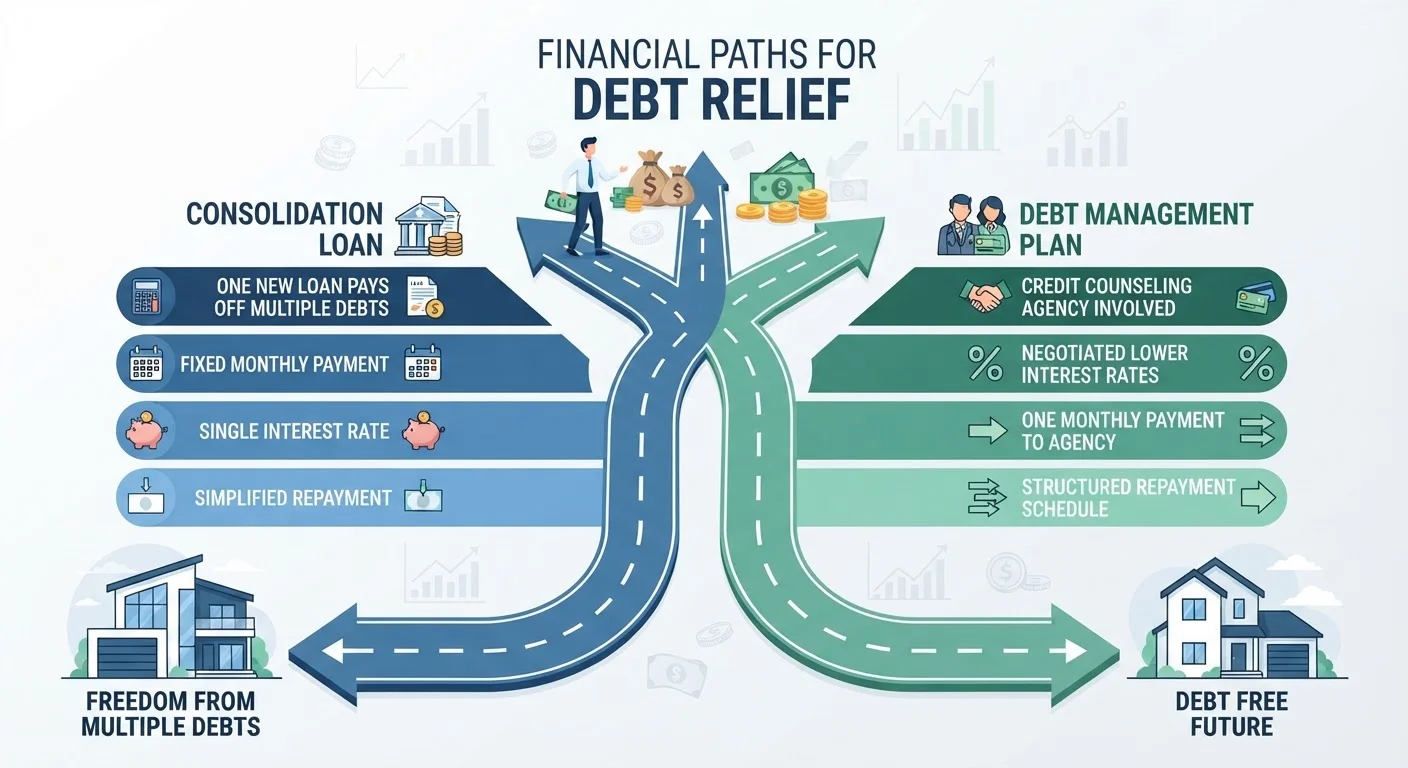
Debt consolidation means taking out a new financial product — typically a personal loan or a balance-transfer credit card — and using the proceeds to pay off multiple existing debts. You then make a single monthly payment toward that new account, ideally at a lower interest rate than your previous balances carried.
The core appeal is mathematical simplicity: fewer accounts, one due date, and potentially significant interest savings if you qualify for a rate substantially below what you were paying. For example, rolling several credit card balances charging 20–25% APR into a personal loan at 12% can materially reduce total repayment cost over time.
The catch is qualification. Lenders extend competitive rates to borrowers with solid credit scores and demonstrated repayment history. If your credit has slipped — which often happens when debt becomes unmanageable — the rate you're offered may not improve your situation meaningfully. It's worth understanding how secured and unsecured debt differ before pursuing this route, since consolidation products typically apply only to unsecured obligations.
| Debt Consolidation | Debt Management Plan | |
|---|---|---|
| Mechanism | New loan or credit product | Agency-negotiated repayment program |
| Credit requirement | Fair-to-good credit typically needed | No credit threshold; open to damaged credit |
| Interest rate relief | Depends on rate you qualify for | Creditors may reduce rates as part of plan |
| Who manages payments | You, directly to lender | Nonprofit agency distributes to creditors |
| Typical timeline | 2–7 years depending on loan term | 3–5 years |
| Ongoing fees | Loan origination fee; no monthly agency fee | Monthly agency fee (~$25–$75) |
| Credit card use during program | Generally unrestricted | Accounts typically closed or frozen |
| Debt types covered | Unsecured debts (varies by product) | Unsecured debts only |
How Debt Management Plans Work
A debt management plan (DMP) is not a loan. Instead, a nonprofit credit counseling agency works as an intermediary between you and your unsecured creditors. After reviewing your income and debts, the agency negotiates with creditors — often securing reduced interest rates or waived fees — then sets up a single monthly payment that you make to the agency, which distributes funds to creditors on your behalf.
DMPs typically run three to five years. Crucially, you don't need good credit to enroll — the agency's leverage comes from its existing relationships with creditors and the structure of the program itself, not your creditworthiness. Most agencies charge a modest monthly fee, generally capped in the range of $25–$75 depending on the state.
Because your credit cards are usually closed or frozen during a DMP, this approach requires a real commitment to living within a budget for the duration. For a detailed walkthrough of what enrollment and completion look like, see this end-to-end guide to DMPs. Pairing a DMP with stronger budgeting habits significantly improves completion rates.
Key Differences at a Glance
The structural differences between these two approaches drive very different real-world experiences. Consolidation keeps you in direct control — you own the new loan and manage it independently. A DMP places a third party in a coordinating role, which adds accountability but also dependency on the agency's processes.
Credit impact also diverges. Applying for a consolidation loan triggers a hard inquiry and opens a new account, which can temporarily lower your score. A DMP, by contrast, typically results in creditors noting "enrolled in credit counseling" on your report, which is not inherently damaging — though closed accounts and reduced available credit can affect your score during the program.
If you're weighing other repayment strategies alongside these two, the debt avalanche vs. debt snowball comparison covers self-directed payoff methods that require no third party or new credit product.
Risks and Limitations to Know
Neither approach is risk-free. With debt consolidation, the most common pitfall is accumulating new balances on the paid-off accounts — leaving you with both the consolidation loan and fresh debt. This outcome is common enough that financial counselors frequently flag it as the primary failure mode for otherwise successful consolidations.
DMPs carry their own limitations. They cover only unsecured debts, so student loans, auto loans, and mortgages fall outside the program. Missing a payment can cause creditors to withdraw their concessions, revert to original rates, and potentially exit the arrangement. And not all credit counseling agencies operate with the same standards — look for agencies accredited by the National Foundation for Credit Counseling (NFCC) or the Financial Counseling Association of America (FCAA).
Debt settlement — a third category sometimes confused with both — works differently still and carries more severe credit and tax consequences. The trade-offs of debt settlement are worth understanding if you're considering all options.
This article is for general informational and educational purposes only and does not constitute personalized financial or legal advice. Consult a qualified financial professional regarding your specific circumstances.