

Key Takeaways
- Secured debt is backed by a specific asset; defaulting can result in that asset being repossessed or foreclosed.
- Unsecured debt has no collateral, but lenders can pursue legal judgments and wage garnishment after default.
- Secured debts typically carry lower interest rates because the lender's risk is offset by the collateral.
- Knowing which debts are secured helps you prioritize payments and assess the real cost of falling behind.
- Both debt types affect your credit score, though the consequences of default differ significantly.
- Your repayment strategy should account for debt type before deciding which balances to tackle first.
Option A
Secured Debt
The asset-backed obligation with higher stakes for non-payment.
Best for: Borrowers who qualify for lower interest rates by pledging collateral such as a home or vehicle.
Option B
Unsecured Debt
The collateral-free obligation with fewer immediate physical consequences.
Best for: Borrowers who need flexible credit access without pledging a specific asset.
If you're deciding which debts to prioritize when cash is tight
Secured Debt
Missing payments on secured debt can trigger repossession or foreclosure, making these obligations the higher-stakes priority in most hardship scenarios.
If you're evaluating the total cost of borrowing over time
Secured Debt
Secured debt typically carries lower interest rates, which means less total interest paid over the life of the loan for large, long-term obligations.
If you're looking for flexibility without risking a major asset
Unsecured Debt
Unsecured credit lines and personal loans don't tie a specific asset to the balance, giving borrowers more flexibility — though often at a higher cost.
If you're exploring debt consolidation or restructuring options
Unsecured Debt
Unsecured balances are generally easier to negotiate, consolidate, or include in a debt management plan without risking loss of property.
What Makes a Debt Secured or Unsecured
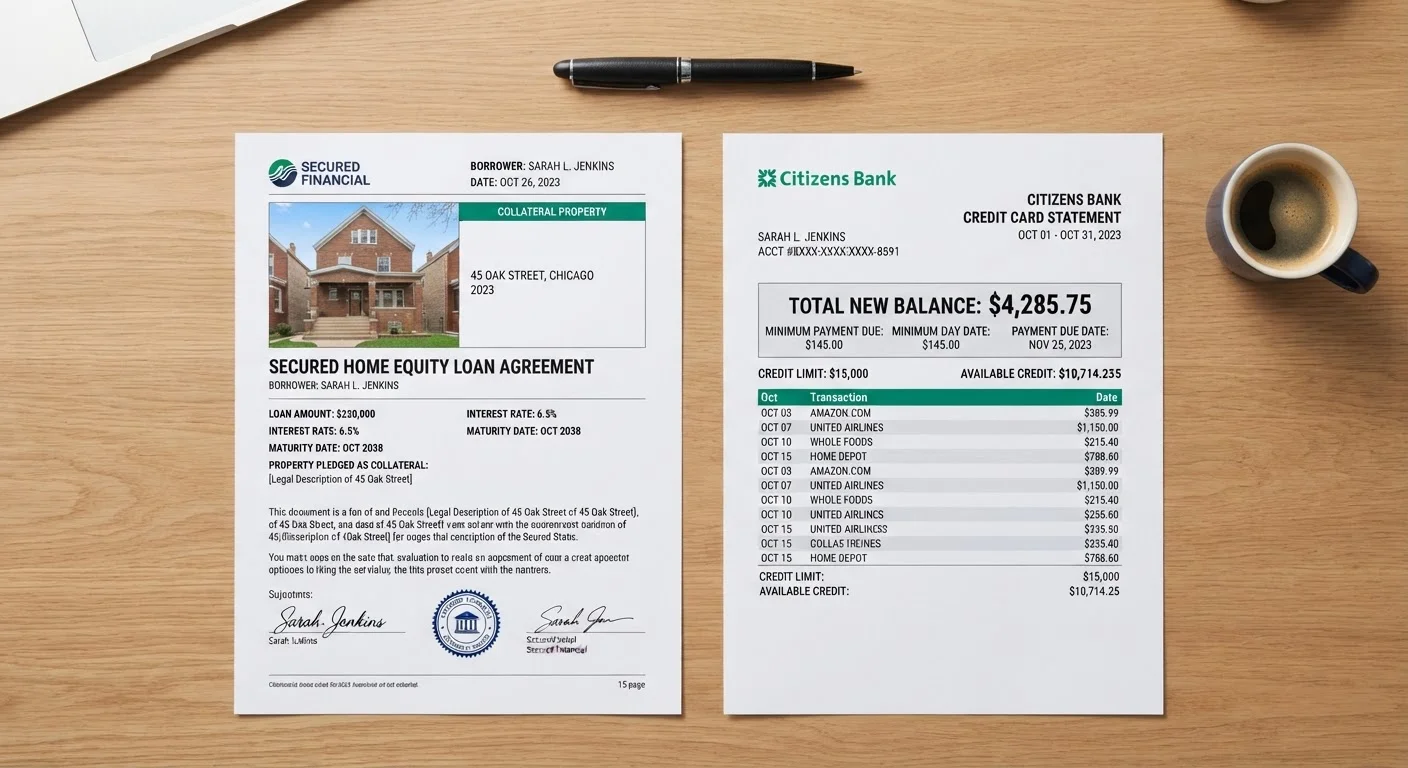
The core difference comes down to collateral — a specific asset legally tied to the debt. With a secured debt, the lender holds a claim on that asset (called a lien) until you repay in full. If you default, the lender has the legal right to seize or foreclose on the asset to recover what they're owed.
Common examples of secured debt include mortgages (backed by real estate), auto loans (backed by the vehicle), and some secured personal loans or lines of credit backed by savings deposits or other property.
Unsecured debt, by contrast, is issued based on your creditworthiness alone — no specific asset is pledged. Credit cards, medical bills, personal loans, and student loans (in most cases) fall into this category. The lender's recourse after default is limited to reporting the delinquency, pursuing collection, or obtaining a court judgment — but they cannot immediately seize property the way a secured lender can.
For a broader look at how these debt types fit into your overall financial picture, see our overview of personal debt types and causes.
How the Distinction Changes the Consequences of Default
The stakes of missing payments are meaningfully different depending on the debt type — and understanding this is critical before you decide where to focus repayment energy.
Secured debt default: The lender can initiate repossession (for auto loans) or foreclosure (for mortgages) once you're in default, which is typically defined by your loan agreement. Timelines vary by state and contract terms, but the outcome — losing the asset — is a defined legal mechanism the lender can invoke without needing a separate court judgment in many cases.
Unsecured debt default: The path is longer but still consequential. Lenders typically charge off the account, sell it to a collections agency, and may eventually sue for a civil judgment. If they obtain one, they may be able to garnish wages or bank accounts, depending on state law. Your credit report also takes significant damage.
| Criterion | Secured Debt | Unsecured Debt |
|---|---|---|
| Collateral required | Yes — specific asset pledged | No asset required |
| Typical interest rate | Generally lower | Generally higher |
| Consequence of default | Repossession or foreclosure | Collections, potential court judgment |
| Lender recourse speed | Faster — lien already in place | Slower — requires legal process |
| Common examples | Mortgage, auto loan | Credit cards, personal loans, medical bills |
| Impact on credit score | Yes — both payment history and default | Yes — both payment history and default |
| Consolidation flexibility | Limited; tied to asset | More options available |
This asymmetry is why financial counselors and consumer advocates generally recommend keeping secured debt payments current even when managing hardship — the loss of a home or vehicle creates cascading problems that are harder to recover from than a credit score drop alone. That said, anyone facing serious default risk should consult a licensed financial counselor or attorney to understand their specific options.
Interest Rates, Risk, and the Collateral Trade-Off
Secured debts almost always carry lower interest rates than unsecured debts of similar size, and the reason is structural: the collateral reduces the lender's risk of total loss. Mortgages, for example, have historically offered some of the lowest consumer interest rates available — in part because the lender can recover value by selling the home if needed.
Unsecured lenders price in the absence of that backstop. Credit card rates and personal loan rates are typically far higher, reflecting the greater uncertainty lenders accept. This is also why your credit score matters more for unsecured lending — with no collateral, your repayment history becomes the primary signal of risk.
~20%
Average credit card interest rate (APR)
The Federal Reserve tracks average credit card rates, which have been at or near historic highs in recent years, underscoring the cost of carrying unsecured balances.
~6–7%
Typical 30-year fixed mortgage rate range
Mortgage rates, while variable over time, have historically sat well below unsecured consumer credit rates, reflecting the lower lender risk from collateral.
$17T+
Total U.S. household debt outstanding
According to the Federal Reserve Bank of New York's Household Debt and Credit Report, the majority of this figure is secured mortgage debt.
The practical implication: unsecured debt tends to be more expensive to carry over time, especially if you're only making minimum payments. This is one reason why paying down high-interest unsecured balances is a priority in most structured repayment approaches. For a detailed comparison of those strategies, see our guide on debt avalanche vs. debt snowball.
Building a Strategy Around Debt Type
Knowing whether each of your debts is secured or unsecured should inform how you sequence repayment — and what you do when money gets tight. Before mapping out any repayment plan, it's worth building a complete inventory of what you owe, explicitly noting which balances are secured and which are not.
A few frameworks worth considering:
- In hardship scenarios: Prioritize secured obligations — mortgage, rent, auto loan — to protect your housing and transportation stability. These are harder to replace than a good credit score.
- In normal repayment mode: Once secured payments are current, many people find it effective to direct extra dollars at high-interest unsecured debt, which compounds fastest.
- Consolidation and restructuring: Unsecured balances are typically more amenable to consolidation or debt management plans. Be cautious about converting unsecured debt into secured debt (e.g., a home equity loan to pay off credit cards) — you're taking on more risk than you may realize.
Finally, both debt types show up on your credit report and affect your score, though in different ways. Understanding how debt influences your credit profile can help you make smarter decisions about which balances to tackle and when.
This article is for general informational and educational purposes only and does not constitute personalized financial, legal, or tax advice. Consult a qualified financial adviser or attorney for guidance specific to your situation.