

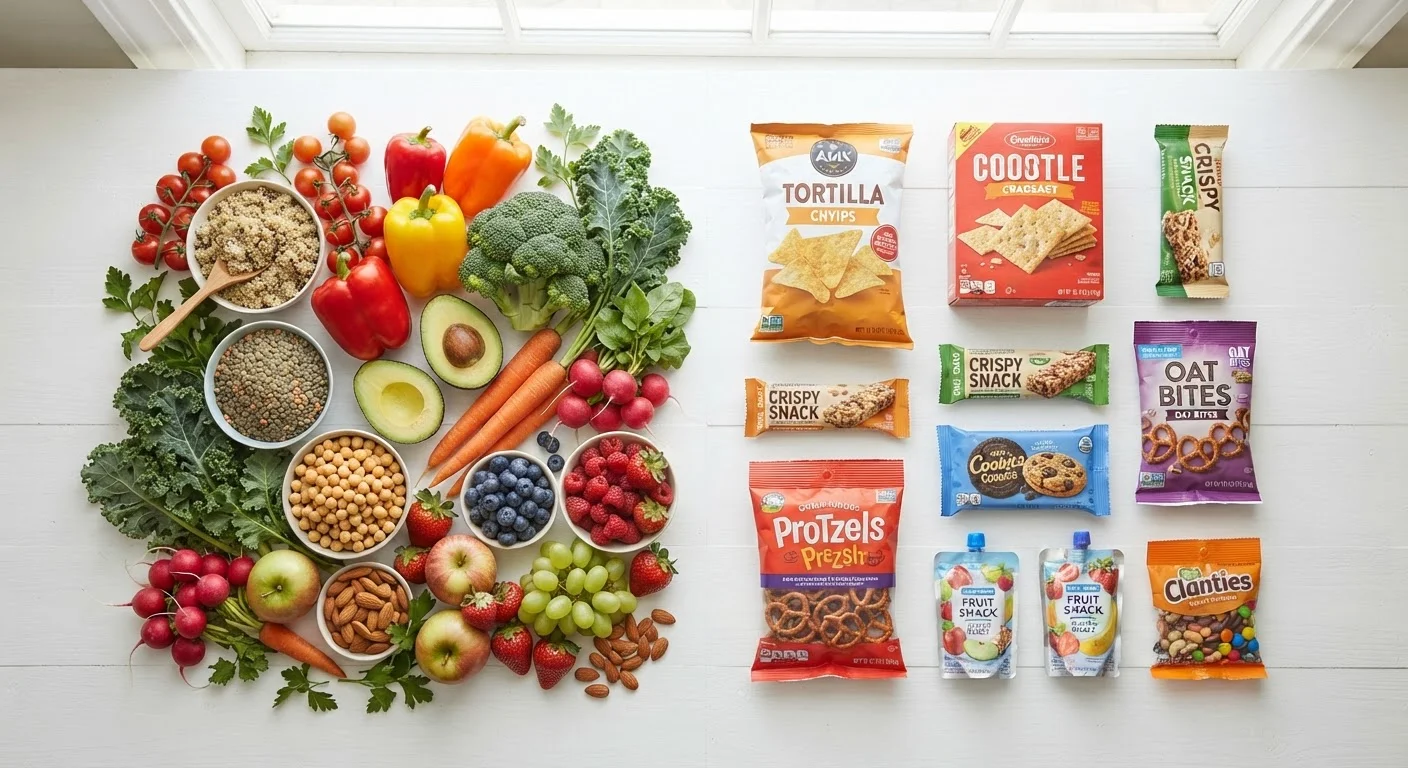
Key Takeaways
- Whole foods are minimally altered from their natural state and retain most original nutrients and fiber.
- Ultra-processed foods are defined by industrial formulations, not just added sugar or salt — the NOVA system is the leading classification framework.
- Observational studies consistently link higher ultra-processed food consumption to poorer health outcomes, though causation is complex.
- Processing level is one useful lens, but overall dietary pattern and caloric context still matter.
- Small, practical shifts toward more whole foods can improve dietary quality without requiring perfect eating habits.
Option A
Whole Foods
The minimally altered, nutrient-dense foundation of traditional diets.
Best for: People seeking to maximize fiber, micronutrient density, and dietary variety with foods close to their natural state.
Option B
Ultra-Processed Foods
Highly engineered products formulated for palatability and shelf stability.
Best for: Understanding what to limit or moderate — and why researchers single out this category above other processed foods.
If you want to improve overall diet quality
Whole Foods
Research consistently shows diets higher in whole foods are associated with better nutrient profiles, greater fiber intake, and lower disease risk markers across large population studies.
If you're trying to understand why certain packaged foods are flagged by researchers
Ultra-Processed Foods
Studying the ultra-processed category helps clarify which products are associated with overconsumption patterns and poorer health outcomes — informing smarter label reading.
If food access or budget is a limiting factor
Whole Foods
Staples like dried legumes, canned vegetables (without added sodium), oats, and frozen produce offer whole-food benefits at accessible price points — no premium products required.
If you're navigating a busy schedule and rely on convenience foods
Whole Foods
Minimally processed convenience options — such as canned beans, plain yogurt, or frozen fruit — sit closer to the whole-food end of the spectrum and can anchor a practical eating pattern.
Defining the Categories: More Than a Label
The terms "whole foods" and "ultra-processed foods" are often used loosely, but researchers have developed more precise definitions. Understanding those definitions is the foundation for evaluating the evidence.
Whole foods are foods that have undergone minimal or no industrial processing — think fresh vegetables, fruit, legumes, whole grains, eggs, and plain meat or fish. Some minor processing, such as milling or freezing, is generally accepted as compatible with the category. The key characteristic is that the food retains most of its original nutritional structure.
Ultra-processed foods are defined most rigorously by the NOVA classification, developed by researchers at the University of São Paulo. NOVA groups foods into four categories based on the extent and purpose of processing, not just their nutrient content. Ultra-processed foods (NOVA Group 4) are industrial formulations that typically contain additives — such as emulsifiers, artificial flavors, stabilizers, and colorants — not commonly found in home kitchens. Examples include packaged snack cakes, carbonated soft drinks, reconstituted meat products, and instant noodle dishes.
Importantly, not all processed food is ultra-processed. Plain canned tomatoes, pasteurized milk, and frozen vegetables are processed but fall into lower NOVA groups. This distinction is often lost in popular media coverage. For a deeper look at how study designs shape our understanding of these categories, see interpreting nutrition research.
What the Research Shows — and Where It Has Limits
The body of research linking ultra-processed food consumption to health outcomes has grown substantially over the past decade. Large observational cohort studies — including analyses from the NutriNet-Santé study in France and the UK Biobank — have reported associations between higher ultra-processed food intake and elevated risks of cardiovascular disease, type 2 diabetes, certain cancers, and all-cause mortality.
57%
Share of US adult calories from ultra-processed foods
A nationally representative analysis published in BMJ Open estimated that ultra-processed foods account for roughly 57% of caloric intake among US adults.
+12%
Associated cardiovascular risk increase
A large NutriNet-Santé cohort study found a 12% higher risk of cardiovascular disease associated with each 10-percentage-point increase in ultra-processed food dietary share.
~500 kcal/day
Extra calories consumed on ultra-processed diet
In Hall et al.'s 2019 Cell Metabolism randomized trial, participants on an ultra-processed diet consumed approximately 500 more calories per day than during the whole-food phase.
Conversely, diets rich in whole foods — particularly those resembling Mediterranean or traditional plant-forward patterns — are consistently associated with better cardiometabolic markers, healthier gut microbiome diversity, and lower inflammatory indicators. For a discussion of how eating patterns compare, see popular eating patterns and their tradeoffs.
However, important caveats apply. Most of this research is observational, meaning it can identify associations but cannot establish direct causation. People who eat more ultra-processed foods often differ from those who eat fewer in ways that are difficult to fully control for — including income, stress levels, physical activity, and overall dietary context. A 2019 randomized controlled trial published in Cell Metabolism by Hall et al. was one of the few to show that, when caloric intake was matched, participants on an ultra-processed diet consumed significantly more calories and gained more weight — but it was a small, short-duration study conducted in a controlled setting.
The broader research picture on processed versus whole foods supports caution, not alarmism — the science points to patterns, not single foods as sole causes of disease.
Practical Implications Without Prescriptive Rules
The evidence does not suggest that eating any ultra-processed food causes harm, nor that every meal must consist solely of unaltered whole foods. What it does suggest is that the overall balance and pattern of a diet matters considerably.
Several practical frameworks emerge from the research:
- Fiber and micronutrient density: Whole foods — especially vegetables, legumes, fruits, and whole grains — tend to be richer in dietary fiber and essential micronutrients than their ultra-processed counterparts. Fiber in particular plays a meaningful role in gut health and satiety. For a deeper look at the gut microbiome, see what we know about gut health.
- Energy density and satiety signals: Ultra-processed foods are often engineered to be highly palatable and energy-dense, which some researchers hypothesize may interfere with normal satiety cues — though the mechanisms remain under investigation.
- Protein considerations: The source and processing level of protein-containing foods also varies significantly. Plant-based versus animal protein involves its own set of trade-offs worth exploring separately.
Rather than eliminating entire food categories, most nutrition researchers emphasize shifting the overall dietary pattern toward more minimally processed foods where feasible — a goal compatible with real-world budgets and schedules.
This article is for general informational and educational purposes only and is not a substitute for professional medical or dietary advice. Consult a qualified healthcare provider or registered dietitian for guidance tailored to your individual health needs.