

Key Takeaways
- Researchers use the NOVA classification to distinguish minimally processed foods from ultra-processed formulations.
- Ultra-processed foods are linked in large observational studies to higher risks of obesity, cardiovascular disease, and type 2 diabetes.
- Processing is a spectrum — not all processed foods carry the same nutritional risks.
- Whole foods generally deliver more fiber, micronutrients, and satiety per calorie than their processed counterparts.
- Practical dietary improvement rarely requires eliminating all processed foods — strategic substitution is often more sustainable.
- Consult a registered dietitian for guidance tailored to your specific health circumstances.
Option A
Whole Foods
Minimally altered, nutrient-dense eating anchored in food's natural state.
Best for: Adults seeking sustained energy, fiber, and micronutrient density without relying on food labels to decode what they're eating.
Option B
Ultra-Processed Foods
Convenient, engineered for palatability, but often nutritionally diluted.
Best for: Situations demanding shelf stability and speed, though habitual heavy reliance raises documented health concerns.
If you want to improve long-term metabolic health
Whole Foods
A diet built around minimally processed foods consistently shows stronger associations with healthy weight maintenance and reduced chronic disease risk in population studies.
If time and budget are significant daily constraints
Whole Foods
Staples like dried legumes, oats, frozen vegetables, and eggs are often affordable whole foods that require minimal prep — closing the convenience gap considerably.
If you're making incremental changes rather than an overnight overhaul
Whole Foods
Swapping a few high-frequency ultra-processed items for whole-food alternatives can meaningfully shift your diet's nutritional profile over months without requiring perfection.
If you travel frequently or rely on shelf-stable options
Ultra-Processed Foods
In genuinely limited circumstances, minimally bad processed options — such as lower-sodium canned beans or plain nut butter — can bridge gaps without derailing an otherwise balanced pattern.
Defining the Terms: What Researchers Actually Mean
The words "whole" and "processed" get used loosely in popular nutrition discourse, which obscures what the evidence actually measures. Researchers most commonly use the NOVA classification system, developed by researchers at the University of São Paulo, which groups foods into four categories based on the extent and purpose of industrial processing — not nutrient content alone.
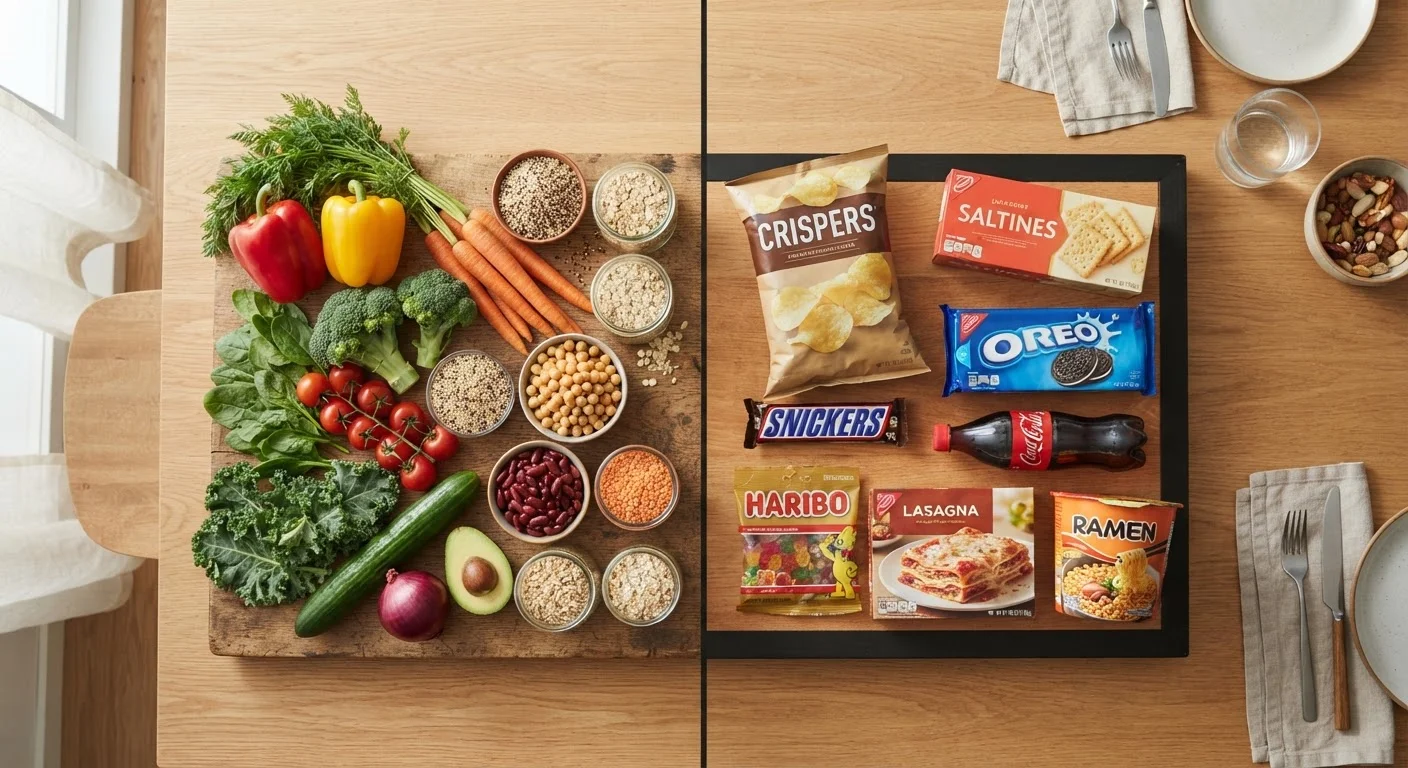
Group 1 (unprocessed or minimally processed): Foods in or close to their natural state — fresh fruit, vegetables, plain meat, eggs, legumes, whole grains, plain yogurt. Minimal processing includes drying, freezing, or pasteurizing without adding substances.
Group 4 (ultra-processed foods, or UPFs): Industrial formulations made mostly or entirely from substances extracted from foods — such as refined starches, hydrogenated oils, added sugars, and flavor additives — with little or no whole food content. Think mass-market packaged snacks, sodas, reconstituted meat products, and many instant noodles.
Groups 2 and 3 cover culinary ingredients (oils, salt, butter) and conventionally processed foods (canned vegetables, cheese, cured meats) — important middle-ground categories often overlooked when the debate is framed as a simple binary. For a deeper dive into how these categories interact with specific dietary approaches, see the tradeoffs of popular eating patterns.
| Criterion | Whole Foods | Ultra-Processed Foods |
|---|---|---|
| NOVA Classification | Group 1 — minimally processed | Group 4 — industrially formulated |
| Fiber Content | Generally high | Often very low |
| Micronutrient Density | Broad range, naturally occurring | Frequently added back via fortification |
| Added Sugar & Sodium | Minimal to none | Commonly elevated |
| Satiety per Calorie | Higher — protein and fiber promote fullness | Lower — engineered for palatability over satiety |
| Shelf Life & Convenience | Often limited; requires preparation | Long shelf life; ready to eat |
| Cost Variability | Wide range; staples can be affordable | Often cheap per serving, but nutritionally diluted |
| Chronic Disease Association | Linked to lower risk in cohort studies | Linked to higher risk in multiple large studies |
What the Evidence Shows — and Where It Has Limits
The observational evidence linking high ultra-processed food consumption to adverse health outcomes is substantial. Large cohort studies — including analyses from the NutriNet-Santé study in France and the UK Biobank — have associated high UPF intake with elevated risks of cardiovascular disease, type 2 diabetes, depression, and all-cause mortality. A notable randomized controlled trial published in Cell Metabolism (Hall et al., 2019) found that participants assigned to an ultra-processed diet consumed significantly more calories and gained weight compared to those on a whole-food diet, even when meals were matched for macronutrients on paper.
That said, important caveats apply. Observational studies cannot definitively prove causation — people who eat more UPFs may also differ in income, stress levels, sleep, and physical activity in ways that independently affect health. The NOVA classification, while useful, groups foods by industrial process rather than nutritional quality, meaning a minimally sweetened whole-grain cracker and a sugar-laden cookie can end up in the same group. Researchers continue to debate the most meaningful way to measure "processing" and its independent effect.
57%
Share of US adult calories from ultra-processed foods
Based on national dietary recall data published in BMJ Open (Martínez Steele et al.), reflecting average American dietary patterns.
+500 kcal/day
Extra calories consumed on ultra-processed diet
Participants in a randomized controlled trial (Hall et al., Cell Metabolism, 2019) ate approximately 500 more calories daily when assigned to an ultra-processed menu versus a whole-food menu.
10% increase
Cardiovascular disease risk per 10% rise in UPF intake
A large prospective study published in The BMJ found a roughly 10–12% higher risk of cardiovascular events for each 10-percentage-point increase in UPF dietary share.
What the balance of evidence does support: dietary patterns emphasizing whole, minimally processed foods are consistently associated with better health outcomes across diverse populations. For more on how individual macronutrients function within these food types, see what carbs, proteins, and fats actually do.
Practical Implications for Everyday Eating
Most US adults eat a diet where UPFs account for over half of total caloric intake, according to national dietary survey data. An all-or-nothing approach to eliminating processed foods is rarely realistic or necessary. A more grounded strategy focuses on replacing high-frequency, high-volume UPF staples — sweetened beverages, packaged snack foods, and fast-food regulars — rather than achieving purity.
Affordable whole-food staples — oats, dried or canned beans (rinsed to reduce sodium), frozen vegetables, eggs, and plain full-fat dairy — compare favorably on cost per serving to many UPF equivalents while delivering substantially more fiber, protein, and micronutrients. Fiber intake is one of the most consistently under-consumed nutrients in the American diet, and whole foods are its primary dietary source.
For those working on incremental shifts, small dietary changes that add up over time outlines evidence-informed substitutions that accumulate meaningfully without demanding a wholesale overhaul. Protein source decisions — a common practical question — are covered in more depth in plant-based vs. animal protein trade-offs.
Not All Processing Is Equal
Plain canned tomatoes, frozen spinach, and pasteurized milk are all technically processed — but they retain most of their nutritional value and are meaningfully different from packaged snack foods or reconstituted meat products. The goal isn't to avoid all processing; it's to recognize when industrial formulation substantially strips nutritional quality or adds problematic ingredients. Reading ingredient lists — rather than just front-of-package claims — is one of the most practical tools available.
This article is for general informational purposes only and does not constitute medical or dietary advice. Consult a registered dietitian or qualified healthcare professional before making significant changes to your diet, especially if you have a chronic health condition.