

Key Takeaways
- Your owner's manual — not generic advice — is the authoritative source for your car's specific service intervals.
- Maintenance intervals are expressed in miles, months, or both; whichever threshold arrives first applies.
- Skipping scheduled services can accelerate wear, void warranty provisions, and reduce resale value.
- Driving conditions matter: stop-and-go city driving is harder on a vehicle than steady highway miles.
- Many modern vehicles have onboard reminders, but they supplement — not replace — the owner's manual schedule.
Vehicle Maintenance Schedule
A vehicle maintenance schedule is a manufacturer-specified series of service intervals that tell you when to inspect, replace, or service specific components of your car. These intervals are typically expressed in miles driven, months elapsed, or both — whichever comes first. Following the schedule helps preserve reliability, safety, and in many cases your warranty coverage.
Modern vehicles often use an onboard diagnostic system — sometimes called an oil life monitor or service reminder — that calculates intervals based on actual driving conditions rather than fixed mileage alone.
Why the Maintenance Schedule Exists
Every vehicle is engineered with defined wear tolerances for its components. Fluids degrade, filters clog, belts stretch, and rubber seals dry out — all on timelines that engineers can broadly predict. The maintenance schedule is how those predictions get translated into actionable service intervals for owners.
Think of it less as a list of upsells and more as a manufacturer's acknowledgment of how their own vehicle ages. When an automaker specifies a timing belt replacement at a certain mileage, it's because the engineering data shows that belt becomes a reliability risk beyond that point. Adhering to the schedule is ultimately about managing known risks before they become expensive failures.
For context on the broader costs involved, see what scheduled servicing contributes to annual ownership costs.
How to Read the Intervals
Maintenance intervals are almost always expressed as mileage, elapsed time, or both — and the rule is simple: whichever threshold you reach first triggers the service. A vehicle might call for a cabin air filter change every 15,000 miles or 12 months. If you drive only 8,000 miles a year, the 12-month mark comes first and that's when the filter should be changed.
This dual structure exists because time-based degradation is real even when a car sits largely unused. Brake fluid absorbs moisture from the air over months. Engine coolant becomes more acidic over time regardless of mileage. Tires age from UV exposure and ozone even when parked.
5,000–10,000 mi
Typical modern oil change interval
Many current vehicle models specify synthetic oil changes in this range, well above the historically common 3,000-mile guideline, per manufacturer owner's manual data.
2 years
Common brake fluid replacement interval
Numerous automakers recommend replacing brake fluid every two years due to moisture absorption, regardless of mileage driven.
60,000–100,000 mi
Lifespan of iridium/platinum spark plugs
Extended-life spark plugs used in many modern engines can last significantly longer than conventional plugs, according to typical manufacturer specifications.
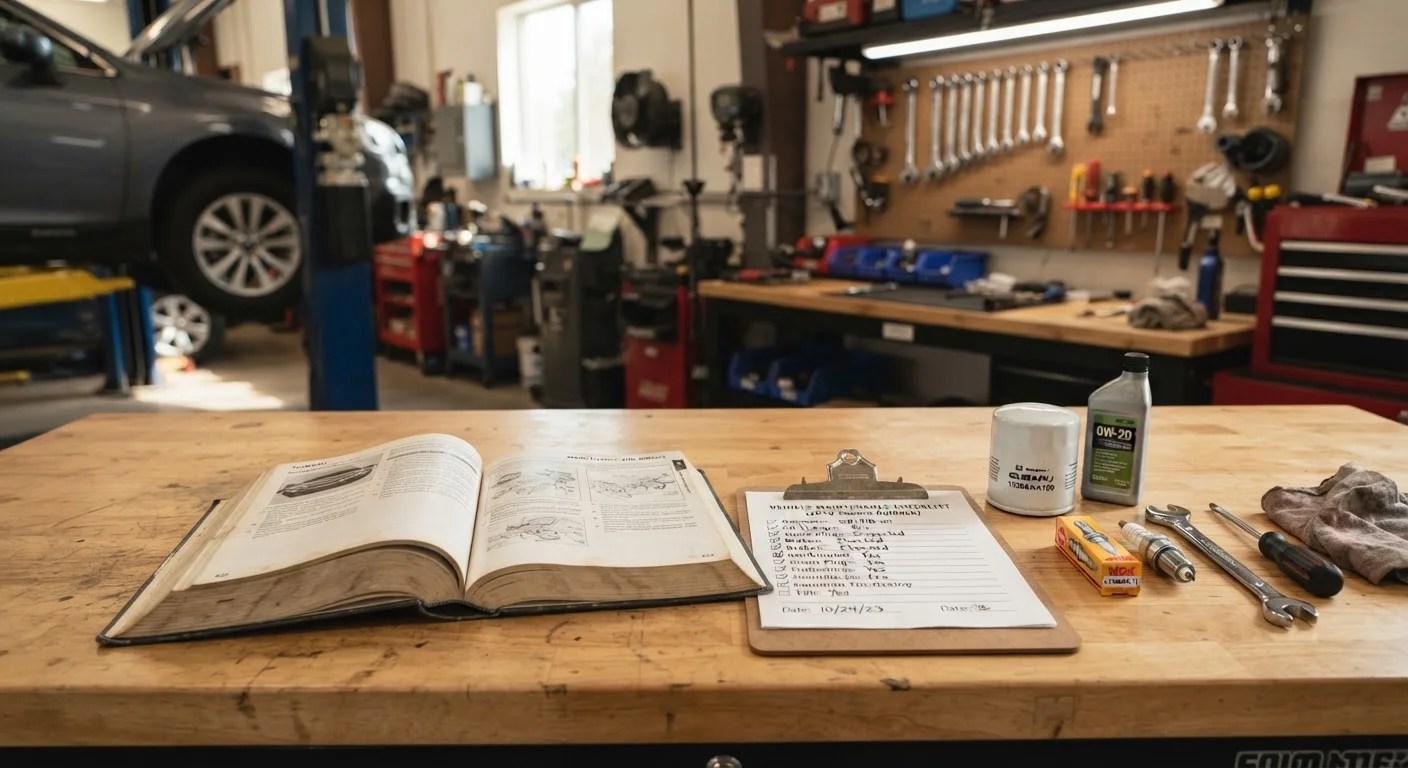
Owner's manuals typically organize intervals into a maintenance table or checklist — often broken into 5,000-mile or 10,000-mile blocks with checkmarks indicating which services apply at each milestone. Scanning that table once gives you a clear picture of what's coming and when.
Key Milestones and What They Cover
While every vehicle differs, certain service categories appear consistently across makes and models:
- Oil and filter changes: Probably the most frequent scheduled task. Interval varies significantly by vehicle and oil type — consult your manual rather than assuming a universal number.
- Tire rotation: Typically every 5,000–7,500 miles to promote even tread wear across all four tires.
- Air filters (engine and cabin): Engine air filters affect combustion efficiency; cabin filters affect interior air quality. Both are often overlooked until there's a noticeable symptom.
- Brake fluid: Many manufacturers recommend replacement every two years regardless of mileage, due to moisture absorption that lowers the fluid's boiling point.
- Spark plugs: Conventional plugs may need replacement around 30,000 miles; iridium or platinum plugs in modern engines often last 60,000–100,000 miles.
- Timing belt or chain: Where a belt is used (rather than a chain), replacement is typically required at a specific high-mileage milestone — missing it can result in catastrophic engine damage.
- Transmission and differential fluids: Often neglected because they have no visible indicator. Intervals vary widely but ignoring them accelerates internal wear.
This is not an exhaustive list — your owner's manual will include items specific to your drivetrain, climate control system, and other components. See long-term vehicle care habits for guidance on building a consistent routine around these milestones.
Normal vs. Severe Service Conditions
Most owner's manuals include two maintenance tracks: a standard schedule and a more frequent one labeled something like severe duty or special operating conditions. Many drivers assume they fall into the standard category, but the criteria for severe service are broader than expected.
Severe conditions typically include: frequent short trips under five miles, extended idling, towing or hauling heavy loads, driving in extreme heat or cold, and operating on dusty or unpaved roads. If several of these describe your regular driving, the severe schedule likely applies — and that generally means more frequent fluid changes and inspections.
It's worth reading those criteria carefully. City driving with frequent stop-and-go traffic is harder on an engine than the same number of highway miles, because the engine never fully reaches operating temperature on short trips, which allows moisture and fuel byproducts to accumulate in the oil. For a deeper look at how conditions affect your service needs, seasonal maintenance considerations is a useful companion read.
Check Your Driving Conditions Honestly
Before assuming the standard maintenance schedule applies to you, read the severe-service criteria in your owner's manual. Many everyday drivers — particularly those making frequent short trips or living in climates with extreme temperatures — technically qualify for the more frequent severe-duty schedule. Applying the wrong track can mean under-servicing your vehicle without realizing it.
Using Your Schedule Confidently
The most common maintenance mistake isn't skipping services outright — it's relying on memory or generic online advice instead of the owner's manual. Intervals that apply to one vehicle may not apply to another, even within the same model year if engine options differ.
A practical approach: locate the maintenance table in your owner's manual now, note your current mileage and recent service history, and identify the next two or three upcoming milestones. Keep a simple log — digital or paper — of what was done and when. That record also matters when selling the vehicle, as documented maintenance history is a tangible factor in private-party resale negotiations.
If you're weighing which tasks to handle yourself versus taking to a shop, the trade-offs between DIY and professional servicing covers that ground directly. And if you've encountered conflicting advice about what your car actually needs, common maintenance myths worth questioning separates evidence from convention.