

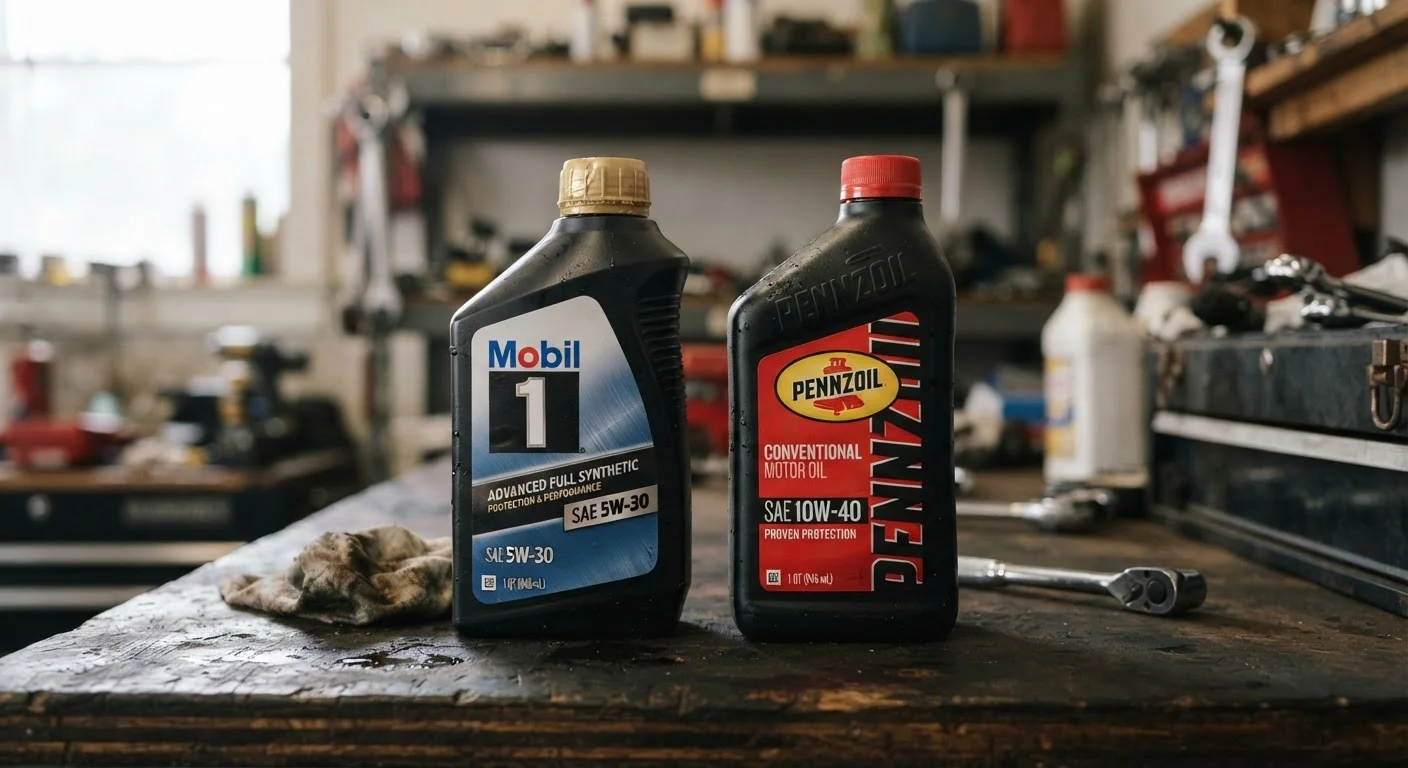
Key Takeaways
- Synthetic oil is chemically engineered for more uniform molecules, while conventional oil is refined directly from crude petroleum.
- Synthetic oil generally holds up longer between changes, though your owner's manual sets the authoritative interval for your vehicle.
- Conventional oil remains a viable option for many older engines and light-duty driving situations.
- Switching from conventional to synthetic mid-life does not harm a healthy engine.
- Neither oil type eliminates the need for regular maintenance — neglect causes damage regardless of formulation.
Option A
Synthetic Motor Oil
The engineered, high-performance formulation.
Best for: Drivers with newer vehicles, turbocharged engines, extreme climates, or longer intervals between oil changes.
Option B
Conventional Motor Oil
The time-tested, widely available baseline.
Best for: Owners of older or lower-mileage vehicles with simple engine designs and standard driving conditions.
If you drive a newer vehicle with a turbocharged or high-revving engine
Synthetic Motor Oil
Modern engines with tight tolerances and turbochargers run hotter and demand oil that resists breakdown under sustained thermal stress — synthetic formulations are engineered specifically for this.
If you own an older, well-maintained vehicle with a simple engine and drive moderate miles
Conventional Motor Oil
Many older engines were designed around conventional oil's properties and run reliably on it, provided the recommended change intervals are observed.
If you live in a region with extreme seasonal temperature swings
Synthetic Motor Oil
Synthetic oil maintains more stable viscosity in both deep cold and high heat, providing better cold-start protection and less thinning at high temperatures.
If you want maximum intervals between oil changes and fewer service visits
Synthetic Motor Oil
Synthetic oil resists oxidation and degradation longer, which is why many manufacturers now specify extended drain intervals for vehicles filled with full synthetic.
If your budget is a primary concern and your vehicle's manufacturer allows conventional oil
Conventional Motor Oil
Conventional oil costs less per quart, and for vehicles whose specifications permit it, it delivers adequate protection when changed on schedule.
How the Two Oils Are Made
The core difference between synthetic and conventional motor oil is origin and molecular structure. Conventional oil — sometimes called mineral oil — is derived from crude petroleum extracted from the ground. Through refining, impurities are removed, but the resulting molecules remain a naturally varied mix of sizes and shapes.
Synthetic oil, by contrast, is chemically synthesized — typically starting from a base stock (such as polyalphaolefin, or PAO) that is built molecule by molecule in a controlled process. The result is a far more uniform molecular structure with fewer contaminants. This consistency is what gives synthetic oil its performance advantages in demanding conditions.
There is also a middle category: synthetic blends, which combine conventional base oil with some synthetic base stock. Blends typically offer modest performance improvements over full conventional oil at a lower cost than full synthetic.
For a deeper look at how viscosity grades like 5W-30 relate to oil selection, see our guide to engine oil grades and viscosity.
Performance Differences That Actually Matter
Molecular uniformity translates into measurable real-world performance differences under specific conditions.
Temperature Stability
Conventional oil thickens more in cold weather and thins more aggressively under heat. Synthetic oil maintains a more stable viscosity across a wider temperature range, which means engines typically receive adequate lubrication faster at cold starts — the period when a significant portion of engine wear occurs.
Oxidation and Breakdown Rate
All motor oil degrades over time through oxidation, heat cycling, and contamination. Conventional oil breaks down faster because its less uniform molecules are more reactive. Synthetic oil resists this degradation longer, which is the primary reason manufacturers who specify it also allow extended drain intervals.
Deposit and Sludge Formation
When oil degrades, it can leave behind deposits and sludge on internal engine surfaces. Synthetic oil's cleaner base and the detergent additives it carries tend to keep engine internals cleaner over time.
| Criterion | Synthetic Motor Oil | Conventional Motor Oil |
|---|---|---|
| Base Origin | Chemically engineered base stocks | Refined crude petroleum |
| Molecular Consistency | Highly uniform | Naturally variable |
| Cold-Weather Performance | Flows more readily at low temps | Thickens more in cold conditions |
| Heat Resistance | Resists thinning under high heat | Thins more at elevated temperatures |
| Typical Drain Interval | Often 7,500–10,000+ miles (per OEM spec) | Often 3,000–5,000 miles (per OEM spec) |
| Cost Per Quart | Higher | Lower |
| Sludge Resistance | Generally higher | Generally lower |
| Suitable for Turbocharged Engines | Yes — strongly recommended | Not typically recommended |
These differences matter most in turbocharged engines, performance engines, vehicles operating in extreme climates, or any application where oil temperatures regularly run high. For standard highway commuting in moderate climates, the performance gap narrows considerably.
Common Misconceptions Worth Addressing
A persistent myth holds that once you switch a high-mileage engine from conventional to synthetic, you'll cause leaks. In practice, a healthy engine seal will not be damaged by switching oil types. Synthetic oil is not a solvent. If an engine develops leaks after switching, those seals were likely already compromised.
Another outdated belief is that all vehicles need an oil change every 3,000 miles regardless of oil type. Many modern vehicles running full synthetic have manufacturer-specified intervals of 7,500 to 10,000 miles or more — though your owner's manual remains the authoritative source, not general rules of thumb. Separating automotive myths from current evidence is worth doing before making maintenance decisions based on outdated advice.
Your Owner's Manual Overrides General Advice
Every claim about synthetic versus conventional oil is a generalization. Your vehicle manufacturer has tested and specified the exact oil type, viscosity grade, and service interval for your engine. Consulting your owner's manual — or the manufacturer's official maintenance schedule — is the most reliable step you can take before purchasing any motor oil. No article, mechanic, or quick-lube recommendation should override that specification.
If you're considering doing your own oil change after understanding which oil to use, our walkthrough of the DIY oil change process covers the tools, safety steps, and when to defer to a professional.
Which Oil Belongs in Your Engine?
The single most reliable answer to this question is your vehicle's owner's manual. Manufacturers specify the oil type and viscosity grade required for warranty compliance and optimal engine protection. Using an oil that does not meet the specified standard — regardless of whether it's synthetic or conventional — is a greater risk than the synthetic-versus-conventional choice itself.
That said, a few practical patterns hold:
- Newer vehicles (roughly 2010 onward) increasingly require or strongly recommend full synthetic, and many come factory-filled with it.
- Turbocharged engines nearly universally benefit from synthetic due to the extreme heat generated around the turbocharger.
- Older, simpler engines — particularly those from the 1990s and earlier — often run well on conventional oil provided the recommended intervals are honored.
- High-mileage formulations (a separate product category) contain seal conditioners and may benefit engines with over 75,000 miles regardless of whether the base oil is synthetic or conventional.
Cost is a legitimate consideration: full synthetic costs more per quart than conventional, but if your vehicle's extended drain interval means fewer annual changes, the annual cost difference may be smaller than it first appears.