

Key Takeaways
- Solo travel offers maximum flexibility but demands significantly more planning and personal responsibility.
- Group tours reduce logistical burden and can lower per-person costs for complex destinations.
- Safety perceptions differ by destination type — neither approach is universally safer than the other.
- Social experience varies greatly: solo travel can be surprisingly sociable; group tours can feel constraining.
- Budget outcomes depend heavily on destination, travel style, and how far in advance you plan.
- Hybrid approaches — joining tours for specific legs while traveling independently overall — are a practical middle ground.
Option A
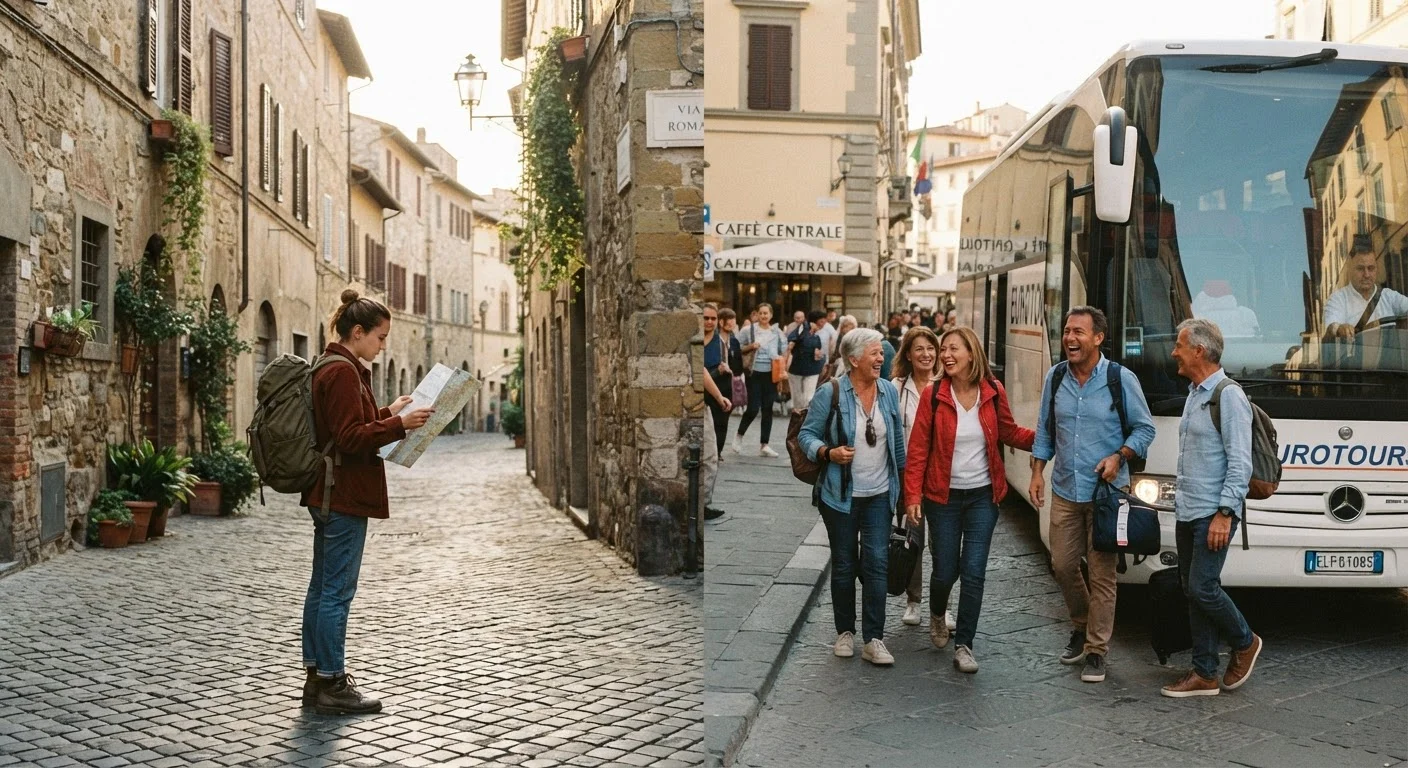
Solo Travel
The self-directed, fully flexible approach to seeing the world.
Best for: Travelers who want complete autonomy over pace, itinerary, and spontaneous decisions.
Option B
Group Tours
The structured, socially rich way to travel with logistics handled.
Best for: Travelers who value convenience, built-in community, and access to expert local guides.
If you prioritise itinerary control and dislike fixed schedules
Solo Travel
You can change plans mid-trip, linger longer in places that resonate, and skip anything that doesn't. No group consensus required.
If you're visiting a logistically complex destination for the first time
Group Tours
Destinations with limited tourist infrastructure, significant language barriers, or permit-restricted sites are often more accessible through an organised tour.
If budget is the primary concern and you're flexible on timing
Solo Travel
Independent travelers can actively hunt for value, adjust dates around pricing, and cut costs that a fixed tour package cannot eliminate.
If you're a first-time international traveler or have safety concerns
Group Tours
Having a guide and a built-in group provides a meaningful safety net, especially in unfamiliar regions where local knowledge matters.
If meaningful social connection during travel matters most to you
Group Tours
Shared experiences create natural rapport. Group tours reliably deliver social interaction that solo travel sometimes requires deliberate effort to find.
What You're Actually Comparing
Solo travel and organised group tours sit at opposite ends of the planning spectrum, but the real differences go deeper than who books your hotel. Each approach represents a fundamentally different relationship with travel itself — how much uncertainty you're comfortable carrying, how you prefer to engage with a destination, and what you're willing to trade for convenience or freedom.
Solo travel means you're the architect. Every decision — where to stay, how long to stay, when to leave — rests with you. That autonomy is its defining feature and its primary demand. Group tours, by contrast, hand the logistics to someone else. An operator designs the route, arranges accommodation and transport, and often provides local guides. You gain expertise and ease; you surrender schedule flexibility.
Neither approach is inherently superior. The right choice depends on the destination, your experience level, and what you actually want from the trip — not on which style sounds more adventurous or more comfortable. See our examination of common travel myths for a look at how assumptions about travel styles can lead planners astray.
Cost: A More Nuanced Comparison Than It Looks
The assumption that solo travel is always cheaper is worth interrogating. Solo travelers pay single-occupancy rates on accommodation, absorb the full cost of private transport, and have no group purchasing power. Group tours spread those costs across multiple travelers, which can meaningfully reduce per-person expenses on accommodation, guided entry fees, and chartered transport — particularly in destinations where logistics are complex or expensive.
That said, solo travelers have levers group tour participants don't. You can shift your travel dates to avoid peak pricing, choose accommodation types that suit your actual needs rather than a package standard, and adjust your itinerary based on real-time value. A group tour price is largely fixed at booking.
| Criterion | Solo Travel | Group Tours |
|---|---|---|
| Itinerary flexibility | Complete — change plans anytime | Fixed schedule, limited deviation |
| Upfront planning burden | High — you arrange everything | Low — operator handles logistics |
| Accommodation cost | Single-occupancy premium common | Group rates can reduce per-person cost |
| Local expertise access | Self-researched; varies in quality | Professional guides typically included |
| Social experience | Self-directed; can be rich or solitary | Built-in group; quality varies |
| Suited to complex destinations | Possible but demanding | Often the more practical choice |
| Ability to control spend | High — adjust in real time | Limited — price largely fixed at booking |
For a practical framework on making deliberate budget trade-offs, our guide to planning around a tight budget outlines where travel spend tends to matter most.
Flexibility, Safety, and the Social Reality
Flexibility is where solo travel wins decisively. You can stay an extra day in a city that surprises you, skip a site that doesn't interest you, or pivot entirely if weather or circumstances change. Group tours operate on fixed timelines — missing the bus is a real consequence, and popular sites may get less time than you'd want.
On safety, the picture is more nuanced. Group tours provide genuine advantages in unfamiliar regions: local guides, pre-vetted logistics, and the social deterrence of traveling in numbers. But solo travel isn't inherently dangerous. Experienced independent travelers mitigate risk through research, situational awareness, and practical tools like offline maps and travel insurance. The calculus shifts depending on destination. A solo trip through Western Europe is a very different risk profile from independent travel in a region with limited tourist infrastructure or active travel advisories. Always verify current conditions through your government's official travel advisory service before finalizing plans.
Socially, the stereotype that solo travel is lonely and group tours are reliably fun doesn't always hold. Solo travelers often find it easier to have genuine interactions with locals and other independent travelers — without the insulation a group can create. Group tours, meanwhile, vary enormously in chemistry. Some cohorts form lasting friendships; others feel like obligation. If social connection is your goal, your travel pace also shapes how meaningfully you connect with both destinations and people.
A Note on Travel Insurance for Both Approaches
Regardless of whether you travel solo or with a group, travel insurance warrants serious consideration. Group tour operators may carry their own liability coverage, but this rarely protects you comprehensively for medical emergencies, trip cancellations, or lost belongings. Solo travelers carry all personal risk directly. Review any policy's coverage scope carefully and verify what is and isn't included before you travel.
When a Hybrid Approach Makes the Most Sense
Many experienced travelers don't choose one mode exclusively. A common and practical pattern: travel independently for the majority of a trip but book a guided tour for a specific leg that genuinely warrants it — a multi-day trek requiring permits, a safari in East or Southern Africa, or a region where local guide knowledge dramatically improves the experience.
This hybrid model lets you preserve the itinerary flexibility that solo travel provides while accessing the logistical expertise of organised tours where it adds real value. It's worth building that flexibility into your planning from the start. Structuring a realistic day-by-day itinerary that accounts for guided segments alongside independent time requires a different planning approach than committing fully to either mode.
The decision ultimately comes down to being honest about your own preferences, risk tolerance, and what you want the trip to feel like — not what sounds most impressive to say afterward.