
Hostels, Guesthouses, and Shared Apartments: Accommodation Trade-Offs Beyond the Nightly Rate

Key Takeaways
- The listed nightly rate rarely reflects the true cost of any accommodation type.
- Hostels suit frequent social interaction; guesthouses offer more privacy at moderate cost.
- Shared apartments often deliver the best value for stays of four nights or longer.
- Hidden costs like cleaning fees, lockers, linen charges, and location affect total spend.
- Your travel style and trip length should drive accommodation choice as much as price.
Our Verdict
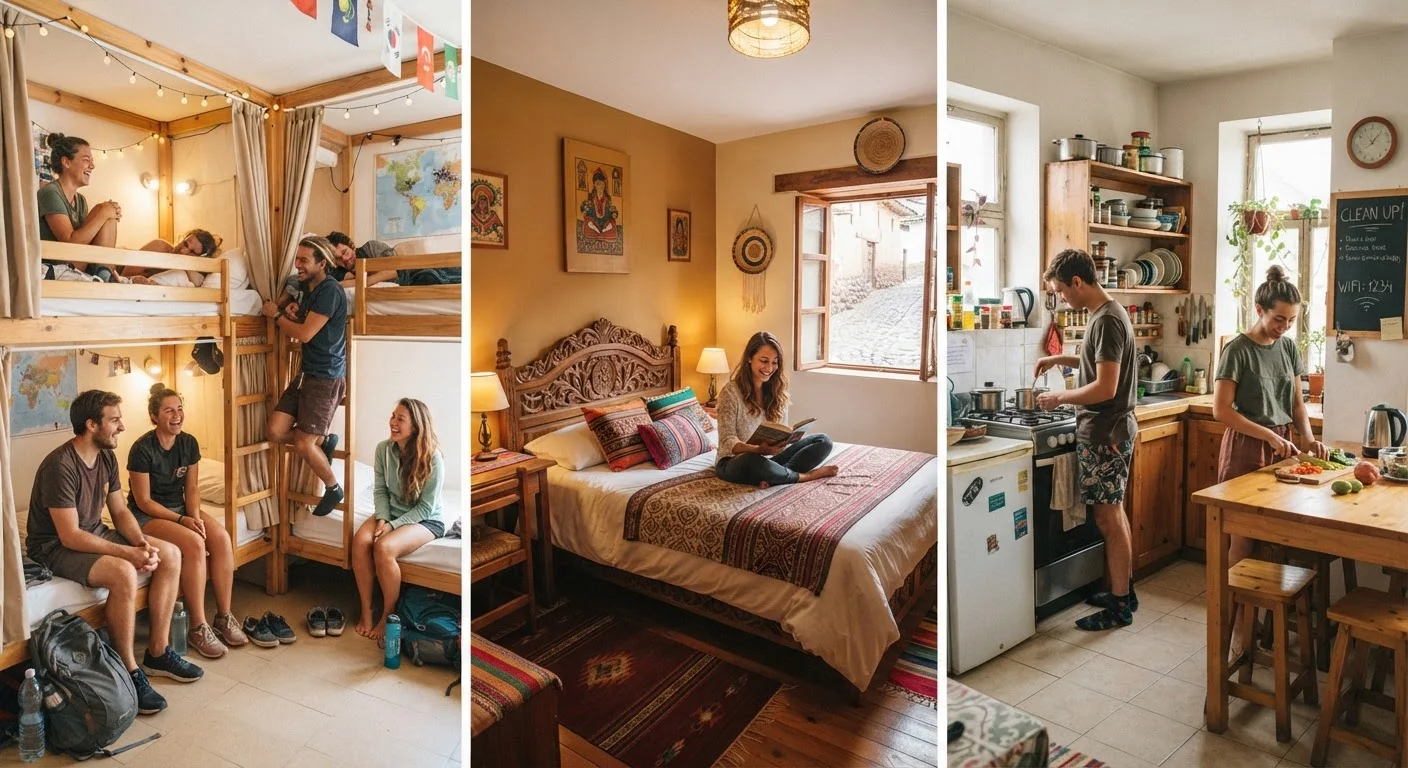
No single accommodation type wins across every trip. Hostels minimize nightly spend and maximize social opportunity but involve real privacy trade-offs. Guesthouses balance comfort and cost for solo or paired travelers staying briefly. Shared apartments reward longer stays with kitchen access and living space, but upfront fees and location disadvantages can erode their value on short trips.
| Best for | Recommended |
|---|---|
| Solo travelers on short city stays who want to meet people | Hostel |
| Couples or travelers prioritizing restful sleep and privacy | Guesthouse |
| Travelers staying four or more nights who cook their own meals | Shared Apartment |
| Group travel where splitting a rental lowers per-person cost | Shared Apartment |
Why the Nightly Rate Is a Starting Point, Not the Answer
Budget travelers often compare accommodation by filtering on nightly price alone — but that figure leaves out a significant share of what you'll actually pay and experience. A $22 hostel bed might carry a $5 linen fee, a $4 locker charge, and sit forty minutes from the neighborhoods you want to explore. A $58 guesthouse room may include breakfast, a central location, and a full night's sleep that actually restores you for the next day.
Understanding what budget travel actually costs means looking past headline numbers to the full picture: add-on fees, included amenities, location-adjusted transport costs, and the less-quantifiable toll of poor sleep or noise disruption. Before confirming any booking, run through a pre-trip budget checklist to surface hidden costs that are easy to miss.
Hostels: Low Floor, Real Trade-Offs
Dormitory-style hostels remain the lowest-cost entry point in most destinations. For travelers who sleep deeply anywhere and prioritize meeting other travelers, they deliver genuine value. Common areas, organized activities, and the natural conversation of shared spaces are genuine features — not marketing language.
The trade-offs are equally real. Shared dormitories mean exposure to varying sleep schedules, different standards of tidiness, and noise you cannot control. Security varies widely between properties: lockers exist at most hostels but aren't universal, and you should budget for a padlock if one isn't provided. Some hostels charge separately for bedding, towels, or breakfast that looks complimentary on the booking page but appears as a line item at checkout.
Location is a compounding factor. Hostels cluster where real estate is cheaper, which often means peripheral neighborhoods. The cost saving on the room can disappear if you're paying for daily transit into central areas. Ground transport costs vary considerably by destination, and a poorly located hostel can easily add $8–$15 per day in transit expenses.
| Hostel (Dorm) | Guesthouse | Shared Apartment | |
|---|---|---|---|
| Typical nightly cost range | $15–$40 per bed | $40–$90 per room | $50–$120 per unit |
| Hidden/add-on fees | Linen, lockers, breakfast | Usually few; variable | Cleaning fee, service charge |
| Privacy level | Low — shared dormitory | High — private room | Medium to high |
| Kitchen access | Shared, often limited | Rarely included | Usually full kitchen |
| Best stay length | 1–3 nights | 2–5 nights | 4+ nights |
| Social opportunity | High — built-in community | Low to moderate | Low unless room-sharing |
| Sleep quality risk | Higher — noise, schedules | Lower — private room | Low — controlled space |
| Value for groups | Moderate | Low | High — cost splits well |
Guesthouses: The Middle Ground Worth Examining
Guesthouses occupy a practical middle tier that often gets overlooked. They typically offer private rooms within family-run or owner-operated properties — smaller than hotels, more personal than most apartment rentals. In many regions, particularly Southeast Asia, parts of Latin America, and Southern Europe, guesthouses represent the most cost-effective private accommodation available.
What you gain is straightforward: a door you can close, a bed you won't share with strangers, and usually a point of contact who knows the local area. Breakfast inclusion is common, and when it's genuine rather than perfunctory, it meaningfully reduces daily food spend. What you may give up is kitchen access, in-room workspace, and the flexibility that comes with self-contained accommodation.
Price variance within the guesthouse category is wide. Quality signals worth checking include independently written reviews noting cleanliness and noise levels, whether the property is owner-managed or listed through a chain-style platform, and proximity to your planned activity zones.
Shared Apartments: When Longer Stays Change the Math
Short-term apartment rentals — whether a private unit or a room within a shared apartment — operate on a different economic logic than hostels or guesthouses. The upfront costs are higher: cleaning fees, service charges, and security deposits can add $30–$80 to a booking before a single night is counted. On a two-night stay, those fees can push the effective nightly rate well above a comparable guesthouse.
Extend the stay to five or seven nights, and the calculus shifts. Cleaning fees spread across more days, kitchen access reduces restaurant spending, and living space allows for a travel rhythm that's closer to ordinary life than hotel-hopping. When planning around a tight budget, anchoring in one apartment for a week while taking day trips often costs less than moving between multiple properties.
Groups are the clearest beneficiaries. A two-bedroom apartment shared between four travelers can produce per-person costs that undercut every dormitory bed in the same city, while offering private bedrooms, a shared kitchen, and a living space to decompress. The trade-off is coordination overhead and the need to trust your travel companions' cleanliness standards — considerations that matter more on longer trips. Solo versus group travel dynamics affect this calculation meaningfully.
Making the Choice: A Framework That Travels
Rather than defaulting to whichever option shows the lowest nightly price, consider four variables before booking: trip length, travel group size, sleep sensitivity, and how much time you'll actually spend in the accommodation. A traveler who wakes at 6am to hike and returns after midnight values a bed and a locker far more than a living room. A traveler using their base city as a working location for a week needs a kitchen, reliable Wi-Fi, and quiet.
Calculate total cost rather than nightly rate. Add cleaning fees, service charges, and mandatory extras to any quoted price before comparing. Factor in transit costs based on location — use mapping tools to estimate realistic commute times and daily transport spend from each property under consideration.
Finally, account for what you've historically found most disruptive about accommodation. If poor sleep has derailed prior trips, a private room is rarely a luxury — it's an investment in the days that follow. If you've found solo travel isolating, a well-run hostel common room can solve that problem in ways no amount of money spent on a private apartment will.
Accommodation costs are one part of a broader travel budget. Prices, fees, and availability vary by destination and season — always verify current rates directly with properties before booking, and check local requirements or advisories through official government sources before traveling.