
Currency Exchange on the Road: Airports, Banks, ATMs, and the Costs Between Them

| Typical airport exchange rate margin | 8%–15% above interbank rate (Commonly cited range across industry analyses of major international airports) |
| ATM foreign transaction fee (typical U.S. bank) | 1%–3% of withdrawal amount (Standard range disclosed by major U.S. retail banks in their fee schedules) |
| Local ATM surcharge (international) | $2–$5 per transaction (Variable by country and ATM operator; can be higher in tourist-heavy areas) |
| DCC rate premium over interbank | Up to 7%–10% (Estimates vary; European Central Bank research has highlighted significant DCC markups) |
| Credit card foreign transaction fee (typical) | 0%–3% (Varies by card issuer; many travel-oriented cards now offer 0% foreign transaction fees) |
| Bank branch exchange (U.S., major currency) | 2%–5% above interbank rate (General range; rates differ by institution and currency availability) |
Why Exchange Method Matters More Than You Think
Most travelers focus on when to exchange money — before departure, on arrival, mid-trip. The more consequential decision is where. Each exchange channel has a different cost structure, and those costs compound quietly across a multi-week trip. A traveler exchanging $200 at an airport kiosk instead of a local ATM could lose $20–$30 to the spread alone, before any fees are added. Multiply that across several transactions and the total drag on your budget becomes meaningful.
Understanding these channels is part of the broader discipline of spending wisely on the road. As we explore in our breakdown of hidden travel costs, currency exchange losses are among the most consistent yet least anticipated line items in a travel budget.
| Typical airport exchange rate margin | 8%–15% above interbank rate (Commonly cited range across industry analyses of major international airports) |
| ATM foreign transaction fee (typical U.S. bank) | 1%–3% of withdrawal amount (Standard range disclosed by major U.S. retail banks in their fee schedules) |
| Local ATM surcharge (international) | $2–$5 per transaction (Variable by country and ATM operator; can be higher in tourist-heavy areas) |
| DCC rate premium over interbank | Up to 7%–10% (Estimates vary; European Central Bank research has highlighted significant DCC markups) |
| Credit card foreign transaction fee (typical) | 0%–3% (Varies by card issuer; many travel-oriented cards now offer 0% foreign transaction fees) |
| Bank branch exchange (U.S., major currency) | 2%–5% above interbank rate (General range; rates differ by institution and currency availability) |
Airport Exchange Counters: Convenient, Costly
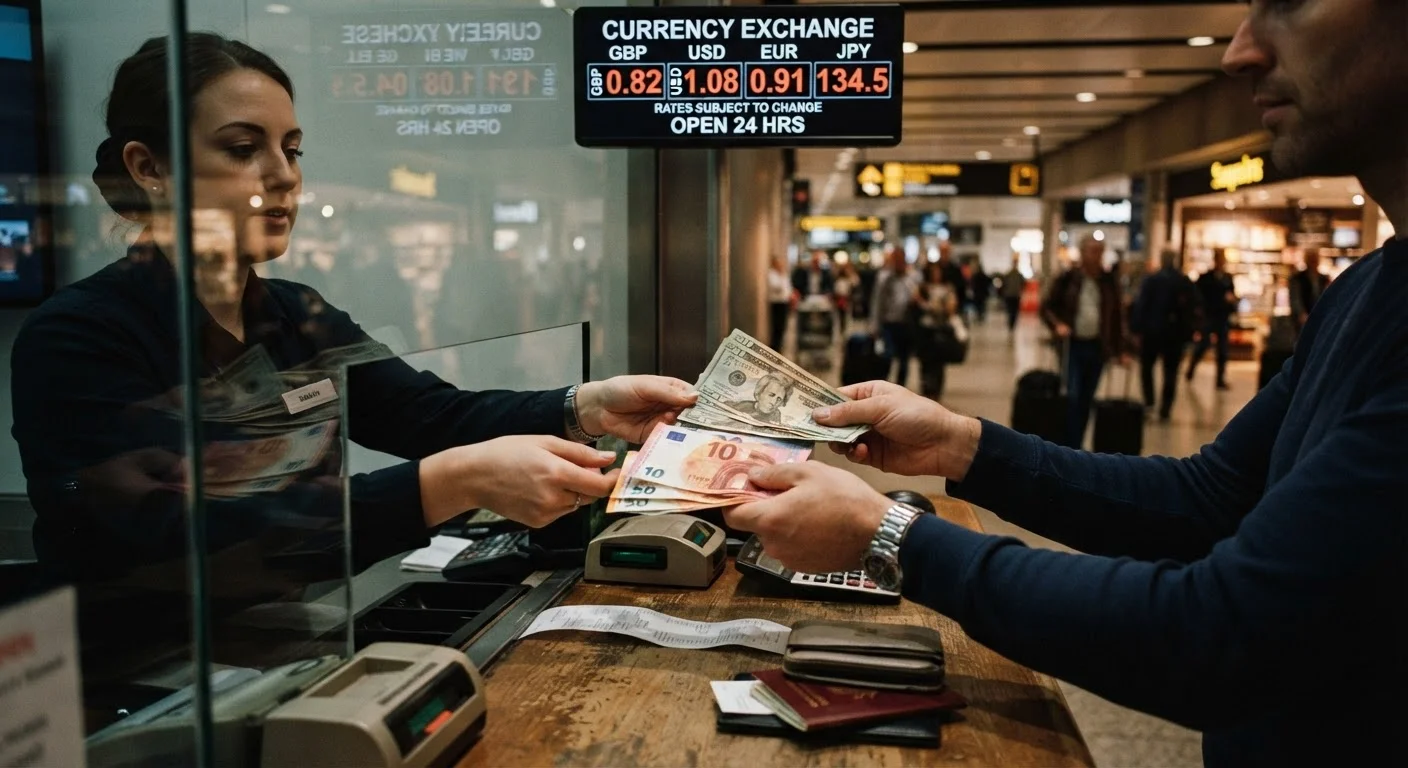
Airport currency exchange booths occupy premium real estate and operate with a captive audience — two factors that produce consistently wide spreads. The advertised rate typically sits 8–15% below the interbank rate, and some counters layer on an explicit commission on top. The math is straightforward: if you exchange $500 at a 12% margin, you're effectively paying $60 for the convenience.
That said, airports are occasionally acceptable for small, emergency exchanges — enough local currency to cover transport and tips on arrival. Treating airport counters as a last resort rather than a default strategy reduces the damage. If you do use them, compare the rate displayed against the current interbank rate (searchable on any currency app) before handing over cash. Some airport locations are more competitive than others, particularly in countries where currency exchange is heavily regulated.
Interbank rate
The baseline exchange rate that banks use when trading currencies with each other. It is the closest thing to a 'true' exchange rate, and the rate most currency apps display. Consumers rarely receive this rate directly.
Spread
The difference between the rate at which a provider buys a currency and the rate at which it sells. A wide spread means the provider takes a larger cut of each transaction.
Foreign transaction fee
A fee charged by a card issuer or bank whenever a transaction is processed in a foreign currency or through a foreign bank. Typically ranges from 1% to 3% of the transaction amount.
Dynamic Currency Conversion (DCC)
A service offered at some foreign ATMs and card terminals that converts the charge to your home currency at the point of sale. DCC rates are almost always unfavorable; declining it is generally the better choice.
No-fee ATM network
A group of ATMs affiliated with a specific bank or alliance that waive surcharge fees for account holders. Availability varies by country and institution.
Commission-free exchange
Marketing language indicating no explicit commission fee is charged. Note that providers can still build profit into an unfavorable exchange rate, so 'commission-free' does not mean cheapest.
ATMs Abroad: Generally Reliable, With Caveats
Withdrawing local currency from a bank-affiliated ATM in your destination country is, for most travelers, the most straightforward approach to accessing competitive exchange rates. The ATM applies a rate close to the interbank rate — typically within 1–2% — and the main costs are the foreign transaction fee from your home bank and any surcharge the local ATM operator imposes.
Key considerations when using foreign ATMs:
- Always decline Dynamic Currency Conversion (DCC). When an ATM offers to process the transaction in your home currency, decline. Accepting means the local operator sets the rate, which is almost always worse than what your bank would apply.
- Choose bank-branded ATMs over standalone kiosks. Independent ATM operators in tourist zones frequently apply higher surcharges and sometimes use DCC by default.
- Check your home bank's international fee policy before departure. Some accounts refund ATM fees or eliminate foreign transaction charges. If yours does not, a larger, less frequent withdrawal typically produces lower per-dollar costs than many small ones.
- Notify your bank before travel. Unusual international activity can trigger fraud blocks, leaving you without access to funds mid-trip.
ATM access and reliability vary significantly by destination. In some countries, cash remains dominant for everyday transactions; in others, card payments are widely accepted and cash needs are minimal. Calibrate your withdrawal strategy to the destination's actual cash culture rather than habit.
Bank Branches and Credit Unions: A Viable Pre-Trip Option
For major currencies — euros, British pounds, Japanese yen, Canadian dollars — many U.S. banks and credit unions can order foreign currency for branch pickup, often at rates more competitive than airport counters. Margins typically run 2–5% above interbank, and there are no ATM surcharges to contend with. The trade-off is lead time: ordering usually requires several business days, and not all institutions offer this service for every currency.
Credit unions and community banks sometimes offer more favorable rates than large retail banks for their account holders. It's worth calling ahead to compare. This approach works best when you can predict roughly how much cash you'll need in the first few days and want to arrive with a workable amount in hand without relying on airport facilities.
For those managing accommodation costs as part of the broader budget picture, understanding accommodation trade-offs complements knowing how to minimize currency loss — both affect how far each dollar stretches.
Credit and Debit Cards: When Plastic Beats Cash
In destinations where card acceptance is reliable, a no-foreign-transaction-fee credit card often delivers rates very close to the interbank benchmark with minimal overhead. Many travel-oriented cards advertise 0% foreign transaction fees, meaning the only cost is the card network's own rate conversion — generally within 0.5–1% of interbank.
Debit cards linked to accounts with international fee waivers offer similar advantages at ATMs. The distinction matters: a debit card used for direct purchases at point of sale can sometimes trigger different fees than when used to withdraw cash.
Plastic isn't universal. Markets across Southeast Asia, parts of Latin America, and rural areas globally remain heavily cash-dependent, and surcharges on card payments are common in some destinations. Carrying both a card and a modest amount of local cash remains the practical standard for most international trips.
This article is for general informational purposes only. Exchange rates and fee structures vary by institution, country, and time. Verify current terms with your bank or card issuer before traveling, and consult official government sources for any entry, currency control, or financial regulations at your destination.