

| Serving size basis | All nutrient values on the panel refer to one listed serving, not the full package (FDA Nutrition Facts label requirements) |
| Low nutrient threshold (%DV) | 5% DV or less per serving (FDA %DV guidance) |
| High nutrient threshold (%DV) | 20% DV or more per serving (FDA %DV guidance) |
| Calorie reference for %DV | 2,000 calories per day (FDA standard reference intake) |
| Ingredient list order | Descending by weight — first listed is most abundant (FDA ingredient labeling rules) |
| "Low sodium" definition | 140 mg or less per serving (FDA nutrient content claim regulations) |
The Anatomy of a Nutrition Facts Panel
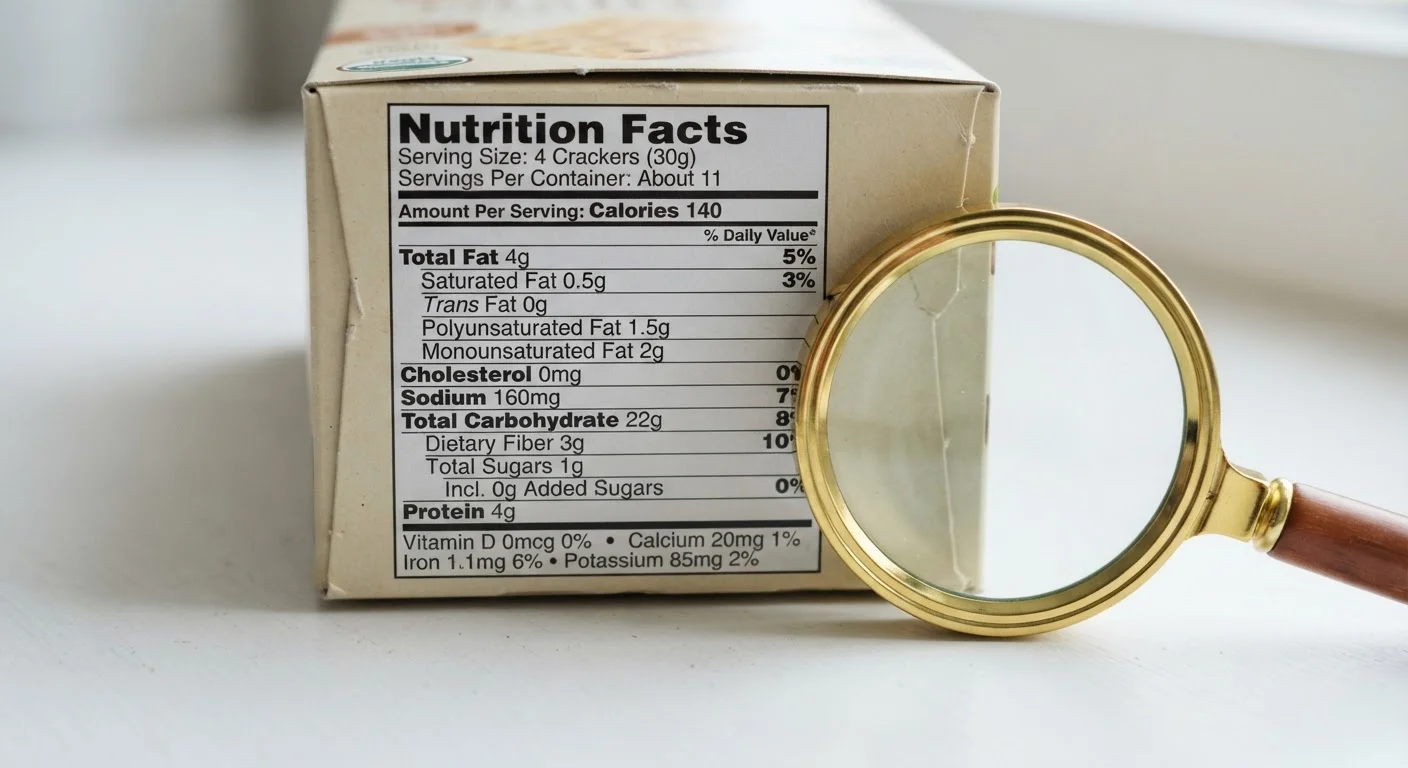
The Nutrition Facts panel is a federally standardized box required on most packaged foods sold in the US. Knowing how its parts relate to each other prevents the most common misreading mistakes.
| Serving size basis | All nutrient values on the panel refer to one listed serving, not the full package (FDA Nutrition Facts label requirements) |
| Low nutrient threshold (%DV) | 5% DV or less per serving (FDA %DV guidance) |
| High nutrient threshold (%DV) | 20% DV or more per serving (FDA %DV guidance) |
| Calorie reference for %DV | 2,000 calories per day (FDA standard reference intake) |
| Ingredient list order | Descending by weight — first listed is most abundant (FDA ingredient labeling rules) |
| "Low sodium" definition | 140 mg or less per serving (FDA nutrient content claim regulations) |
Serving size appears at the very top and is the single most misread element on any label. All nutrient numbers — calories, fat, sodium, sugars — refer to that stated amount, not the whole package. A bag listed as containing 3.5 servings means you multiply every value by 3.5 if you eat the whole bag.
% Daily Value (%DV) shows how much of a nutrient one serving contributes toward a general daily reference intake based on a 2,000-calorie diet. A quick rule of thumb accepted by nutrition educators: 5% DV or less is considered low for a nutrient; 20% DV or more is considered high. Use %DV to compare products and gauge whether a food is a meaningful source of fiber, calcium, or iron — or whether sodium and saturated fat are elevated.
For more context on individual vitamins and minerals listed at the bottom of the panel, see our micronutrient reference guide.
Ingredient Lists: What the Order Tells You
Ingredients are listed by weight in descending order — the first ingredient is the most abundant by mass. This ordering is mandated by the FDA and is one of the most reliable signals on a label.
Practical implications:
- If a sweetener (sugar, high-fructose corn syrup, cane juice, dextrose) appears in the first three ingredients, the product is likely high in added sugar even if the front of the package says "natural" or "wholesome."
- Whole grain claims are only meaningful if a whole grain (whole wheat, oats, brown rice) is the first or second ingredient. "Made with whole grains" requires no minimum amount.
- Long ingredient lists are not automatically bad. A homemade vegetable soup would also have many components. Focus on what the ingredients are, not just how many there are.
Added sugars have their own dedicated line in the updated Nutrition Facts format — look for it indented beneath "Total Sugars." This distinction matters because naturally occurring sugars (in plain milk or unsweetened fruit) behave differently metabolically than sugars added during processing, though both count toward total sugar grams.
If you want to connect label reading to broader shopping decisions, the Grocery Run Checklist offers a practical pre-shopping framework.
Front-of-Package Claims: What They Mean (and Don't)
Front-of-package language is marketing territory, not a nutrition guarantee. The FDA regulates some terms precisely, while others are largely uncontrolled. Knowing which is which prevents you from paying a premium for a claim that means little.
Daily Value (%DV)
A reference number set by the FDA indicating how much of a nutrient one serving contributes to a general 2,000-calorie daily diet. It allows comparison across products without needing to know exact gram targets.
Added Sugars
Sugars and syrups added to foods during processing or preparation, distinct from sugars naturally present in whole foods. Listed separately on updated Nutrition Facts panels to help consumers track intake.
Serving Size
The standardized amount of food the FDA uses as the reference for all nutrient values on the label. It reflects typical consumption amounts, not necessarily a recommended portion.
Whole Grain
A grain that retains the bran, germ, and endosperm in their naturally occurring proportions. Refined grains have the bran and germ removed, reducing fiber and certain nutrients.
Organic (USDA)
A USDA certification indicating a food was produced using specific farming practices that limit synthetic pesticides, fertilizers, and GMOs. It does not regulate or imply a particular nutrient composition.
Natural (FDA labeling)
A front-of-package term the FDA has not formally defined for most food categories. It carries no enforceable standard regarding nutrient content, processing level, or ingredient quality.
Regulated terms to know:
- Low sodium: 140 mg or less per serving
- Low fat: 3 g or less per serving
- Calorie-free: fewer than 5 calories per serving
- High : 20% DV or more per serving
- Good source of : 10–19% DV per serving
Terms that carry limited regulatory weight: "Natural," "wholesome," "artisan," and "clean" have no enforceable FDA standard definition for general food labeling. "Organic" is regulated by the USDA and pertains to farming practices, not specific nutrient profiles. A food can be certified organic and still be high in added sugar or sodium.
"Multigrain" simply means the product contains more than one grain type — it says nothing about whether those grains are refined or whole. Similarly, "no artificial colors" tells you nothing about nutrient content or caloric density.
Understanding how these claims are constructed — and what science actually supports — is a skill that extends to reading nutrition headlines more broadly. Our article on interpreting nutrition research covers how to assess evidence quality critically.
This article is for general informational and educational purposes only. It is not a substitute for personalized dietary advice from a registered dietitian or other qualified healthcare professional.