

Key Takeaways
- Dealer financing is convenient but often includes a markup above the lender's base rate.
- Banks and credit unions typically offer more transparent rate structures and room to negotiate.
- Getting pre-approved before visiting a dealership gives you a concrete benchmark to compare against.
- Promotional 0% APR offers are real but come with strict eligibility requirements and trade-offs.
- The total interest paid over the loan term matters more than the monthly payment figure alone.
Our Verdict
Neither dealer financing nor bank lending is universally better — the gap between them depends heavily on your credit profile, the vehicle you're buying, and whether promotional offers are in play. The most reliable approach is to secure a pre-approval from an independent lender before you step into a dealership, so you have a real number to compare against whatever the finance office proposes.
| Best for | Recommended |
|---|---|
| Buyers who qualify for manufacturer-sponsored promotional rates | Dealer Financing |
| Buyers who want transparent terms and rate flexibility | Bank or Credit Union |
| Buyers with strong credit seeking the lowest possible APR | Bank or Credit Union |
| Buyers prioritising simplicity and one-stop convenience | Dealer Financing |
How Each Financing Channel Actually Works
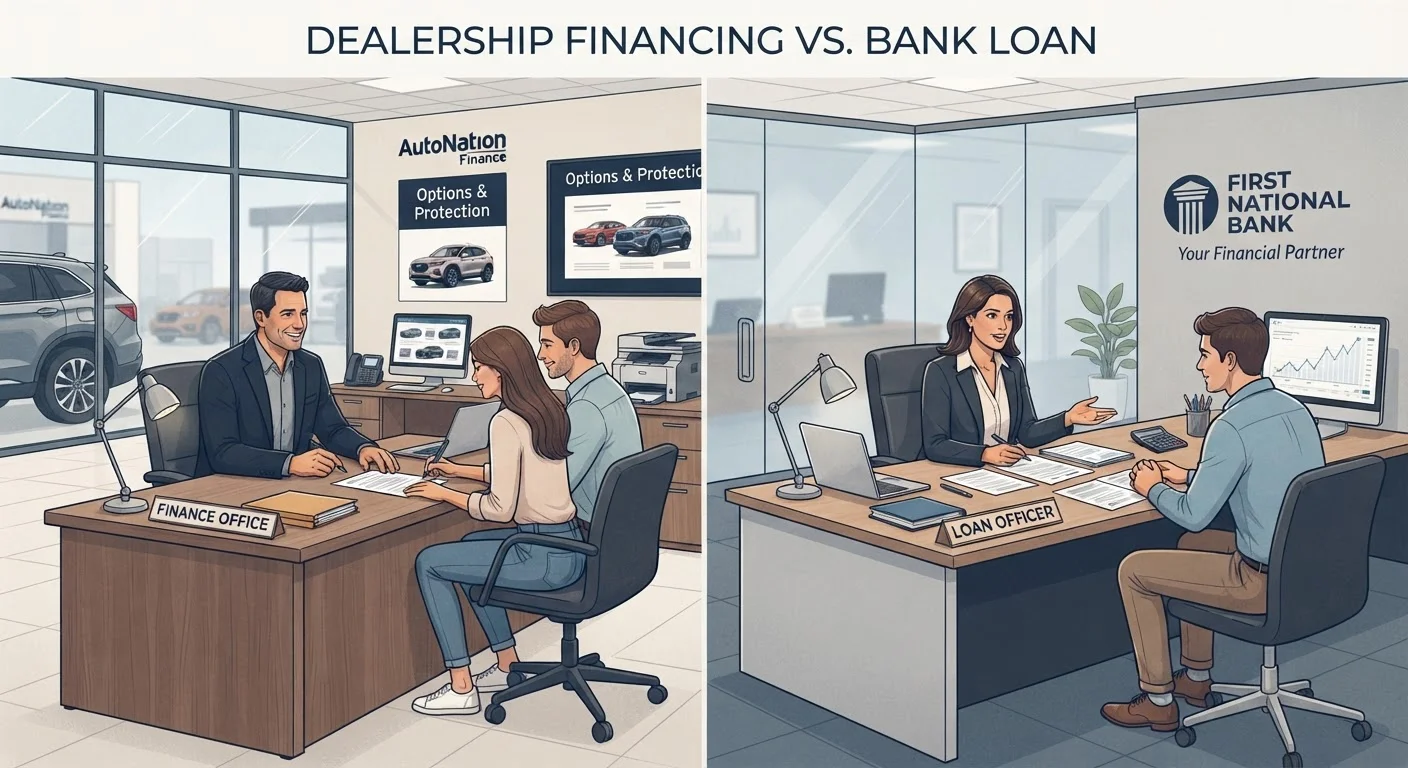
When you finance through a dealership, you're typically not borrowing directly from the dealer. The dealership submits your application to one or more third-party lenders — banks, captive finance arms (lenders owned by the automaker), or finance companies — and presents you with an offer. That offer may include a dealer markup, a percentage added above the rate the lender actually quoted. The dealer earns income on that spread.
When you go directly to a bank or credit union, you negotiate the rate with the lender, full stop. There's no intermediary collecting a margin. Credit unions in particular are member-owned and structured to return value to borrowers rather than shareholders, which often translates to competitive rates.
Understanding this structural difference is the first step to reading any offer clearly. For a deeper look at how lenders use your credit profile to set those initial rates, see how your credit score affects auto loan terms.
Where the Numbers Diverge
The clearest way to compare both channels is to focus on the Annual Percentage Rate (APR) and the total interest paid over the full loan term — not just the monthly payment. Dealers sometimes extend loan terms to lower your monthly figure while increasing the total cost significantly.
| Dealer Financing | Bank or Credit Union | |
|---|---|---|
| Rate transparency | Markup above lender base rate possible | Rate quoted directly — no intermediary |
| Convenience | One-stop, same-day process | Requires separate application step |
| Promotional offers | 0% APR available on select vehicles/credit | Rarely offers manufacturer promotions |
| Rate negotiability | Limited; dealer controls the offer | More room to negotiate or shop around |
| Approval flexibility | Access to multiple lenders, including subprime | Stricter eligibility, especially banks |
| Prepayment penalties | More common depending on lender | Less common, especially at credit unions |
On a $30,000 loan over 60 months, a difference of just one percentage point in APR can add or subtract roughly $800 in total interest. That gap is often larger than the value of any convenience benefit. Run the full-term calculation before signing anything.
If you're also weighing how vehicle type affects financing, new, used, and certified pre-owned vehicles each carry different financing dynamics worth understanding beforehand.
The Case for Dealer Financing — and Its Limits
Dealer financing has legitimate advantages in specific situations. Manufacturer-sponsored promotional rates — sometimes advertised as 0% APR — are funded by the automaker to incentivize sales and can represent genuine savings if you qualify. These offers typically require excellent credit (often 720 or above) and apply only to specific models or trim levels.
Always Read the Full Promotional Terms
Manufacturer 0% APR deals often require you to forgo a cash rebate that could reduce your purchase price. Do the math on both options: a lower vehicle price financed at a standard rate may cost less overall than 0% APR on a higher price. Ask the finance office to show you both scenarios in writing before deciding.
The convenience factor is also real. Arranging financing on-site means you drive away the same day without a separate trip to a lender. For buyers with less-than-perfect credit, dealers may also have access to a wider network of lenders willing to approve more complex applications — though the rates on those approvals tend to be higher.
The limits are equally clear: the markup structure means you may pay more than necessary, and it's difficult to know the lender's base rate without an independent quote to compare against.
Using Pre-Approval as Your Benchmark
The most effective strategy is to obtain a pre-approval from a bank or credit union before you visit a dealership. A pre-approval locks in a rate for a set period (commonly 30–60 days) and gives you a concrete number to use as a negotiating floor. If the dealer can beat it — especially through a manufacturer promotional rate — take the better offer. If they can't, you already have your financing arranged.
When comparing loan offers, look at: APR (not just the interest rate), loan term, any origination or prepayment fees, and whether the rate is fixed or variable. Also compare what happens if you pay off early — some dealer-arranged loans include prepayment penalties that bank loans often do not.
If you're exploring all your borrowing options, a secured auto loan versus a personal loan comparison can clarify which loan structure fits your situation. And if you're still deciding between buying and leasing, this breakdown of leasing versus buying covers the financial implications of each path.
This article provides general financial information for educational purposes only and does not constitute personalised financial or lending advice. Consult a qualified financial professional for guidance suited to your individual circumstances.