

Key Takeaways
- Lisbon suits first-time visitors who want history, nightlife, and urban energy in one compact city.
- Porto rewards travellers who value a grittier, less polished atmosphere with outstanding food and wine culture.
- The Alentejo is Portugal's least crowded region — ideal for slow travel, wine, and cork-forest landscapes.
- The Algarve offers the most reliable summer sun but ranges from dense resort towns to quiet cliff-top villages.
- Season, travel pace, and interests should drive your regional choice as much as budget does.
Why Region Matters More Than You Think
Portugal occupies a relatively small patch of Europe, yet its regions behave like different countries. The north is cooler, greener, and more culturally conservative. The south bakes under a near-Mediterranean sun. The interior plateaus feel emptied out in the most appealing way. Treating these places as interchangeable — or defaulting to whichever flight is cheapest — is one of the most common planning mistakes travellers make.
This guide doesn't tell you where to go. It describes what each major region is genuinely like, including the trade-offs, so you can match the destination to what you actually want from a trip.
Lisbon and the Tagus Valley
Lisbon is Portugal's most visited city, and the attention is earned. The capital packs extraordinary density into a walkable — if hilly — core: medieval Alfama, the grid-planned Baixa, and the wide riverside Ribeira all within reach of each other. The city's food scene, nightlife, and museum culture (the Gulbenkian alone justifies a half-day) draw a genuinely diverse crowd of visitors.
What guides don't always say: Lisbon is noisy, crowded in summer, and expensive by Portuguese standards. Tram 28, one of the most photographed commuter routes in Europe, is frequently gridlocked with tourists and is a known pickpocket environment. Day-trip options — Sintra, Setúbal, Óbidos, the Arrábida coast — are superb, but they require planning; public transport to the coast can be slow.
Book Sintra accommodation or visit on a weekday before 9am — the village becomes nearly impassable by mid-morning in summer, and the hilltop palaces sell timed tickets that sell out days in advance.
Sintra is structurally constrained by its narrow lanes and limited parking, making crowd management a real logistical challenge for day-trippers who arrive without a plan.
If you're renting a car in Portugal, pick it up after leaving Lisbon or Porto by train — urban driving is stressful, parking is expensive, and both cities are better explored on foot or by metro.
Experienced Portugal travellers consistently find that a car becomes valuable in the Alentejo and rural north but adds cost and friction in the major cities where it isn't needed.
The Tagus Valley beyond the city offers a gentler pace. The town of Tomar, with its Templar convent, and the medieval walled settlement of Óbidos are accessible enough for an overnight extension without the crowds Sintra attracts.
Porto and the North
Porto is Portugal's second city and, by many travellers' accounts, the more characterful of the two. The Ribeira waterfront and the port wine lodges of Vila Nova de Gaia are obvious anchors, but the city's appeal runs deeper: a genuinely working-class neighbourhood texture in Bonfim, some of the country's most serious restaurants, and the Douro River framing almost every view.
The north rewards slow exploration. The Douro Valley wine region — about an hour east by train — is one of the most dramatic wine landscapes in Europe, with terraced vineyards dropping to the river. The Minho region bordering Spain is green, rainy, and dotted with romanesque churches and quintas (estate farmhouses) offering rural accommodation.
Trade-offs: Porto is cooler and wetter than Lisbon, particularly outside July–September. Atlantic storms are a genuine possibility in spring and autumn. The city centre is also increasingly popular; accommodation in the most central neighbourhoods now rivals Lisbon on price.
The Alentejo: Slow Travel and Open Space
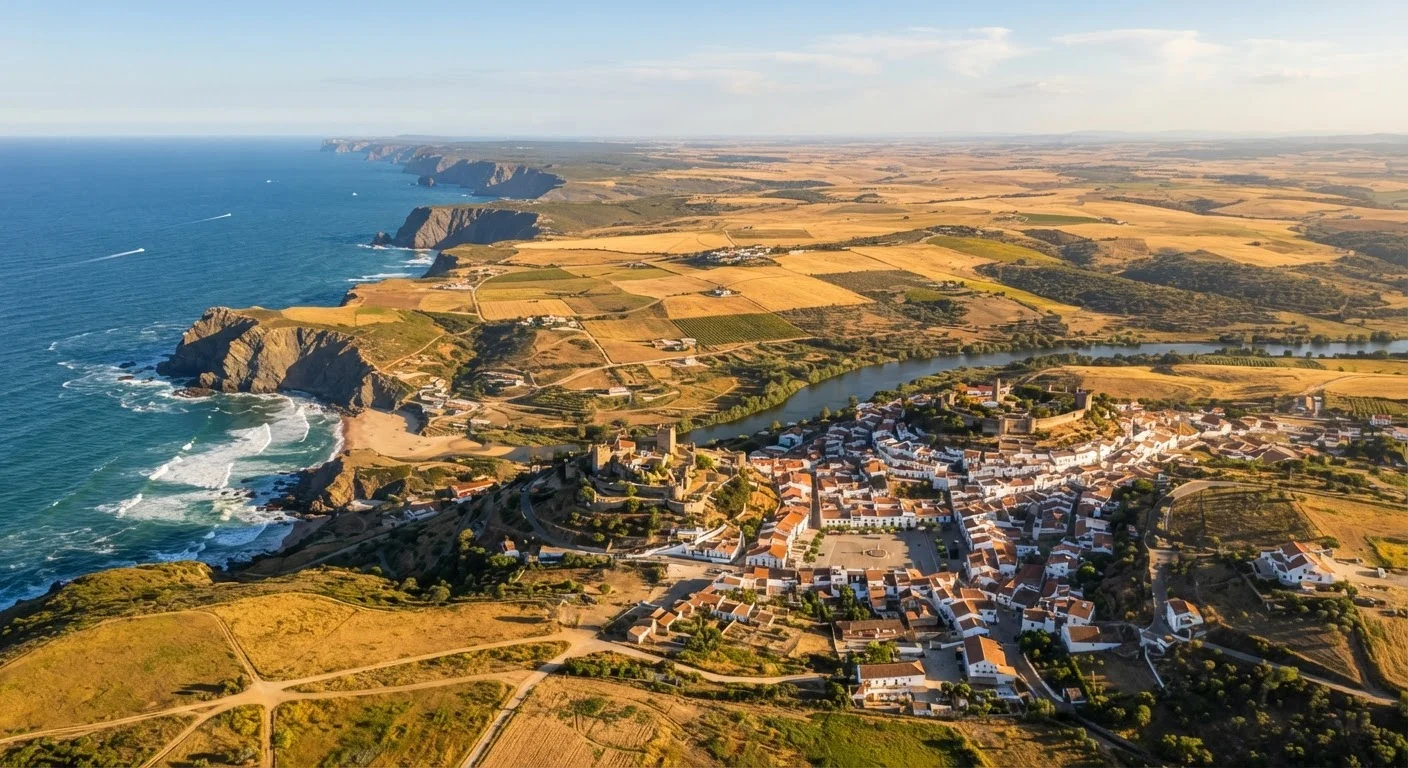
The Alentejo covers roughly a third of Portugal's land area and holds a fraction of its population. That arithmetic produces something rare in Western Europe: genuine emptiness. Rolling plains of cork oak and olive groves, whitewashed hilltop villages, and near-silence define the region. Évora, the principal city, is a UNESCO World Heritage site that most visitors can cover meaningfully in a day and a half.
Alentejo Wine is a Separate Category
Alentejo wine has its own DOC (Denominação de Origem Controlada) designation and produces styles distinct from Douro reds or Vinho Verde. The region's bold, warm-climate reds and increasingly respected whites deserve consideration on their own terms, not just as a curiosity alongside the more famous northern appellations.
The Alentejo is also Portugal's most important wine-producing region by volume, and its table is built around slow-cooked pork, cured meats, açorda (a bread-based soup), and sheep's-milk cheeses. Travellers who prioritise food and wine experiences over sightseeing density often find it more satisfying than either major city.
The honest trade-off: summer temperatures regularly exceed 40°C (104°F), making July and August uncomfortable for anything other than pool-based relaxation. Spring (March–May) and autumn (September–October) are the clearest windows for active exploration.
The Algarve: Beyond the Beach Brochure
The Algarve is the most visited region in Portugal and the one most misunderstood. Its 150-kilometre coastline is internally diverse: the western Algarve around Sagres and Lagos is dramatic and cliff-heavy, with water too cold and rough for casual swimming in most months. The central strip around Albufeira is dense with resort infrastructure. The eastern Ria Formosa lagoon system near Faro and Tavira offers a quieter, bird-rich coastal environment that feels entirely separate from the resort belt.
The climate is the most reliable in Portugal — Faro averages around 300 sunny days per year — and the region is well-served by international flights into Faro Airport. Those logistics make it accessible and, in peak summer, intensely crowded. Travellers expecting a traditional Portuguese atmosphere in high season around the major resorts will be disappointed; what they'll find instead is well-organised beach tourism with good infrastructure.
Off-season — particularly October through February — the Algarve reveals a quieter character. Prices drop substantially, coastal paths are uncrowded, and the towns reclaim a local rhythm.
How to Choose the Right Region for Your Trip
A few honest questions clarify the decision faster than any ranked list:
- How much do you value urban culture vs. nature? Lisbon and Porto are city trips. The Alentejo and parts of the Algarve reward drivers willing to leave the main roads.
- What time of year are you travelling? Summer heat in the Alentejo is punishing. Summer crowds in Lisbon and central Algarve are relentless. Late spring or early autumn is the clearest fit for most of Portugal.
- Do you want to combine regions? Lisbon to Alentejo to Algarve is a logical south-to-north drive. Lisbon to Porto by train (under three hours on the fast service) is straightforward. Doing all four regions in under two weeks means skimming each.
- How important is food and wine? Porto and the Alentejo are the standouts. The Algarve's restaurant scene, while improving, is uneven outside of a few towns.
Portugal rewards the traveller who picks a region and stays. One week in the Douro and Porto will teach you more about the country — and give you better meals — than a five-stop sprint from north to south.
Travel conditions, entry requirements, and local regulations can change. Verify current visa, health, and safety guidance with official government sources before making bookings.