

Key Takeaways
- Summer offers 24-hour daylight and access to nearly all roads and hiking trails; winter closes many highland routes entirely.
- Northern lights are only visible in winter when Iceland experiences sufficient darkness, typically September through March.
- Summer is Iceland's peak tourist season, meaning higher accommodation costs and larger crowds at popular sites.
- Winter ice caves in glaciers like Vatnajökull are a genuine seasonal exclusive not available in warmer months.
- Both seasons carry weather unpredictability — layered preparation is essential regardless of when you visit.
- Your ideal season depends primarily on what activities you prioritize, not on avoiding discomfort.
Option A
Iceland in Summer
The accessible, adventure-rich season of endless daylight.
Best for: Travelers who want maximum road access, hiking, and wildlife without weather hardship.
Option B
Iceland in Winter
The dramatic, moody season of darkness, ice, and northern lights.
Best for: Travelers drawn to aurora hunting, ice caves, and a quieter, more atmospheric Iceland.
If you want to hike Iceland's highlands, including Landmannalaugar or Þórsmörk
Iceland in Summer
Highland roads (F-roads) are typically only open from late June through September. Attempting these routes in winter is dangerous and often physically impossible.
If seeing the northern lights is your primary motivation
Iceland in Winter
Aurora borealis requires darkness, which Iceland simply does not have in summer. Winter nights, particularly away from Reykjavík's light pollution, offer the best conditions.
If you're traveling with children or first-time international travelers
Iceland in Summer
Longer daylight hours, more stable road conditions, and a wider range of open attractions reduce logistical stress significantly.
If budget flexibility matters and you're comfortable with cold and short days
Iceland in Winter
Shoulder and winter months generally see lower accommodation rates and fewer crowds, giving you more breathing room at iconic sites like the Blue Lagoon and Golden Circle.
If exploring glacier ice caves is on your itinerary
Iceland in Winter
Natural ice caves are only stable and accessible during cold months. Warm temperatures cause structural changes that make them unsafe or off-limits from roughly April onward.
Light and Landscape: How the Seasons Reshape Iceland
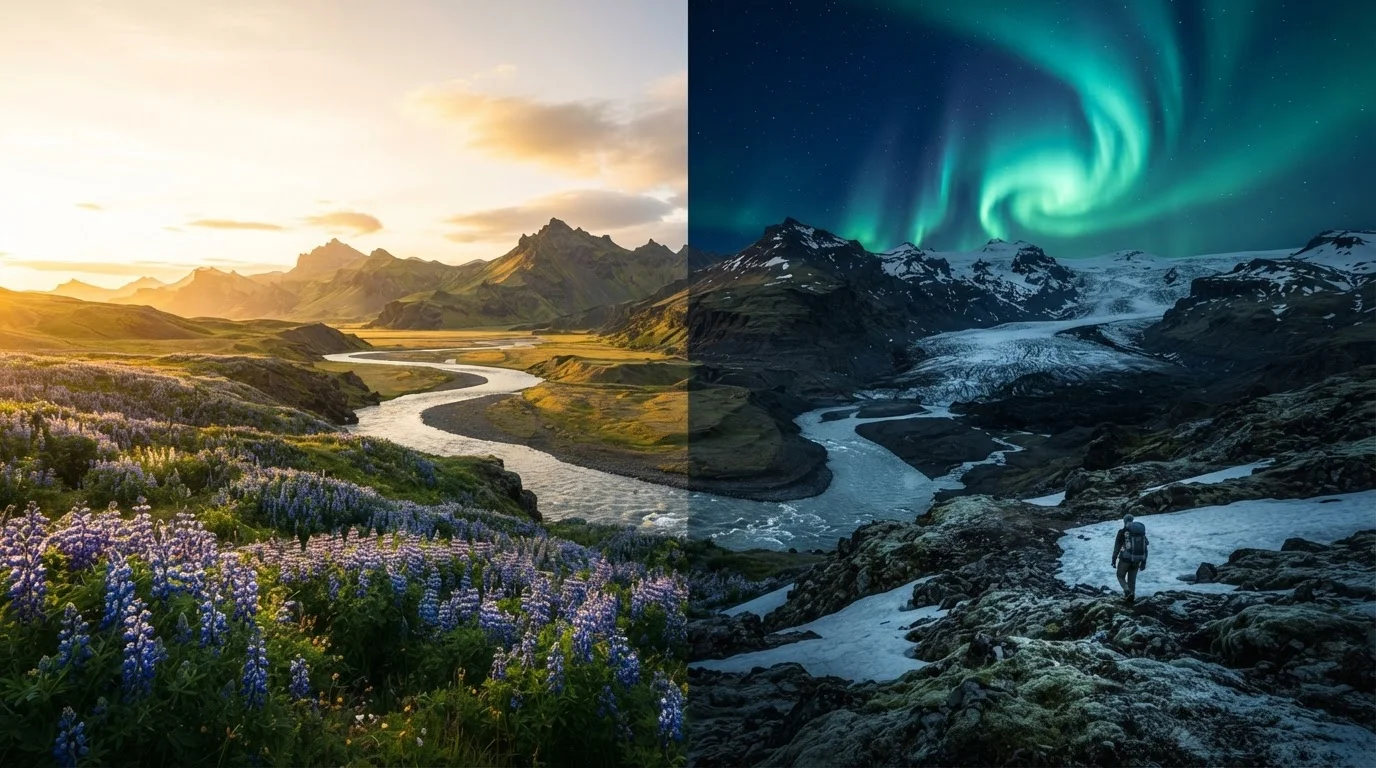
Iceland's position just south of the Arctic Circle means its seasonal extremes are more dramatic than almost any other popular destination. In midsummer, the sun barely dips below the horizon, producing the famous midnight sun — a disorienting, golden light that lasts around the clock from mid-June through early July. In midwinter, daylight shrinks to as few as four to five hours in Reykjavík, and the landscape transforms into a monochrome world of snow, ice, and dark volcanic rock.
These aren't merely aesthetic differences. They fundamentally change what Iceland is as a travel experience. Summer Iceland is green and alive — lupine fields bloom across the south coast, puffins nest on coastal cliffs, and glacial rivers run fast and accessible. Winter Iceland is stark and cinematic — frozen waterfalls, steam rising from geothermal vents against black skies, and the occasional aurora rippling overhead. Neither is superior; they are genuinely different countries sharing the same geography.
| Criterion | Iceland in Summer | Iceland in Winter |
|---|---|---|
| Daylight hours | Up to 24 hours (midnight sun) | 4–5 hours at peak winter |
| Northern lights visibility | Not visible (too bright) | Possible Sept–March |
| Highland road access | Open late June–September | Closed entirely |
| Natural ice caves | Not accessible | Open approx. Nov–March |
| Puffin watching | Yes (May–August) | No (birds at sea) |
| Accommodation cost | Higher (peak demand) | Generally lower |
| Crowd levels | Highest of the year | Notably quieter |
| Driving conditions | More straightforward | Ice and storm risk; verify daily |
Access, Activities, and What You Can Actually Do
Season dictates access more than most travelers anticipate. Iceland's interior — the highlands — is entirely closed in winter. The F-roads that connect these remote volcanic landscapes require four-wheel drive and are only navigable when snow and ice have receded, generally between late June and September. Iconic highland destinations like Landmannalaugar, the Kjölur route, and Þórsmörk are summer-only experiences.
Winter, however, opens its own exclusive doors. Natural glacier ice caves, formed inside outlets of Vatnajökull — Europe's largest glacier — are only accessible and structurally safe during cold months. Reputable guided tours operate these caves roughly from November through March, and no summer equivalent exists. Similarly, dog sledding, snowmobile tours on glaciers, and cross-country skiing are winter-specific. Aurora hunting, while never guaranteed, requires the darkness that only winter provides.
Whale watching is possible year-round from Húsavík and Reykjavík, though species and encounter rates vary by season. Puffin watching is strictly a summer affair, as the birds are at sea the rest of the year.
~2.3M
Annual visitors to Iceland
Iceland Tourism's figures show the vast majority of international arrivals concentrate in the June–August summer window.
4–5 hrs
Daylight hours in Reykjavík in December
Iceland's Meteorological Office confirms daylight in the capital drops to roughly four to five hours around the winter solstice.
8,100 km²
Area of Vatnajökull glacier
Vatnajökull — home to Iceland's accessible ice caves — is the largest glacier in Europe by volume, according to the Vatnajökull National Park.
Crowds, Cost, and Practical Realities
Summer is unambiguously Iceland's peak season, and the difference in visitor volume at major sites is noticeable. The south coast, Golden Circle, and popular waterfalls like Seljalandsfoss and Skógafoss see their highest foot traffic from June through August. Accommodation rates reflect this demand — expect to pay a meaningful premium compared to equivalent stays in January or February.
Winter travel comes with its own costs. Road conditions require more caution, and rental vehicles with appropriate tires — or four-wheel drive for certain routes — are advisable. Shorter daylight hours compress your sightseeing window, and severe storms can close roads temporarily with little notice. Travelers should always check road conditions through the Icelandic Road and Coastal Administration (Vegagerðin) before driving, regardless of season.
What winter lacks in convenience, it can offer in atmosphere. Popular sites feel less crowded, locals are more accessible, and the dramatic light — when it appears — rewards patient travelers in ways that summer's relentless brightness cannot replicate.
Weather Is Unpredictable Year-Round
Iceland's weather is famously volatile in every season. Summer travelers can encounter cold rain, low cloud, and strong winds; winter travelers can experience surprisingly mild and calm days. The local saying — 'if you don't like the weather, wait five minutes' — holds year-round. Building flexibility into your itinerary and checking the Icelandic Meteorological Office (vedur.is) daily is advisable regardless of when you visit.