

Key Takeaways
- Saving before you spend reverses the typical pattern and removes reliance on willpower.
- Automation is what makes the strategy durable — set it up once, then let it run.
- Starting with a small, consistent amount builds the habit before scaling the amount.
- Spending adapts naturally to the reduced take-home, often more easily than expected.
- This approach works alongside — not instead of — a broader budgeting framework.
Pay Yourself First
"Pay yourself first" is a personal finance approach where you move money into savings or investments immediately when you receive income — before paying bills, buying groceries, or spending on anything else. Instead of saving whatever is left over at the end of the month (which is often nothing), you treat saving as a non-negotiable expense that comes first. The idea is that spending adjusts to what remains, rather than savings adjusting to what spending leaves behind.
In practice, this is typically implemented through automatic payroll deductions (such as 401(k) contributions) or scheduled bank transfers triggered on payday, removing any manual step — and the temptation to redirect funds.
The Core Idea: Flip the Order
Most people's default money routine looks like this: income arrives, bills get paid, daily life gets funded, and saving happens with whatever scraps remain. The problem is that scraps are unpredictable — and often nonexistent.
"Pay yourself first" simply inverts that sequence. Income arrives, a predetermined amount goes directly to savings, and everything else — bills, groceries, discretionary spending — gets funded from what's left. The mechanics sound minor, but the behavioral effect is significant. Saving stops being aspirational and becomes structural.
This approach belongs to a broader family of budgeting frameworks worth knowing, sometimes called "reverse budgeting" because it starts from savings targets rather than expense categories. If you're newer to how money flows overall, personal budgeting from the ground up provides a useful foundation.
Why Willpower Alone Doesn't Work
Behavioral research consistently shows that people spend what they see available. When your full paycheck lands in checking, the entire balance reads as spendable — and it tends to get spent. Saving at month-end requires you to make a deliberate decision under conditions that are reliably unfavorable: you've already absorbed the month's costs and surprises.
Automation sidesteps this entirely. When the transfer happens before you log in to check your balance, you never psychologically "count" that money as available. Spending calibrates to the lower figure without a conscious budgeting decision being required.
This is also why employer-sponsored retirement plans — where contributions are deducted before a paycheck is ever deposited — have such strong participation rates relative to plans requiring active deposits. Friction matters enormously.
Setting It Up: The Practical Steps
Making this automatic requires a one-time setup, not ongoing discipline. Here's how the mechanics typically work:
- Choose a destination account. This should be separate from your everyday checking account — ideally at a different institution or at least a savings account that isn't immediately visible in your daily balance view. Separation creates friction against impulsive withdrawals.
- Pick an amount to start with. Choose something small enough to be sustainable immediately. You can always increase it. A percentage of income (say, 5–10%) scales naturally with pay changes; a fixed dollar amount is simpler to track.
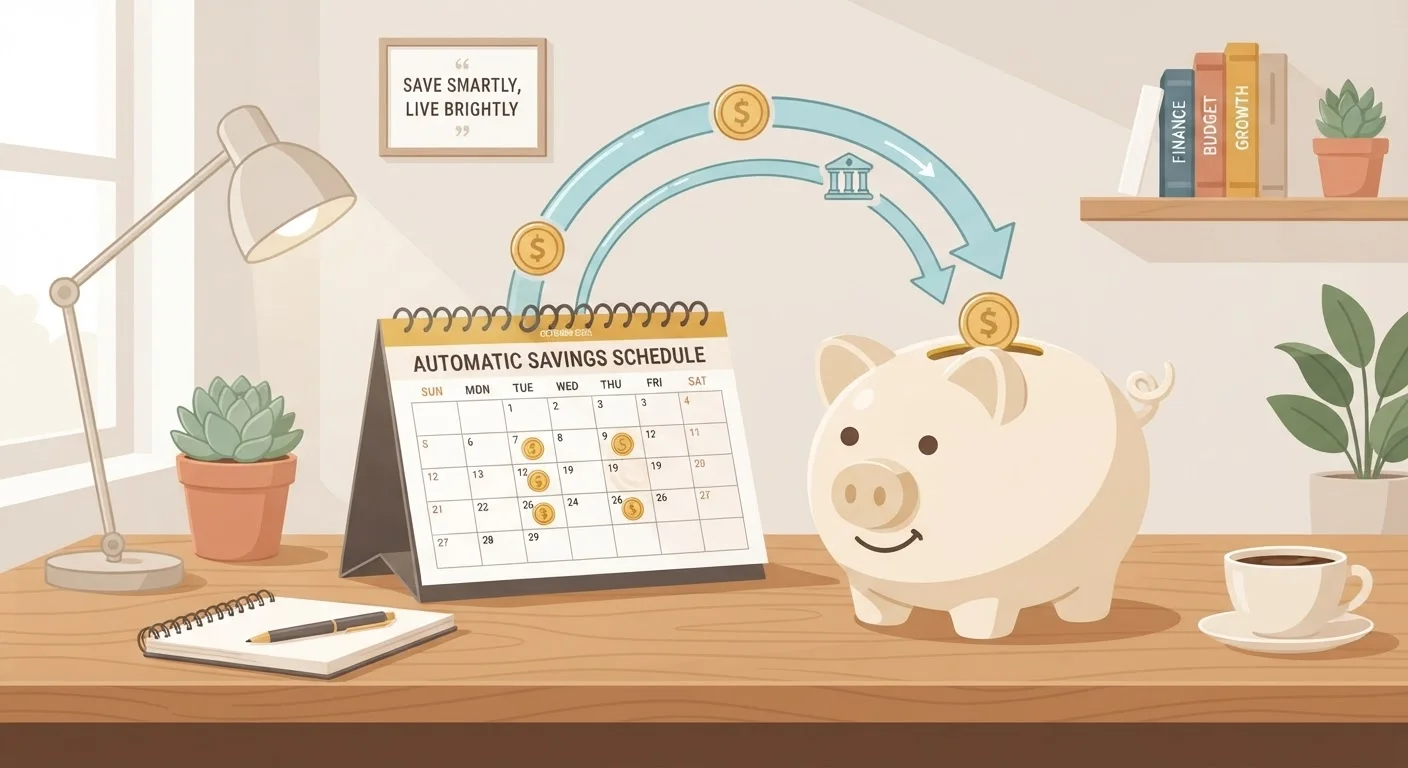
- Schedule the transfer for payday. Log into your bank or employer's payroll portal and schedule the transfer to move on the same day income arrives — or set up a direct deposit split so the savings portion never touches checking at all. Many employers allow splitting direct deposits across multiple accounts.
- Build in a review trigger. Set a calendar reminder to revisit the amount in 90 days. As you adapt to the adjusted take-home, you may find you can increase it without feeling the difference.
For more on structuring automatic transfers into a complete system, see automating your savings without willpower. A weekly money check-in can also help you verify that everything is running as intended.
Common Concerns — and Honest Answers
"I can't afford to save anything right now." This is the most common objection, and it deserves a direct answer. If essential expenses genuinely consume all income, then the math is the constraint — and other strategies (increasing income, reducing fixed costs) come first. But for many people, the feeling of not being able to afford savings is really a reflection of not having tried the constraint. Spending usually does adapt. Starting at $25 per paycheck is not symbolic — it's the beginning of a habit that compounds.
"What if I need that money for an unexpected expense?" An emergency fund is exactly the right destination for early pay-yourself-first transfers. Once you have a meaningful cushion, you're less likely to need to raid it. The Saving & Emergency Funds hub covers strategies for building that buffer.
"This feels too simple to work." Simple is the point. Complex systems require ongoing attention and decision-making; this one requires neither after setup.
This article provides general financial information for educational purposes only. It is not personalized financial advice. Consult a qualified financial adviser before making decisions about savings accounts, investment accounts, or retirement planning.