
Interest Rate, Loan Term, and Balance: How Each Variable Shapes Total Repayment Cost

Key Takeaways
- Interest rate, loan term, and balance each independently affect how much a loan costs over time.
- A longer loan term lowers monthly payments but increases total interest paid.
- Even a small reduction in interest rate can save hundreds or thousands of dollars on large balances.
- Paying down principal faster is often the most direct way to reduce total repayment cost.
- These three variables interact — optimizing one while ignoring the others can produce misleading results.
Total Repayment Cost
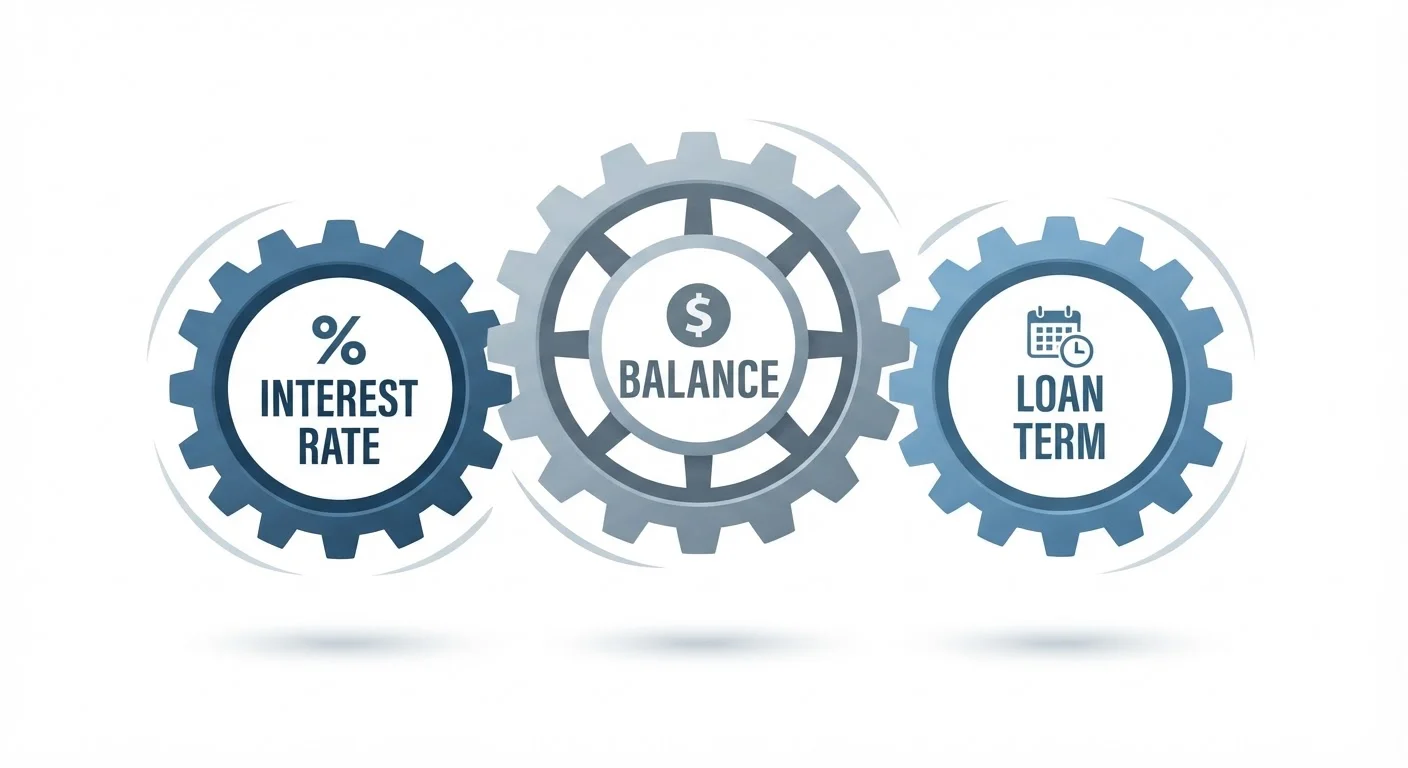
Total repayment cost is the full amount you pay back over the life of a loan — principal plus every dollar of interest that accumulates. It is almost always higher than the amount you originally borrowed. The gap between what you borrowed and what you repay is determined by three variables: the interest rate, the loan term, and the outstanding balance.
For loans with compound interest, the effective cost depends on how frequently interest is calculated (daily, monthly, etc.). APR — annual percentage rate — standardizes this for comparison, though it may exclude certain fees.
The Three Numbers Behind Every Loan
Most debt conversations focus on whether you can afford the monthly payment. That framing is understandable — monthly cash flow is real and immediate — but it obscures the fuller picture. The monthly payment is a byproduct of three underlying variables: the interest rate, the loan term, and the outstanding balance. Understanding how each one works, and how they interact, gives you a much clearer view of what borrowing actually costs.
For a foundational overview of how different debt types are structured, see our guide on personal debt types and what the numbers mean.
~$2,200
Extra interest from a 4-point rate difference
Estimated additional interest cost on a $20,000 five-year loan at 10% vs. 6%, based on standard amortization calculations.
70%
More interest on a 60-month vs. 36-month loan
Approximate increase in total interest on a $15,000 loan at 7% when the term is extended from 36 to 60 months.
$0
Extra cost from rate if balance hits zero
Interest charges stop when the balance reaches zero — illustrating why accelerating principal payoff directly reduces total loan cost.
Interest Rate: The Price of Borrowing
The interest rate is the annual cost of carrying a balance, expressed as a percentage. On a $10,000 loan at 8% annual interest, you owe $800 in interest for each year that balance remains unchanged — though in practice, interest is usually calculated monthly and the balance shifts as you make payments.
Rate differences that look small on paper compound into large dollar amounts over time. The difference between a 6% and a 10% rate on a $20,000 five-year loan is roughly $2,200 in additional interest. On a 30-year mortgage, the same rate gap can represent tens of thousands of dollars.
Your credit profile plays a significant role in what rate you're offered. If you're evaluating an auto loan, our explainer on how credit scores affect auto loan terms walks through exactly how lenders price risk into the rate they quote you.
Loan Term: Time Is Not Neutral
The loan term is the scheduled length of repayment — 36 months, 60 months, 30 years. Extending the term lowers your monthly payment because you're spreading the same balance across more periods. But it also extends the window during which interest accumulates, which pushes total repayment cost higher.
Consider a $15,000 loan at 7% interest. Over 36 months, you'd pay roughly $1,660 in total interest. Extend that to 60 months and the interest grows to approximately $2,800 — nearly 70% more, despite the rate being identical. The lower monthly payment comes at a measurable cost.
This dynamic is explored in depth in our article on why minimum payments extend debt timelines. The underlying mechanic is the same: time spent carrying a balance is time spent paying interest.
Outstanding Balance: What Interest Is Actually Calculated On
Interest isn't charged on what you originally borrowed — it's charged on whatever balance remains unpaid. Reducing the principal faster means every future interest calculation is applied to a smaller number. This is why extra payments, when applied directly to principal, have an outsized effect on total cost.
On revolving debt like credit cards, this relationship is especially visible. Carrying a $5,000 balance at 22% APR and making only minimum payments can result in years of repayment and total interest exceeding the original balance. The relationship between debt and your credit score is also influenced by utilization — the ratio of balance to available credit — making balance management relevant beyond just interest cost.
Apply Extra Payments to Principal, Not the Next Bill
When making an additional payment, confirm with your lender that it's being applied to principal rather than prepaying future scheduled payments. Prepaying future installments doesn't reduce your balance the same way — and therefore doesn't lower your ongoing interest charges. Most lenders allow you to designate principal-only payments, but the process varies.
How the Three Variables Interact
Each variable shapes cost independently, but they don't operate in isolation. A lower rate helps most when the balance is large and the term is long — that's when compounding has the most runway. A shorter term matters most when the rate is high, because it limits how long interest accrues. Paying down balance aggressively is most impactful when the rate is high and the term still has years remaining.
This interaction matters most when you're comparing loan offers or evaluating refinancing. A longer term with a lower rate might produce a similar monthly payment to a shorter term at a higher rate, but the total costs can differ substantially. Looking at all three variables together — not just the monthly figure — gives you an accurate comparison.
For a practical strategy to apply this understanding to existing debt, our breakdown of debt avalanche vs. debt snowball methods explains how each approach targets these variables differently.
This article is for general informational and educational purposes only and does not constitute personalized financial advice. Consult a qualified financial professional before making decisions based on your individual circumstances.